



Most advice on the best fidget toys for adults is a list of children’s toys with the word adult attached. The real difference is not size or colour — it is that an adult fidget spends its day in a pocket, in meetings and on public transport, and every one of those places applies a requirement a bedroom desk does not. Four requirements, in fact, and they knock out most of the category before you get to any question of feel.
The Four Requirements
It has to be pocketable without being a nuisance. Thin and flat beats small and round. A round object rolls to the bottom of a pocket, sits under you when you sit, and comes out with lint in its mechanism. A flat one lies against the fabric and stays where it is.
It has to be operable without looking. A fidget you have to find, orient and inspect is one you will not use in a meeting, which is the moment you most want it. One-handed, no-look operation is the single highest-value property, and it is never listed on a product page.
It has to be socially invisible. Two parts to this: no noise that carries, and no visible repetitive motion. Colleagues notice movement at the edge of vision long before they notice sound, which is why spinners fail this and sliders pass it.
It has to survive keys. Everyday carry means sharing space with the hardest objects most people own. Anything plated, painted or hinged loses that fight eventually.
The Best Fidget Toys for Adults, by Mechanism
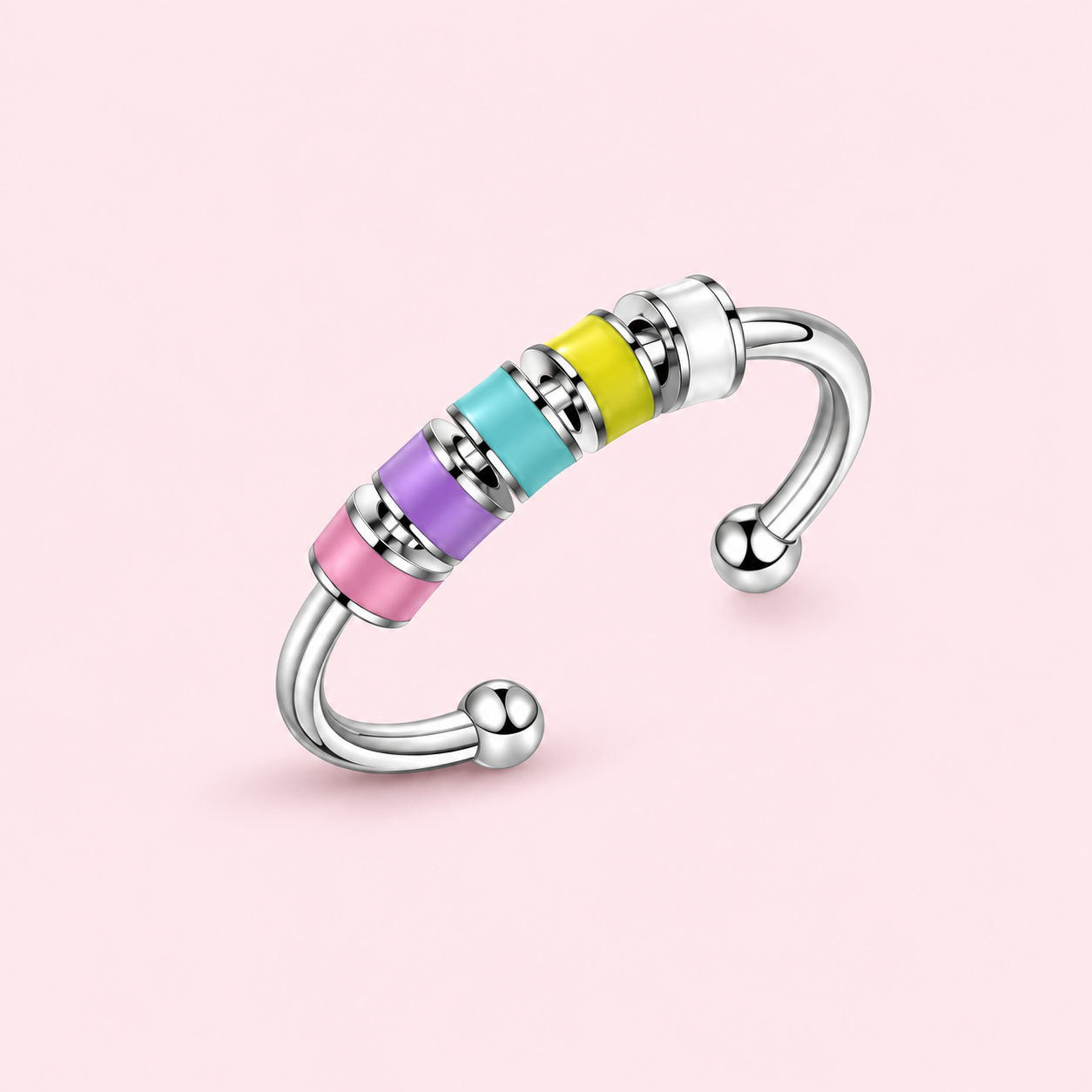
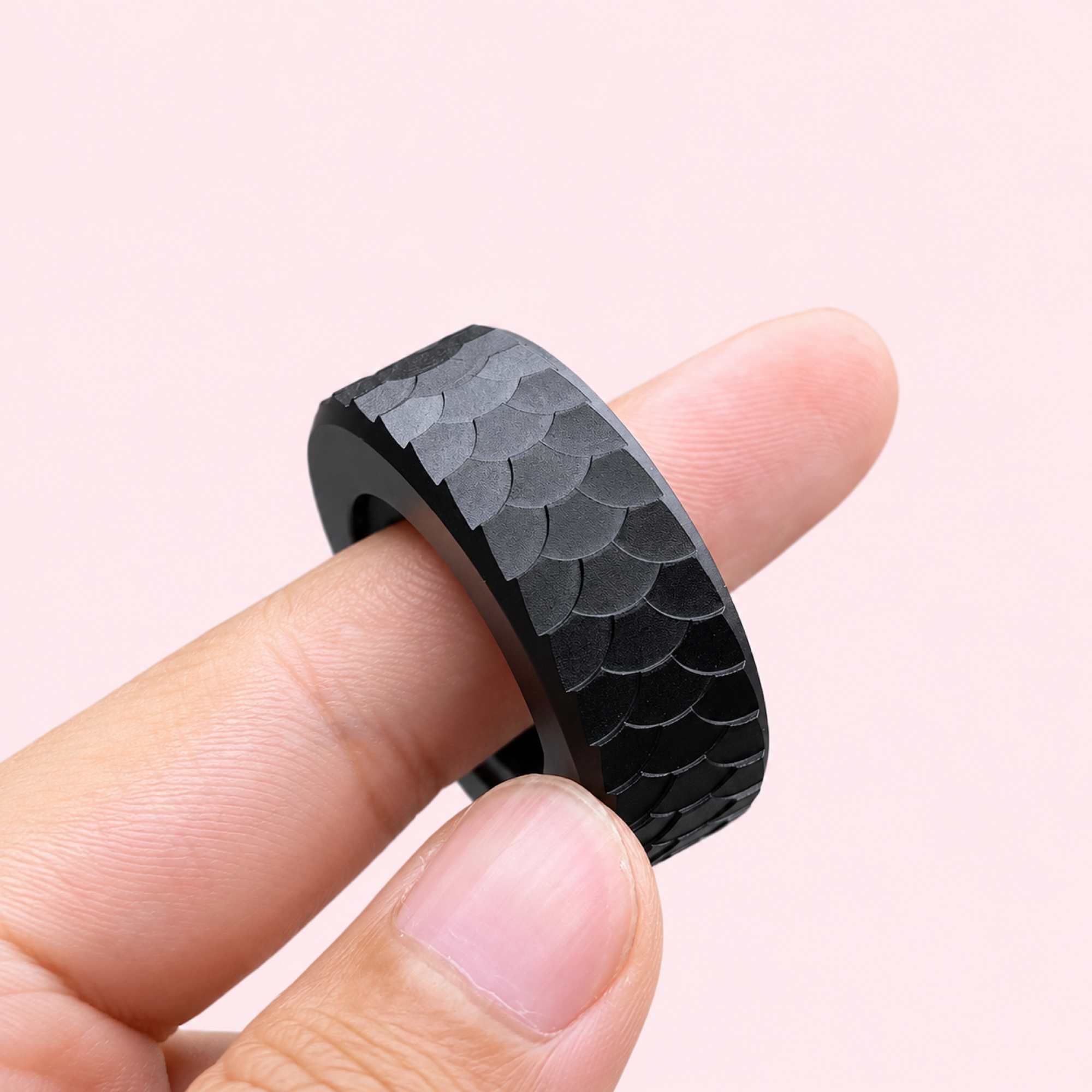
Worn fidgets. A ring is the only category that satisfies all four without compromise: it is never in a pocket, it is always available, it is damped by your own hand, and nobody can see you using it. The Black Mechanical Fidget Ring is a wide band with a layered scale texture that your thumb tracks around. The trade-off is depth — one motion, and after a few weeks it fades into background jewellery rather than staying a deliberate tool.
Flat sliders. The best pocket option. Travel, a defined end-stop and a damped sound, in a shape that lies flat. The Magnetic Silicone Slider pairs a ridged silicone face with a smooth base, and the ridges are what make it a no-look object: your thumb knows where it is on the track without your eyes.
Dual-purpose objects. Anything that is also a normal thing solves the social problem completely. A Metal Spinner Pen on a table is a pen. Nobody asks about a pen. This is the most underrated category for anyone in client-facing work.
Textured solids. No mechanism, nothing to break, nothing to hear. The Silicone Sensory Stones are pocket objects that read as desk objects, and they are the most robust thing here because there is nothing to go wrong.
What Fails the Adult Test
Spinners fail on visible motion, not noise. Excellent at a private desk, awkward on a shared bench, and the reasoning is in what survives a shared office.
Clickers fail on audibility unless the room already sounds like keyboards, in which case they pass comfortably. That distinction is worth getting right rather than guessing, and which clicks are meeting-safe sorts the mechanisms by how far each one carries.
Large squeeze toys fail on pocketability and pass on everything else, which makes them desk objects rather than carry objects.
Anything with lights, or anything that needs two hands, fails outright for carry.
The Commute Case, Which Is Its Own Problem
Public transport applies a fifth requirement that offices do not: you are using the fidget in someone else’s personal space, standing up, often with one hand holding something else.
That rules out anything you would be upset to drop. A dropped metal object on a train floor is loud, it travels, and you may not get it back. It also rules out anything that needs a flat surface, which eliminates most of the desk category outright.
What works is the same shortlist narrowed further: a worn fidget needs no hands at all to keep hold of, and a flat slider can be operated inside a coat pocket without ever coming out. Both survive being jostled; neither makes a sound anyone else can locate.
If you are flying rather than commuting, the constraint shifts again toward things that read as unremarkable in a tray, which is another argument for objects that are also ordinary objects.
Building a Two-Object Setup
One fidget is rarely enough and five is clutter. The setup that works for most people is two: one worn or carried for out-of-the-house use, and one parked at a desk with a different mechanism.
Two different mechanisms matter more than two different objects. A ring and a slider give you rotation and linear travel; two rings give you one sensation twice. The reason is that a single mechanism stops registering after a few weeks, which is the main way a fidget quietly stops getting used — the pattern our month-on-a-desk ranking is built around.
On the Softer End
If what you actually want is compression rather than a mechanism, the answer is different and lives in our squishy-side round-up, which covers the foam and slow-rising end of the range. Soft goods fail the pocket requirement and win on depth of sensation, so the two shortlists are genuinely different rather than competing versions of the same list.
Three to Start With
Black Mechanical Fidget Ring — worn rather than carried, silent, invisible in use. The lowest-friction option in the range.
Magnetic Silicone Slider — flat, quiet, no-look operation from the ridged face. The best pocket mechanism here.
Metal Spinner Pen — spins in the hand, writes at the desk, and looks like stationery in a meeting.
Browse the desk and everyday-carry range, or step back to all fidget toys if you are still deciding which mechanism suits you.