



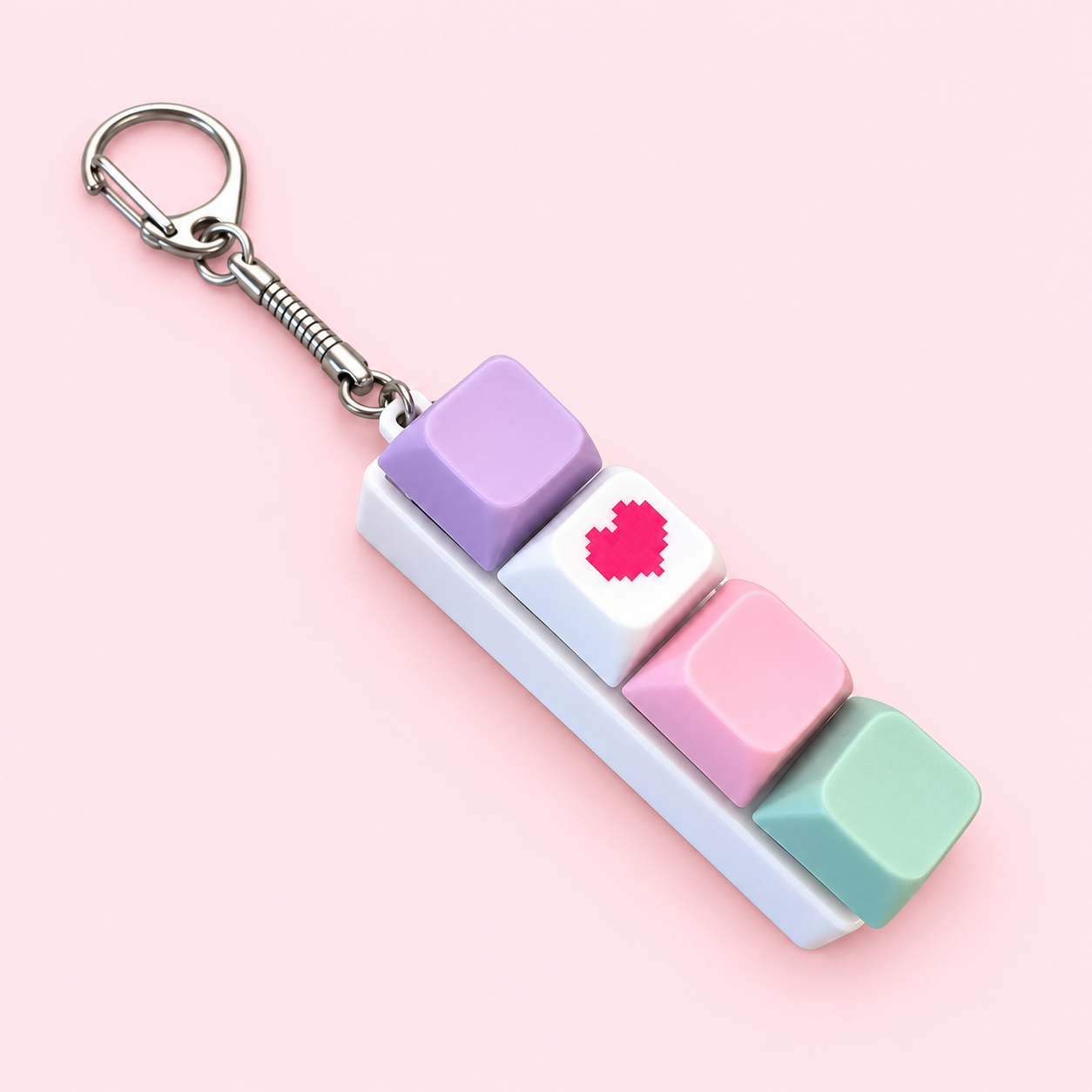
Every mini keyboard fidget toy is a compromise between two things that pull against each other: a keyring wants the object small, and a satisfying press wants the keycap big enough to land a fingertip on. Manufacturers resolve that by cutting the key count rather than the key size, which is the right call, and it means the number on the listing tells you more about the object than its outside dimensions do.
Why the Key Count Is the Number That Matters
A keycap has a floor. Below roughly the width of a fingertip, you stop pressing one key and start pressing the gap between two, which is the single fastest way to make a keyboard fidget unsatisfying.
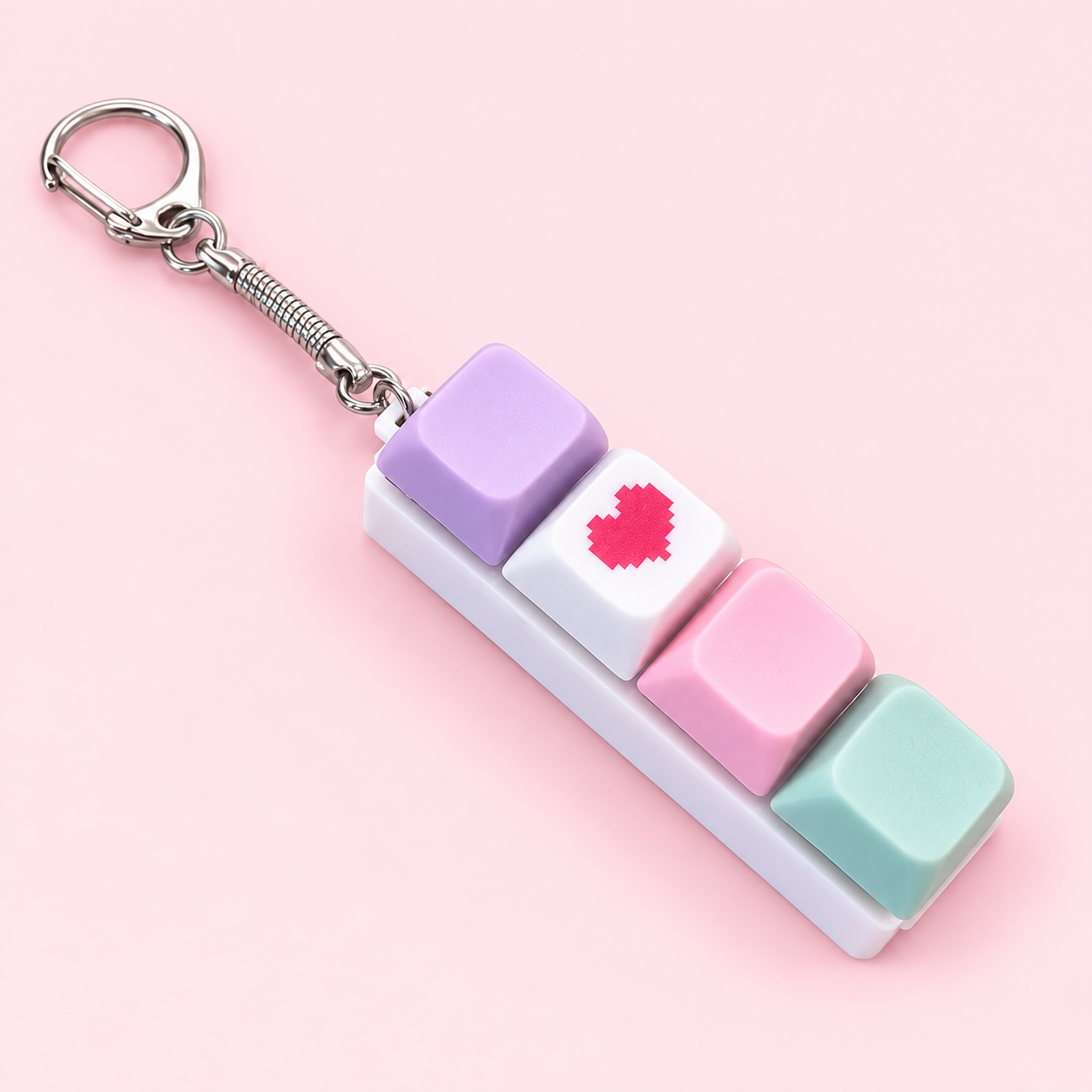
So shrinking the body cannot shrink the keys much. What gives instead is how many of them fit — and that turns key count into the honest size spec. A four-key unit like the Pastel Keyboard Keychain is a keyring object; a denser grid is a pocket or desk object.
The rest of the mechanism is unchanged by scale. The switch, the travel and the click are the same regardless of how many keys sit above them, which is why the press quality question is separate and covered in why the press feels so good.
What Four Keys Can Actually Do
More than it sounds, because a fidget is not a keyboard and you are not typing.
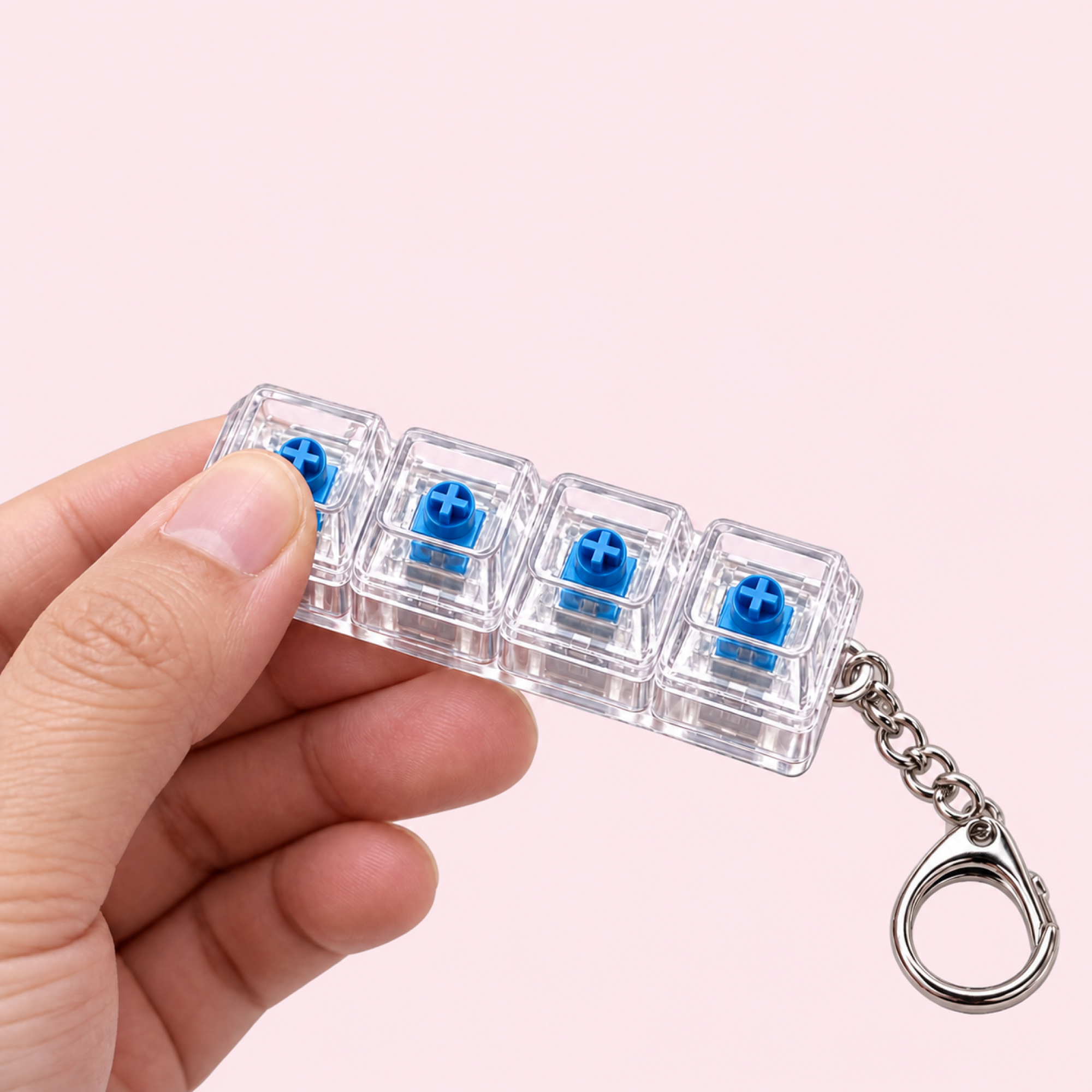
Four keys support a repeating pattern in either direction, alternating index and middle fingers, or a roll across all four. That is enough variety to stay interesting, and it is the single most common thing people actually do with these.
What four keys cannot do is give you a hand position. You hold it in one hand and press with the other, or hold and press with the same thumb, rather than resting fingers on it the way you would with a wider grid.
Four also means every key is near an edge, so a mis-press lands on plastic rather than on another key. In practice that makes a small unit more forgiving than its size suggests.
What More Keys Buy
Six to twelve keys allow a hand to rest, which changes the object from something you operate to something you idle on — a real difference over a long call.
They allow two-handed patterns, which is where the rhythmic use comes from.
They make mixed-switch units possible, so different keys feel different, and that variety is the main reason to go bigger.
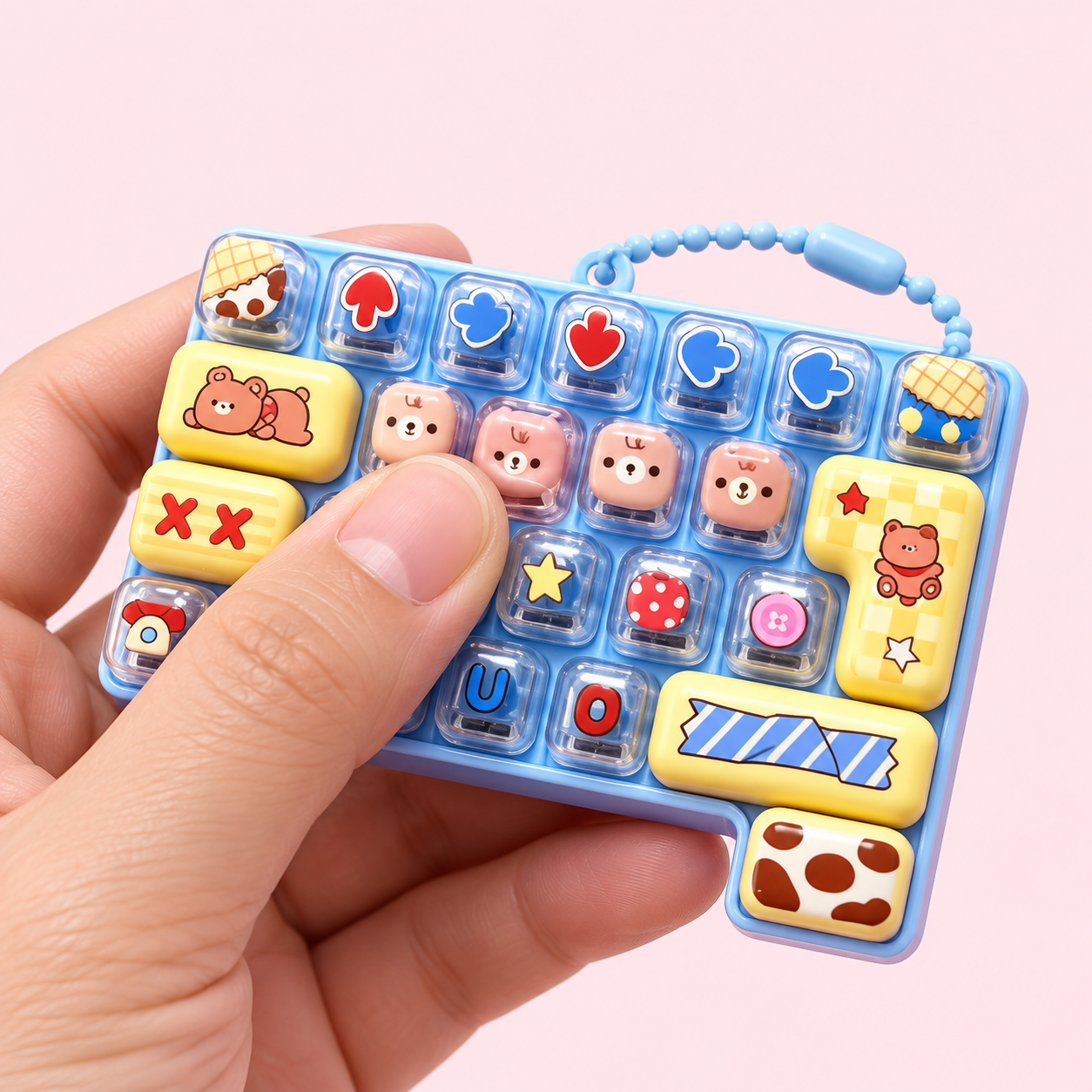
They also stop it being a keyring object. Past about six keys, the thing lives in a pocket or on a desk, which is the trade the Mini Keyboard Fidget Keychain is built to avoid.
The Keyring Test
Clip it to the keys you actually carry and put them in a pocket for a day. Three things show up quickly.
Does it press against your leg? A keyboard fidget with exposed keys will actuate in a pocket. Quiet switches make this a non-issue; loud ones make it embarrassing.
Does it survive the jangle? Keys are abrasive. Painted keycaps scuff against a metal keyring faster than anything else in ordinary use, and pale pastels show it first.
Does the ring attach through metal or plastic? A moulded plastic loop is the part that breaks. A metal ring set into the body, as on the Pastel Heart Mini Keyboard Keychain, outlasts the keys themselves.
Where Small Units Fail First
The keycap legend, where there is one. Printed characters wear off under a thumb long before anything mechanical goes wrong.
The loop attachment, for the reason above.
Key wobble, which is more noticeable on a small unit because there is less body mass to damp it. A key that rocks before it presses is the defect worth checking at unboxing.
None of these is a failure of the switch. The switch is usually the last thing to go, which is why a scuffed keyboard fidget still presses perfectly.
Choosing a Mini Keyboard Fidget Toy by Use
On your keys, all day. Four keys, quiet switches, metal loop. Accept that it will scuff.
In a pocket, deliberately. Six keys. Bigger patterns, still carryable, and no keyring abrasion.
On a desk. Key count stops mattering and the sound starts to — the room-by-room judgement is in which clicks are meeting-safe and the desk rotation in keyboard-side fidgets.
Silent, Clicky, or Somewhere Between
Switch choice matters more on a small unit than a large one, because a keyring object goes everywhere with you rather than staying on a desk where you have already decided the noise is acceptable.
Quiet switches make a keyring fidget usable in a meeting, on a train and in a pocket without consequence. They also feel less rewarding, which is the honest trade.
Clicky switches are the reason to buy one of these at all, and they are also the reason it ends up in a drawer. A four-key unit clipped to your keys is by definition in every room you enter that day, and you do not get to choose the room.
The workable compromise is a tactile switch with a bump you can feel and very little audible click. You keep the moment of actuation, which is the satisfying part, and lose the part that other people hear.
Three Sizes to Compare
Pastel Keyboard Keychain — four pastel keycaps and a metal ring, the keyring format at its most honest.
Pastel Heart Mini Keyboard Keychain — compact press keys with a quieter action, built for a shared desk.
Mini Keyboard Fidget Keychain — pressable keys with a carry loop, the plain version of the format.
Browse fidget keyboards and clickers, or all fidget toys if a press is not the action you want.