



Almost all reviews of fidget cube designs are written in the first hour, and the first hour is the least informative hour a cube has. Everything clicks, nothing has loosened, and the reviewer has not yet discovered which two faces they will actually use. Reading them well means knowing what that timing hides.
The Four Things a First-Hour Review Cannot Know
Which faces survive the novelty. Everyone uses all six on day one. By week two most people are down to two, and which two depends on the room they sit in rather than on the cube. A review listing all six as equally good is describing an unboxing.
Whether the clicker goes dead. Click quality degrades with use as the dome softens, and it is the single most common long-term complaint. No review written on arrival can tell you this.
Whether the shells part. Cubes are two shells around an internal frame, and seam failure shows up after a drop, not before one.
Whether it is quiet enough for your actual room. Reviewers assess noise alone at a desk. The question that matters is what happens in a meeting, and that is a different test entirely — set out in meeting-safe clicks.
Reading Reviews of Fidget Cube Designs Properly
Discount every adjective about satisfaction. All new mechanisms feel satisfying. It tells you nothing about the cube and everything about mechanisms.
Look for the word “flex”. A reviewer who mentions body flex has held it properly. Flex at the seam is the fault that ends a cube.
Note which face they describe in most detail. That is the face they actually used, and it is more informative than the list of six.
Trust photographs over descriptions. You can see whether the clickers sit flush, whether the gear teeth are fine or coarse, and whether the seam line is tight.
Ignore any review that compares it to a named brand original. Those comparisons are about branding rather than mechanism, and the mechanism is what you are buying.
What to Judge Instead
Buy on layout rather than on reviews, because the layout determines whether you will like the cube and the layout is visible in the listing.
Decide first whether you want discrete actions or continuous ones. Clickers and rockers are discrete; balls, dials and slides are continuous. That single choice eliminates half the market.
Then decide on size. A 2-inch body is a one-hand pocket object; a 5 cm body sits in a palm and uses both hands, and the difference is bigger than any quality gap between two cubes of the same size.
The face-by-face breakdown of what each mechanism does, and where each one fails, is in what is inside a fidget cube, and the buying decision itself is in deciding which kind you actually want.
The Checks You Can Run Yourself
These take under a minute with the cube in your hand and beat any review.
Press every clicker in turn. One that sounds different from its neighbours means an inconsistent batch.
Rock the switch to both ends. A defined hard stop at each end or it will feel vague forever.
Spin the ball or dial through a full rotation. A catch at one point is a moulding flaw and it does not wear smooth.
Squeeze across the seam. Any give there and the shells are not properly bonded.
What a Month of Ownership Actually Looks Like
The clicker face gets used far more than you expected and starts to soften first.
One mechanism becomes your default and the others become scenery. This is normal and not a fault.
The cube migrates to wherever your non-dominant hand rests, or it disappears into a drawer — and which of those happens is decided by placement rather than by quality.
If it ends up in the drawer, the usual reason is that you bought a mechanism you do not actually enjoy. That is a layout mistake, not a build-quality one, which is why layout deserves more of your attention than reviews do.
Why Two People Rate the Same Cube Differently
Read enough reviews and you will find the same cube called excellent and dead in the hand, and usually neither reviewer is wrong.
Hand size accounts for a lot of it. A 2-inch body that a large hand wraps completely is a different object from the same cube in a smaller hand, where every face stays reachable.
Room accounts for most of the rest. Someone working alone rates the clicker highest; someone in an open office rates it lowest, and they are describing the same mechanism.
Expectation accounts for the remainder. A reviewer who wanted one deep sensation finds six shallow ones disappointing; a reviewer who wanted variety finds the same cube generous.
None of that is resolvable by reading more reviews. It is resolved by knowing which of those three people you are before you buy.
Three Layouts, Plainly Described
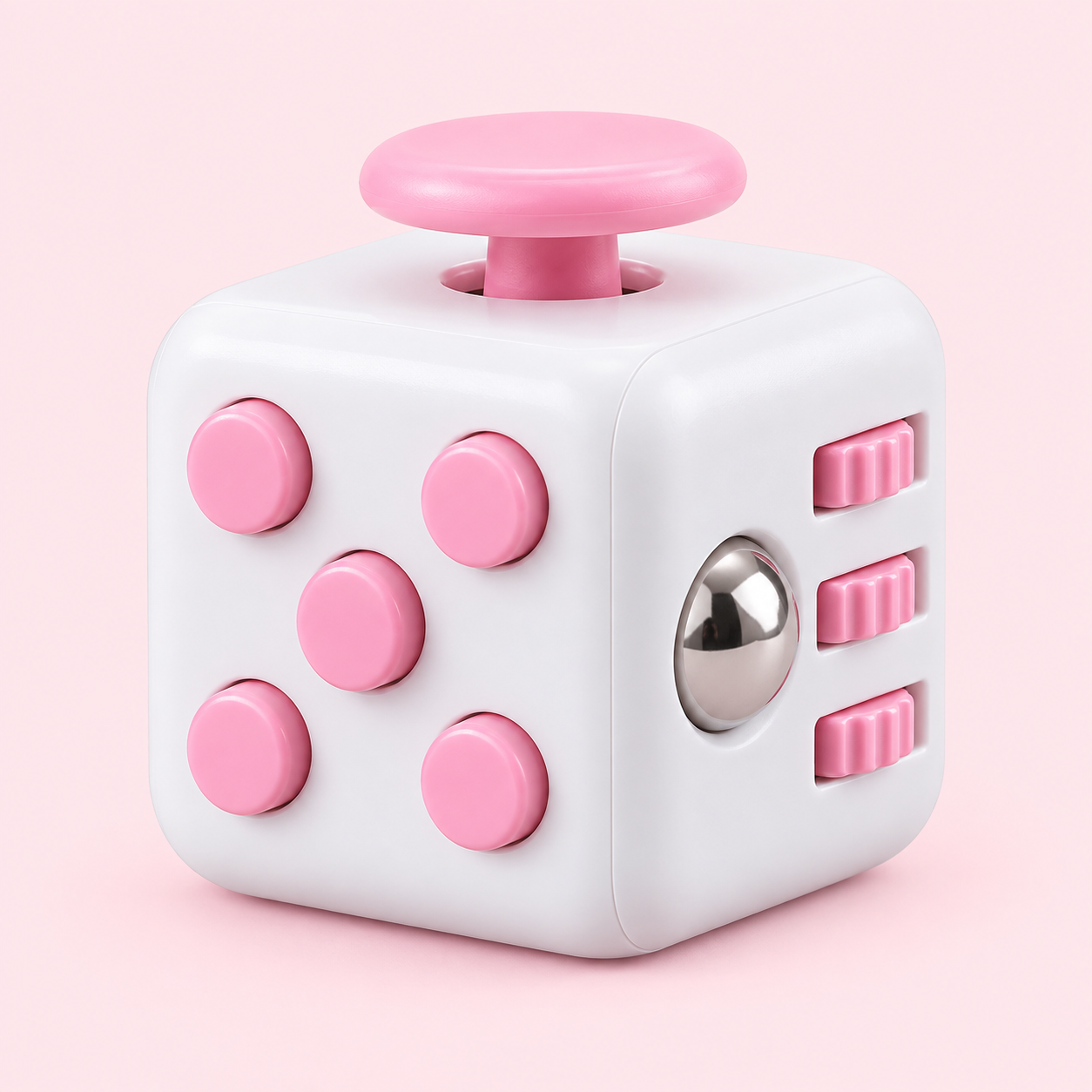
White & Pink Six-Sided Fidget Cube — 2 × 2 × 2 in, the classic six-function layout, one-handed.
Mint Spin & Slide Fidget Cube — 5 × 5 × 5 cm, continuous mechanisms rather than clickers, the quiet choice.
Blue Gray Busy Fidget Cube — 5 × 5 × 5 cm, more mechanisms across larger faces.
Browse fidget cubes and infinity cubes, or all fidget toys.