


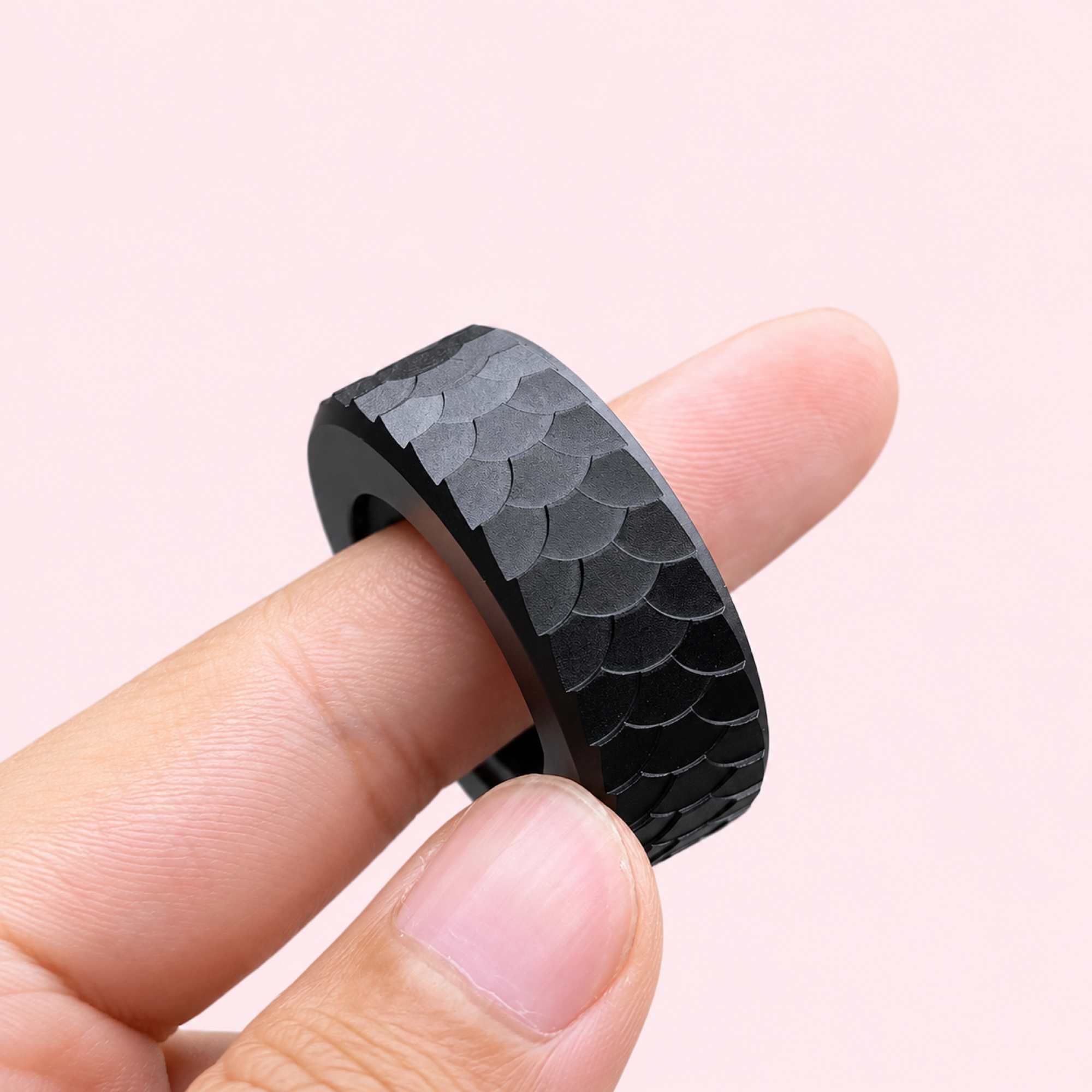
What is a fidget ring? It is a ring with one moving part — a spinning outer band, a rolling bead, a rotating face or a textured surface — that you can work with the thumb of the same hand, without looking at it and without anyone noticing. That is the whole definition, and everything interesting about the category follows from the fact that it is worn rather than carried.
What Is a Fidget Ring Actually For
It cannot be forgotten. This is the actual reason people move to rings after owning a drawer full of other things: a fidget only works if it is present, and a worn object is present by default.
It cannot be dropped, lost under a seat, or left in a hotel room.
It is invisible in use. A thumb rolling a band on the same hand reads as nothing at all, which is why a ring works in rooms where a spinner or a clicker does not.
And it is continuous rather than ballistic. There is no spin to watch decay, no click to land — just motion for as long as you keep making it.
The Four Motions
Spinning band. An outer ring that rotates freely around an inner core. The most common design, the smoothest sensation, and the one most people mean by the term. The Sunburst Spinner Ring is this type.
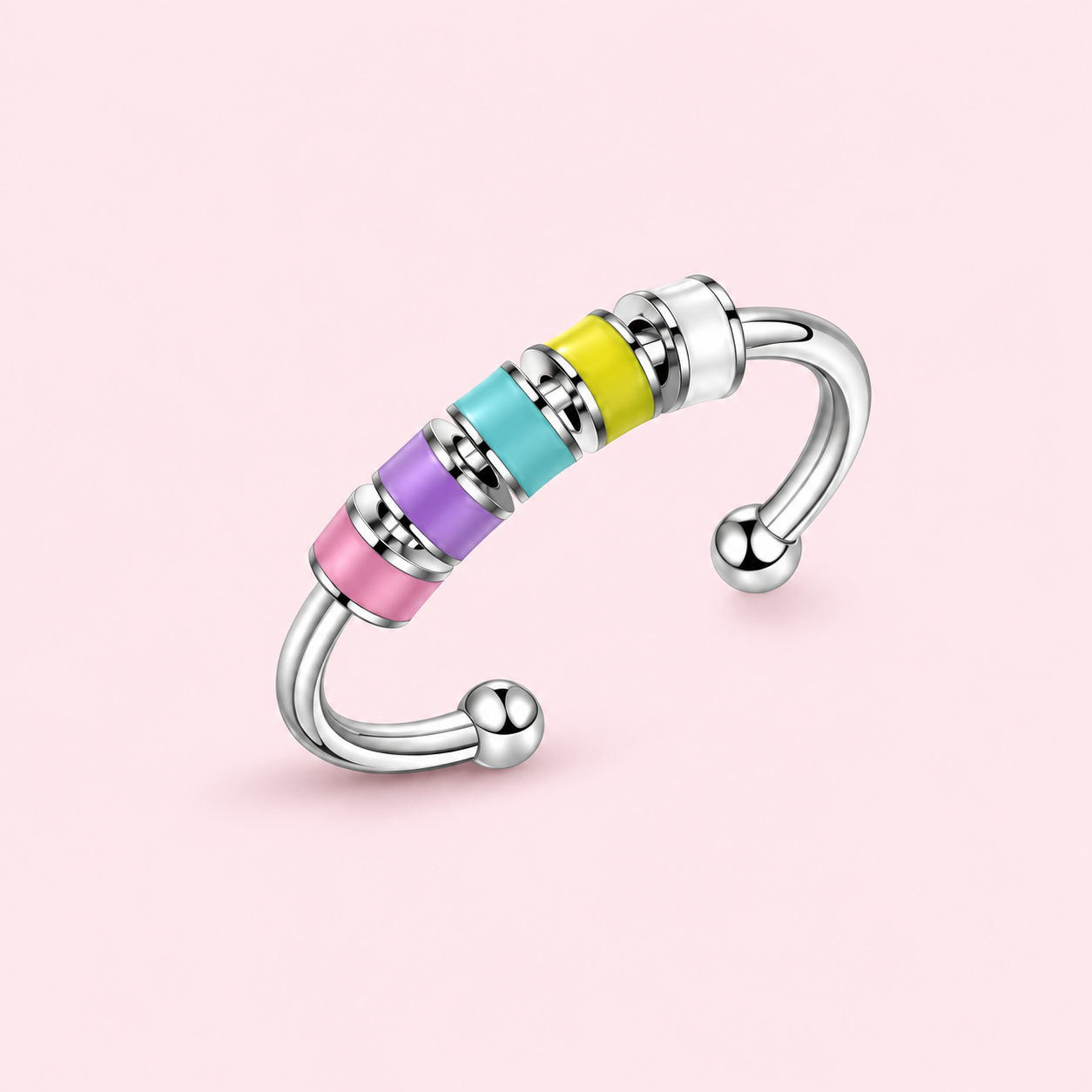
Rolling beads. Beads captured in a channel that travel around the band under a thumb. More tactile feedback than a spinning band and a faint sound at close range — the Silver Rolling Bead Fidget Ring and the Rainbow Bead Spinner Fidget Ring are examples.
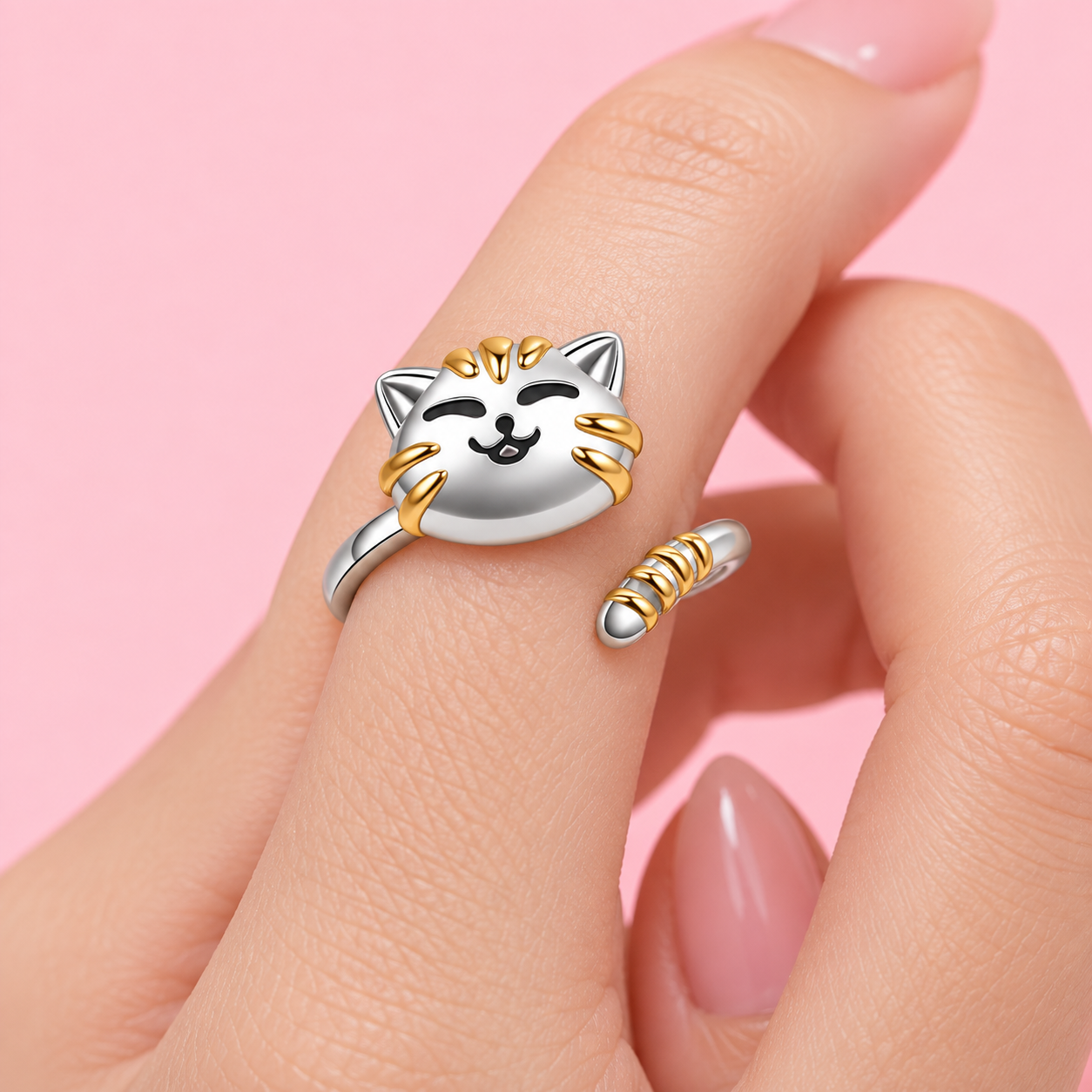
Rotating face. A disc or ornament set into the top of the ring that turns independently. Visual as well as tactile, so it is the least discreet of the four.
Fixed texture. No moving part at all — ridges, knurling or a mechanical pattern the thumb tracks. Nothing to wear out and nothing to seize, which makes the Black Mechanical Fidget Ring the format that survives longest.
Which Finger to Wear It On
The index finger of your non-dominant hand is where most people end up, because the thumb of that same hand reaches it naturally and the motion stays inside one hand.
The middle finger works and gives a slightly longer thumb reach, which suits larger bands.
The thumb itself is the worst choice, since you then need the other hand to operate it and the whole one-handed advantage disappears.
Wear it on the hand you do not write, type or hold a phone with. A spinning band under a keyboard is a distraction rather than a help.
How Long a Fidget Ring Lasts
Longer than any other fidget format, with one qualification: the failure is almost always the finish rather than the mechanism.
Plating wears at the contact points where the thumb works, and on a ring that is used daily you will see it inside a year. Solid material — steel through and through — has no plating to lose, which is the argument made in full in the stainless steel guide.
Spinning bands can develop a gritty feel as skin oil and dust collect in the gap. Rinsing under warm water and drying fully restores it.
Bead channels are the one genuine weak point. A bead that escapes its channel cannot be put back, and that is the most common way one of these actually ends.
What a Fidget Ring Cannot Do
It cannot give you depth of sensation. A ring offers one small motion, and that is the trade for being wearable — when people find rings insufficient, this is why.
It cannot be shared or swapped, since it is sized to a finger.
It cannot be resized, which makes fit the single most important thing to get right before anything else about the design matters.
And it makes no health claims worth repeating. What a ring does is give a hand something small and repeatable to do, in places where a visible fidget would be out of place. Whether that is useful to you is a personal question rather than a clinical one.
Fit Is the Whole Decision
A fidget ring that is loose will spin on the finger rather than the band spinning on the ring, which defeats the mechanism entirely.
One that is tight becomes uncomfortable within an hour, because a fidget ring is worn far more actively than an ordinary one.
Measure before buying, and when you fall between sizes let the band width decide rather than applying a blanket rule: a wide band takes the larger size so it clears the knuckle, a narrow one takes the smaller so the ring cannot rotate on the finger. Fingers swell over a day, so check that the larger choice is still snug enough to need a small twist to remove. The buying criteria in full are in what separates a good ring from an ornament.
Do Anxiety Rings Actually Work
This is the most asked question about the category and it deserves a plain answer rather than a marketing one.
What a ring reliably does is occupy a hand. Hands that have something to do stop doing other things — tapping, picking at a cuticle, drumming on a table — and for many people that substitution is the entire benefit, with no mechanism beyond it needed.
What no ring does is change how you feel by itself. Anyone telling you otherwise is selling rather than describing.
The useful way to judge one is therefore practical rather than clinical: does it stay on your hand, does the motion still interest you after a fortnight, and do you reach for it without deciding to. A ring that passes those three is working. One that sits in a drawer is not, regardless of what it is made of.
Three Motions to Try
Sunburst Spinner Ring — a freely spinning outer band, the classic version of the format.
Silver Rolling Bead Fidget Ring — captured beads in a channel, more feedback under the thumb.
Black Mechanical Fidget Ring — fixed texture, nothing to seize or escape.
Browse the fidget rings range, or all fidget toys if you want something with more depth than a worn object can give.