





Eight linked cubes folding endlessly through themselves is a mechanism that does not change with material — the geometry is identical whether the blocks are aluminium or ABS. What changes is everything about how it feels to run. A metal infinity cube folds with momentum you have to manage; a plastic one folds with a control you barely notice. Neither is better, and picking the wrong one is the most common reason a folding cube stops getting used.
What a Metal Infinity Cube Does Differently in the Hand
A heavier cube carries the fold. Start the rotation and the mass keeps it going, so the motion becomes a continuous cascade you guide rather than a sequence you drive. It feels substantial and slightly ceremonial, and it rewards slow use.
A lighter cube stops when you stop. Every segment of the fold is something you actively do, which makes it faster and more responsive — better for rapid absent-minded use while you are reading or listening.
The practical test is what you intend to do with it. If it lives on a desk and you pick it up deliberately, weight is a benefit. If it lives in a pocket and gets used one-handed during a call, weight works against you twice: it is heavier to carry and harder to control with one hand.
One-handed operation is the clearest dividing line. Most people can run a light cube with one hand after a little practice. Very few can run a heavy one that way without dropping it.
Hinges, Which Fail Differently
Metal hinges wear by abrasion. The pivot faces polish against each other and the fit gradually loosens, which shows up as a slightly sloppier fold over years rather than months. Metal cubes are the most durable version of this mechanism by a wide margin.
Plastic hinges wear by deformation. The pivot rounds off under repeated load, and once it has, the cube develops one loose joint that flops ahead of the others. This is the most common way a plastic folding cube dies, and it is not repairable.
Mixed designs with plastic blocks on metal pins sit between the two: the pins outlast the blocks, and the failure is still at the plastic.
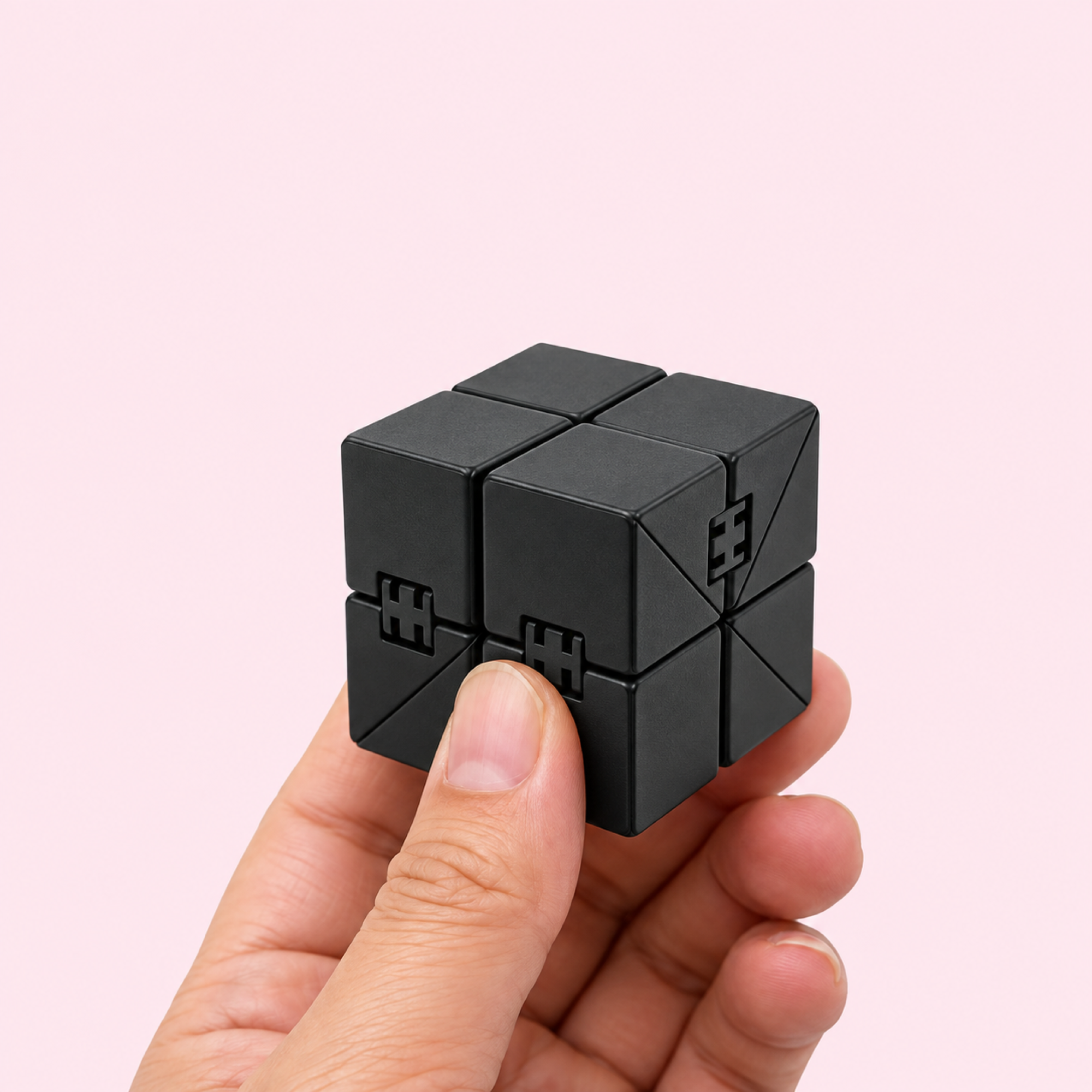
The Infinity Folding Cube is a compact black body of linked segments, and whichever material a cube uses, the hinge is the component to judge — the blocks themselves essentially never fail.
Noise, Where Plastic Wins
This is the one where the lighter material is clearly better in a shared room.
Metal blocks meeting metal blocks produce a bright, hard click that carries. It is a satisfying sound in your own hands and an intrusive one from two desks away, and a metal cube dropped on a hard desk is genuinely loud.
Plastic blocks make a duller, softer knock that dissipates faster. In an open-plan office that difference decides whether anyone notices you, which is the same logic applied across mechanisms in the quietest fidget toys that aren’t squishies.
Neither is silent. A folding cube is a percussion instrument by construction, because the fold ends with blocks meeting blocks.
Surface and Grip
Metal is slippery when your hands are cold or dry, and a cube you are rotating through your fingers is exactly the object that punishes a slippery surface. Anodised and bead-blasted finishes help; polished ones do not.
Plastic is grippier and picks up skin oil, which eventually gives it a slightly tacky feel. That is cleanable, unlike a polish worn into metal.
Temperature is worth mentioning because it is entirely one-sided: a metal cube is cold for the first thirty seconds in winter and stays cool in summer. Some people find that pleasant and some find it unpleasant; nobody finds it neutral.
Choosing Between Them
Pick metal if it lives at one desk, you use it deliberately, you want it to last for years, and the room is yours.
Pick plastic if it goes in a pocket, if you use it one-handed, if you share a room, or if you are not yet sure you like the mechanism.
If you are unsure whether a folding mechanism suits you at all, start light and cheap to carry — that is the same advice that applies before committing to any mechanism, and the deciding question of whether you want continuous motion, a definite click or something to look at is worked through in 3D printed infinity cube vs bought.
Related Cube Mechanisms
A folding cube is only one of the cube-shaped options, and the others feel nothing like it.
Panel cubes with magnetic faces give a latch-and-release action instead of a continuous fold — the Magnetic Fidget Box has visible magnetic panels and sliding parts.
Multi-function cubes put several small mechanisms on six faces, like the White & Pink Six-Sided Fidget Cube. More variety, and the trade-off is that choosing a face is a small visual task, which is why single-mechanism objects tend to stay in use longer.
Shaped folders like the Hamburger Folding Fidget Cube keep the hinge chain in a different silhouette, which changes the balance in the hand.
Three Cubes to Compare
Infinity Folding Cube — linked black segments, continuous fold in both directions. The benchmark mechanism.
Magnetic Fidget Box — magnetic panels and sliding parts, a latch rather than a fold.
White & Pink Six-Sided Fidget Cube — several mechanisms on one body, for people who want variety over depth.
Browse the fidget cubes range, or see all fidget toys if folding is not the action you want.