



A board is the only fidget format that puts several mechanisms on one surface without asking you to choose between them, and that is both its appeal and its risk. Good sensory board ideas are the ones where each element does something genuinely different from its neighbours; a board with six variations on the same action is one fidget taking up the space of six.
Sensory Board Ideas That Earn Their Space
Tracked paths. A groove or channel with a slider you push along it. The most absorbing element on any board, because it has direction, distance and an end — there is a small journey rather than a single event. The Pink Multi-Track Fidget Activity Board is 8 × 8 × 1 inches with four winding tactile paths, which is enough length to make the travel worth following.
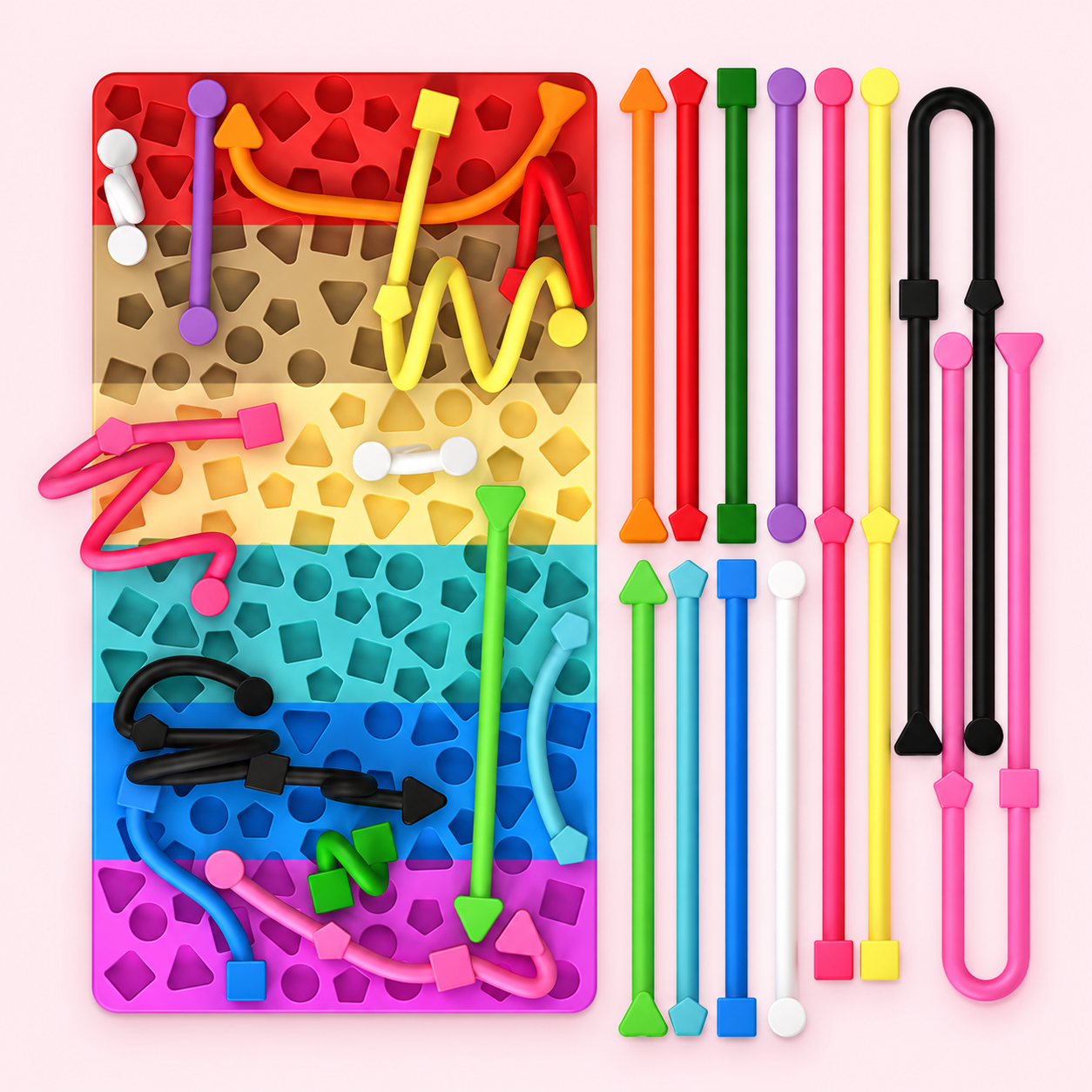
Movable rods and beads. Elements that shift position and stay where you leave them. They give a visible record of use, which is oddly satisfying, and they are the quietest elements available. The Rainbow Sensory Activity Board at 20 × 15 × 3 cm uses movable textured rods.
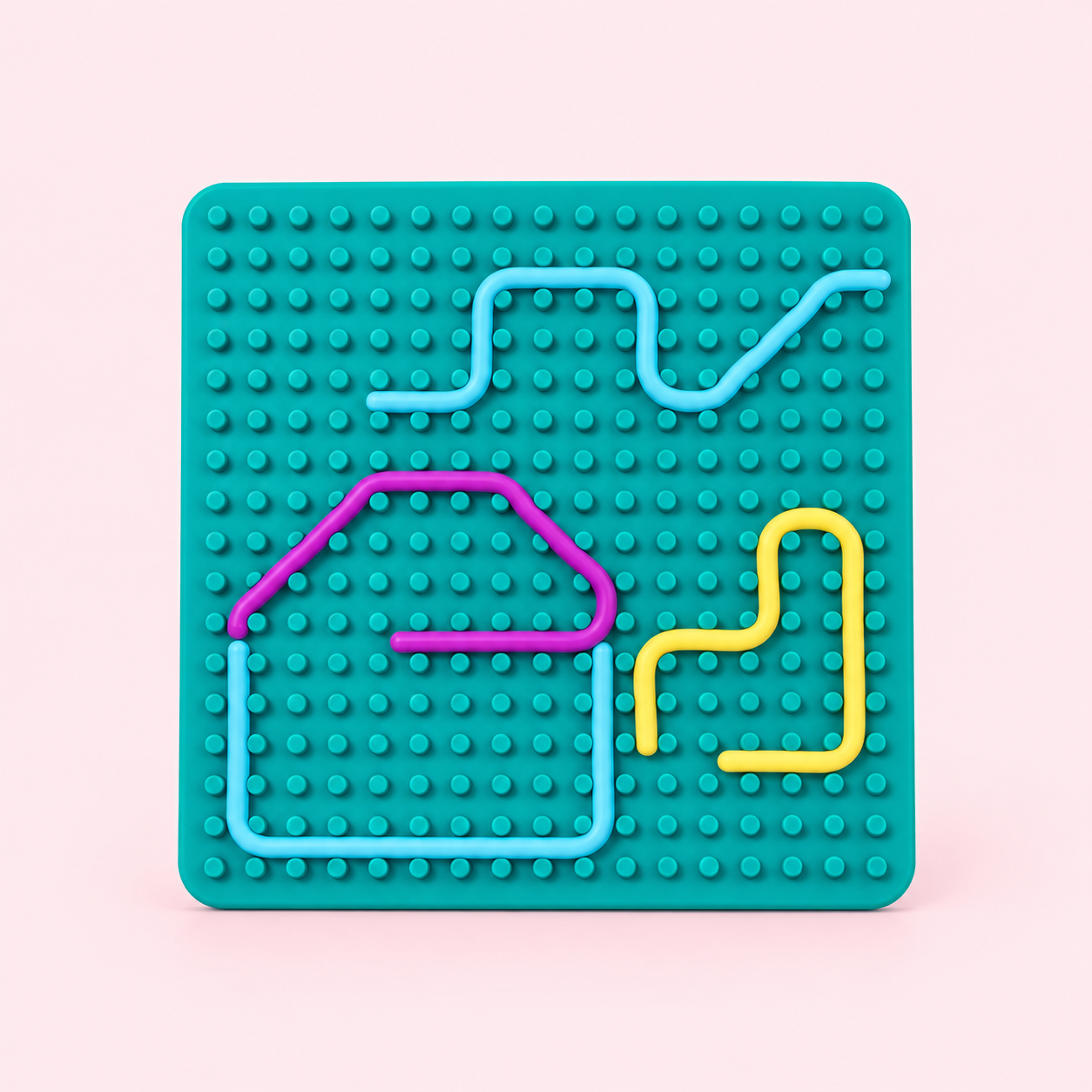
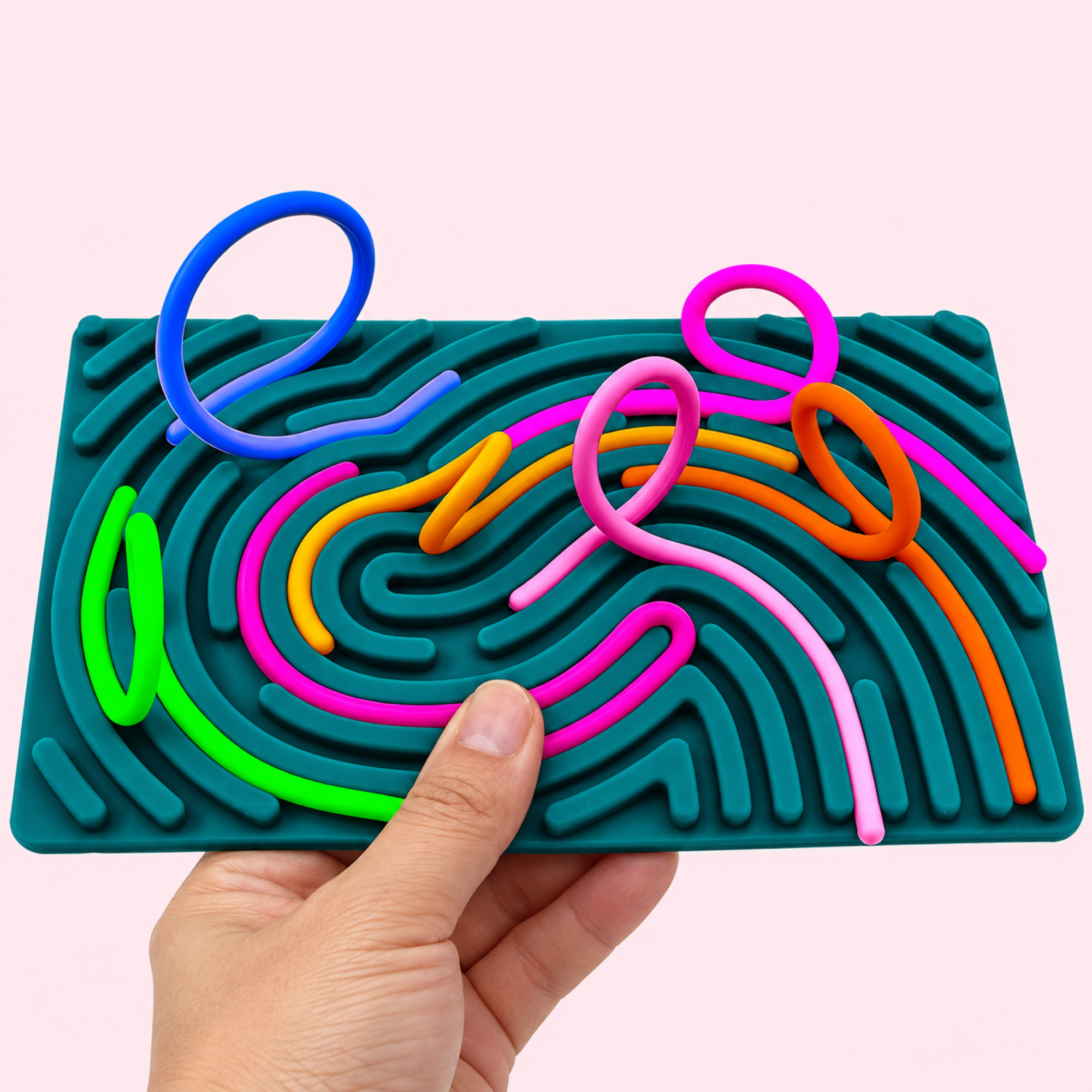
Flexible path pieces. Segments you can rearrange into different routes, which turns the board into something you configure rather than only operate. The Teal Sensory Activity Board is a peg board with repositionable path pieces.
Raised textures. A surface to run a thumb across, costing nothing and adding an action that needs no attention at all.
One press, if any. A single clicking or popping element gives the board a punctuation point. More than one and the board becomes audible, which limits where it can live.
What Does Not Earn Its Place
Duplicated actions in different colours. Four sliders is one slider, and the other three are decoration.
Anything requiring two hands to operate. A board is already a two-handed object in the sense that it sits still while one hand works it; elements needing both hands remove that advantage.
Loose parts. Anything that detaches is a part you will lose, and a board with a missing piece looks broken in a way a single fidget never does.
Small text or printed detail. It is the surface your hands are on constantly, and print does not survive that.
How Many Elements Is Right
Four to six distinct actions is the useful range.
Below four, a board is doing less than two separate fidgets would, and separate objects are easier to place on a desk.
Above six, you start looking at the board to find the element you want, and looking is the thing a fidget is supposed to avoid — the same weakness that makes six-sided multi-function cubes less usable than they appear, argued in best fidget cube.
The sweet spot is a board where your hand can find every element by feel in the first day.
Where a Board Belongs
On a desk, permanently. Boards are the least portable fidget format and the most visually present, which means they only work where they can live out in the open.
That has a real advantage: a fidget you can see is one you remember to use, and invisibility in a drawer is the most common way any fidget stops getting picked up, as set out in what holds up after a month on a desk.
It also has a cost in a shared room, because a board is obviously a fidget in a way that a slider or a ring is not. Somewhere private, that is irrelevant; on a shared bench it invites comment, which the object-by-object reasoning in what survives a shared office covers.
Choosing Between a Board and Separate Objects
Buy a board if you want variety in one place, if the desk is yours, and if you like the idea of something you can look at as well as use.
Buy separate objects if you need portability, if you share a room, or if you already know which single action you prefer — in which case a dedicated object does that action better than any board element will.
The underlying question is the same as everywhere else in the category: which hand actions do you actually reach for, which is what types of fidget toys is for.
Care
Boards collect dust in their channels and under their sliders, which is what makes a smooth track go gritty. A dry brush clears most of it; compressed air clears the rest.
Silicone elements can be washed properly. Wooden and painted boards should only be wiped, since water sits in the joints.
Size, and Why Bigger Is Not Better Here
Boards are one of the few fidget formats where the largest option is usually the wrong one.
A large board forces you to move your whole hand between elements rather than reaching them from one resting position, which turns each use into a deliberate action instead of a background one. It also takes desk space that a working desk does not have, and anything competing for desk space eventually loses.
A board that fits under a spread hand is the practical limit: every element reachable without moving your wrist, which is what lets you use it without looking. Both a 20 × 15 cm board and an 8 × 8 inch one sit comfortably inside that; much larger and the format stops being a fidget and starts being an activity.
Three Boards Worth Comparing
Pink Multi-Track Fidget Activity Board — 8 × 8 × 1 in with four winding paths. The most travel per element.
Rainbow Sensory Activity Board — 20 × 15 × 3 cm with movable textured rods, the quietest element type.
Teal Sensory Activity Board — a peg board with repositionable path pieces, for a board you configure rather than only use.
Browse the fidget boards range, or all fidget toys if a single dedicated mechanism suits you better.
If you are still deciding whether a ready-made board is the right object at all, what a sensory board is covers the format, the sizes and where boards fail.