


Size looks like the most trivial specification on a squeeze toy and it changes more than the material does. A giant stress ball is not a normal one scaled up in your experience of it — past roughly palm width the object stops being something you grip with fingers and becomes something you compress between two hands, which is a different action using different muscles with a different reason to do it.
Where the Threshold Sits
A ball smaller than your palm is operated by fingers closing against the thumb. The motion is precise, repeatable and one-handed, and it can run in the background while you do something else.
A ball the width of your palm is the crossover: you can grip it with one hand but only at full stretch, and the squeeze becomes a whole-hand action rather than a finger action.
Anything wider than a palm is two-handed. You compress it between palms or against your chest, both hands are occupied, and it stops being a background object entirely.
That threshold is personal, and it is the single most useful thing to measure before buying. Put a tape measure across your own palm at the widest point; anything above that number is a two-handed purchase whether the listing says so or not.
What a Giant Stress Ball Is Actually Good At
Whole-hand compression, which small balls cannot deliver. A large foam body lets you close your entire hand rather than just your fingertips, and for anyone whose tension sits in their forearms rather than their fingers, that is the difference between a toy and something useful.
Slow deliberate use. A big object cannot be used quickly, and that is a feature — it forces a slower rhythm than the rapid absent-minded squeezing a small ball invites.
Visual presence. A large soft object on a desk is an invitation to pick it up, which is why big squishies get used by people who never remember to use small ones.
Grip work with both hands at once, where symmetry matters and small objects force you to alternate.
What Gets Worse
Resistance drops. This is the counterintuitive one. Bigger foam bodies are usually softer in the hand, because the same material across a longer compression distance gives way more easily before it bottoms out. If you want firm resistance, large is the wrong direction — a small dense body pushes back harder than a large soft one.
Storage becomes a real problem. A small ball lives in a drawer, a mug, a pocket. A large one has to live on the desk surface, taking space, or it goes in a cupboard and stops existing. This is the single biggest reason large squeeze toys stop getting used, and it is the same abandonment pattern in what holds up after a month on a desk.
Portability disappears. Large means desk-only, which means it is not with you when you actually want it.
Surfaces collect. More area means more dust, more lint and more of whatever is on your desk, particularly on flocked or textured finishes.
The Shape Question
Round is the worst shape at large sizes. A big sphere rolls, needs a container, and offers no natural grip. Flat-sided and elongated shapes solve both problems at once: they stay where you put them and they give your hands somewhere to land.
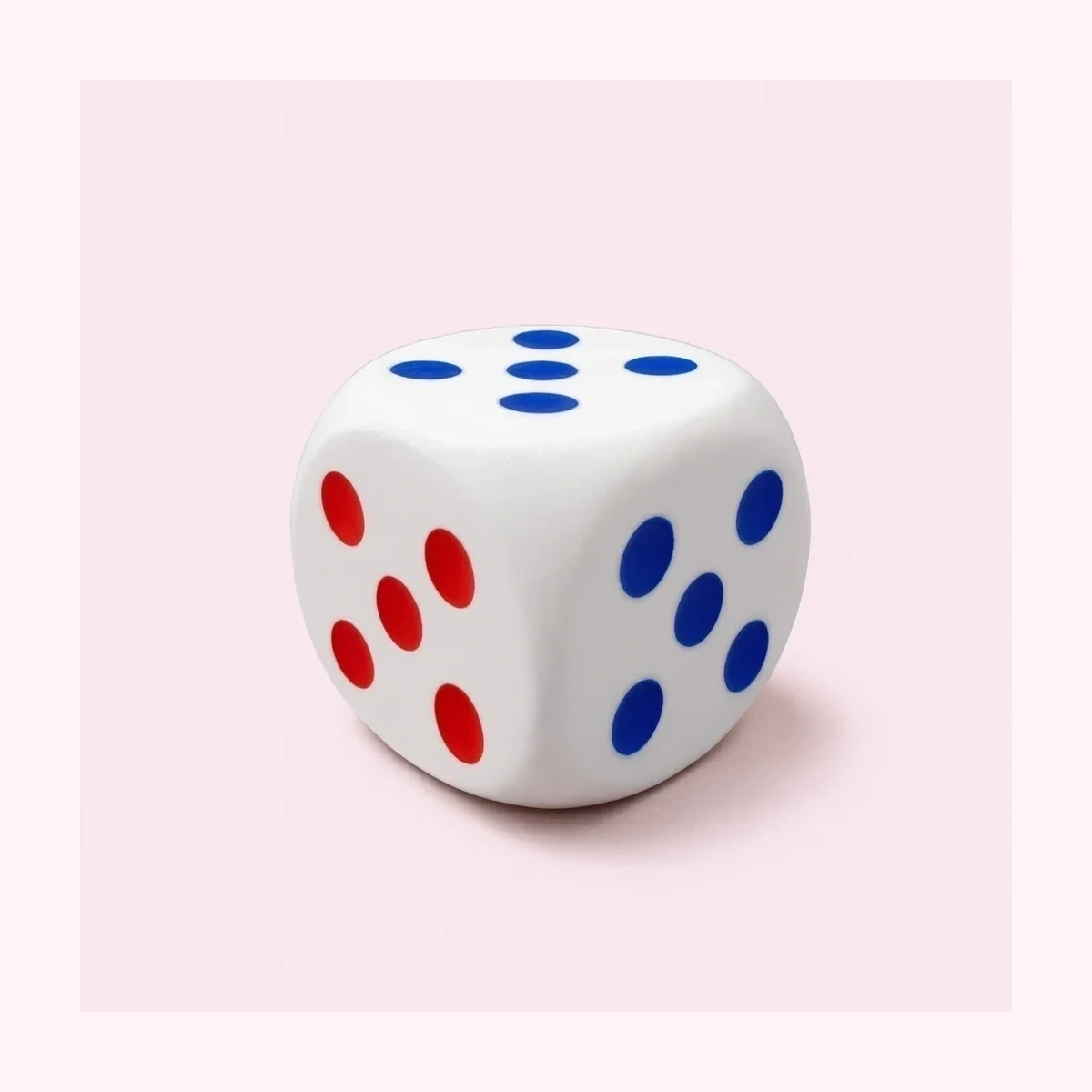
A 6-inch jumbo foam dice is a good worked example — a cube at that size sits still, presents flat faces to compress against, and stacks rather than scattering. Elongated bodies like a jumbo butter stick work for the same reason in a different direction: you can wrap a hand around the length rather than trying to span a diameter.
If you want genuine two-hand scale with a defined shape, the 20 cm pineapple at 600 grams is at the top end of what a hand can work with, and the weight is worth noting — large slow-rising bodies are heavy, and that is part of why they feel substantial.
Big and Hard Is a Different Product Again
Everything above assumes soft. A large hard fidget — a segmented press-and-spin ball, for instance — behaves nothing like a large soft one, because the size buys you mechanism room rather than compression distance. The Orange Yellow Press and Spin Fidget Ball at 3 × 3 × 3 inches and 90 grams is about as large as a hard fidget ball usefully gets before it stops fitting one hand.
For hard bodies, larger mostly means more travel and more moving parts rather than more give. The filling and construction comparison across the whole category is in what the filling changes.
Choosing a Size Honestly
Buy small if the toy needs to be with you, if you want resistance, or if you fidget absent-mindedly while doing something else.
Buy large if you want a deliberate two-handed squeeze, if it will live permanently on one desk, and if you have somewhere to put it that is not the floor.
Buy both if the two uses are genuinely different for you, which for most people they are — and keep the large one where you can see it, because an unseen large object is a wasted one.
Three Sizes to Compare
6 Inch Jumbo Dice Squishy — three giant soft foam cubes. Flat faces, stays put, genuinely two-handed.
20 cm Pineapple Squishy — 20 cm tall, 600 grams, slow-rising. Top of the practical size range for one pair of hands.
3-inch Foam Dice Stress Ball — the one-handed control case, for comparing what you actually gain and lose by going large.
Browse the fidget balls range across sizes, or see all fidget toys if a squeeze is not the mechanism you want.