





A folding cube either runs smoothly through itself or it does not, and when it does not the fault is almost always in one of twelve hinges rather than in the cube as a whole. Working out how to fix an infinity cube starts with identifying which of three faults you have, because they have different causes and only two of them respond to anything you can do at a desk.
How to Fix an Infinity Cube: Identify Which of Three Faults You Have
Binding. The fold stops partway or needs force to continue. Something is either too tight or obstructed.
Flopping. A joint has no resistance, so the cube falls through itself and the motion loses its rhythm. Something has worn or loosened.
Sticking. The fold moves but feels gritty or catches intermittently. Almost always contamination rather than damage.
Find the single joint responsible first. Fold slowly and watch which hinge behaves differently from its neighbours — there is nearly always exactly one, and people waste time treating the whole cube.
Fixing a Sticking Cube
This is the common case and the easy one.
The usual contaminant is pocket lint, skin oil and dust packed into a hinge. Work the cube slowly through several full folds to see where the resistance is, then clear that joint: compressed air first, then a dry brush.
Do not oil it. Household oils thin the friction briefly and then collect more dust than they displaced, so the cube feels better for a week and worse afterwards. This is the same mistake people make with bearings, described in the fidget spinner bearing explained.
If the cube has been somewhere greasy, a cotton bud barely damp with warm water and a trace of washing-up liquid will lift residue off a metal hinge. Dry it completely afterwards, and keep water away from painted or wooden bodies.
Fixing a Binding Cube
Binding has two causes and only one is fixable.
Debris in the joint presents as binding that appeared suddenly. Treat it as sticking above.
Tolerance presents as binding that has been there since the cube arrived, or that appeared after a drop. A hinge that is too tight from manufacture will not loosen on its own — it wears at the contact faces until it becomes a flopping joint instead, which is a worse fault arriving slowly.
If a cube has bound since new, this is a manufacturing problem rather than a maintenance one. That is also the most common outcome with printed cubes, where clearance error accumulates along the chain — the reasoning is in 3D printed infinity cube vs bought.
A dropped cube can bind because a pin has been knocked out of square. Gentle pressure on the block to realign it sometimes works; force does not, and force is how a repairable cube becomes a broken one.
Fixing a Flopping Cube
Be honest about this one: usually you cannot.
In plastic-hinged designs, flopping means the pivot has deformed permanently. There is no way to restore material that has rounded off, and the joint will keep getting looser.
In metal-pin designs, a loose joint occasionally means a pin has migrated slightly. If the pin is visible at the block edge, pressing it back flush with a flat tool can restore the fit for a while.
A cube with one floppy joint still works, just unevenly. A cube with two has reached the end of its life, and the sensible reading is that folding is a mechanism with a finite number of cycles in it.
What Not to Do
Do not dismantle it. The blocks are usually pressed or glued onto pins, and the reassembly tolerance is what makes the cube work. A dismantled folding cube is almost never as good afterwards.
Do not apply heat to loosen a stiff joint. It softens the plastic around the pivot and accelerates exactly the deformation you are trying to avoid.
Do not soak it. Water gets into hinges and stays there, and rust or swelling follows.
Do not force a fold that is resisting. The resistance is information.
Preventing All Three
Keep it out of pockets that contain lint, keys and coins. A small pouch costs nothing and prevents most sticking.
Do not leave it in a hot car. Heat is what softens hinge material, which is the beginning of a flopping joint.
Fold it at a moderate pace. The mechanism is not damaged by use; it is damaged by shock, and slamming the fold is a shock load on one hinge at a time.
If you are buying rather than repairing, hinge consistency is the single property to judge, as set out in what is an infinity cube and compared by material in metal infinity cube vs plastic.
When It Is Worth Repairing at All
A folding cube is one of the few fidgets where a repair is genuinely worthwhile, because the failure is usually one joint rather than the whole object, and clearing a joint takes two minutes.
It stops being worthwhile at the point where the fault is wear rather than contamination. Wear is progressive: a joint that has deformed once keeps deforming, and time spent on it buys weeks.
The quick test is whether the fault changes. A fault that comes and goes, or that improves after a clean, is contamination and worth treating. A fault that is identical every single fold is mechanical, and no maintenance addresses it.
Three Cubes Worth Comparing
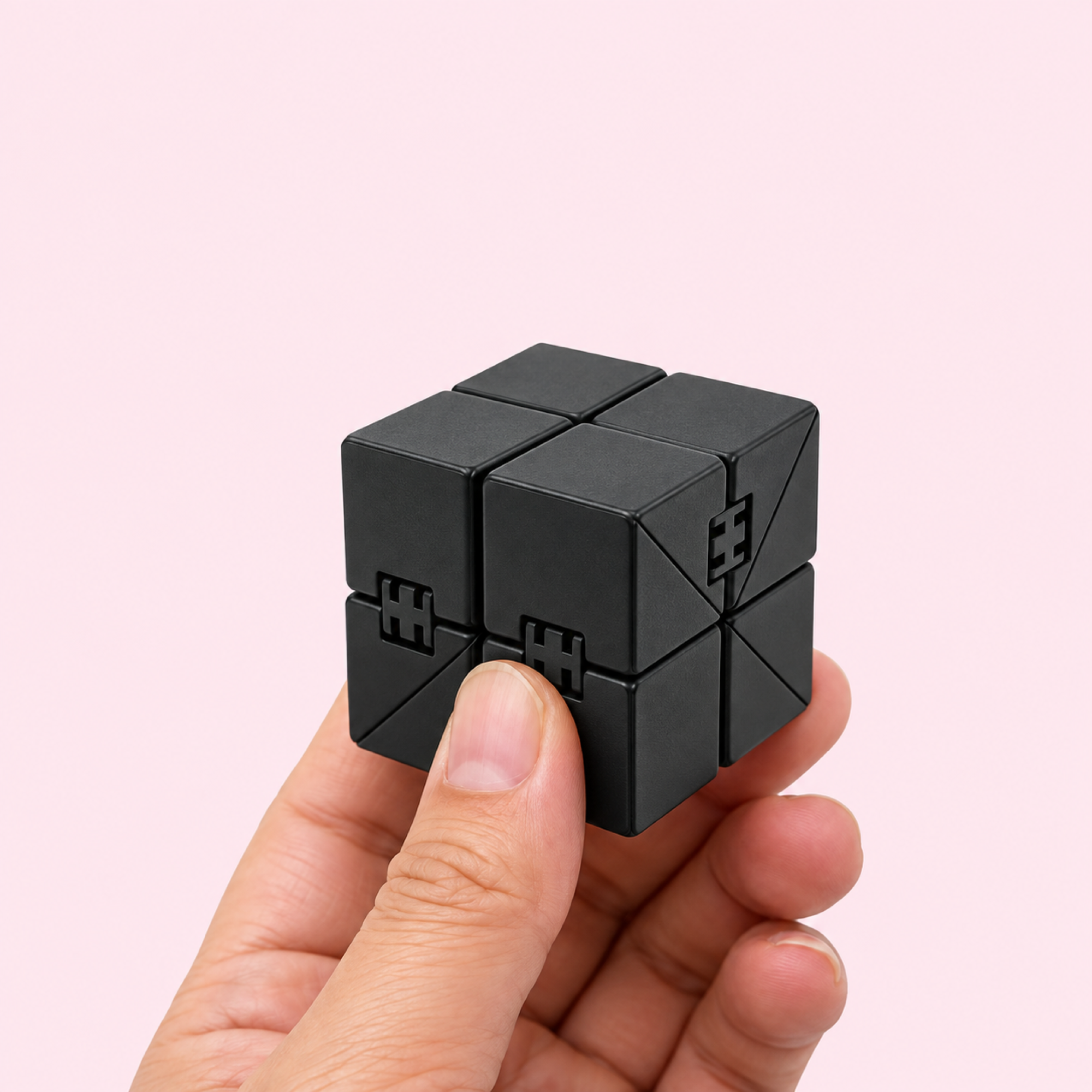
Infinity Folding Cube — linked black segments, the standard folding mechanism.
Hamburger Folding Fidget Cube — the same hinge chain in a shaped body.
Magnetic Fidget Box — panels and magnets instead of hinges, which removes the whole class of faults above.
Browse the fidget cubes range, or all fidget toys if folding has stopped being the action you want.