


Every list of top rated fidget spinners ranks a different set, and they all look plausible, which is the tell. Spin duration depends on the bearing and how hard you flicked; feel depends on mass distribution; a photograph shows neither. What actually separates a good spinner from a bad one takes about ten seconds to establish, and you can run the check on anything — a model you already own, one in a shop, or one that just arrived.
The Four Checks
Listen to the bearing at low speed. Give it a gentle flick, not a hard one, and hold it near your ear. A good bearing is almost silent with a faint even hiss. A bad one produces a grainy whirr that changes pitch unevenly as it slows, which is the sound of balls that are not rolling smoothly in their races. Hard flicks mask this; gentle ones expose it.
Watch for wobble at the end of a spin. Balance problems are invisible at full speed and obvious in the last few seconds. Spin it, rest your elbow on a table so your hand is steady, and watch the outer edge as it winds down. A balanced body slows evenly; an unbalanced one develops a visible rocking motion, and that rocking is what you feel as buzz through your fingers.
Press the centre caps. Hold the spinner still and push each cap with a thumbnail. Any movement at all means it will rattle at speed, and a loose cap is the single most common reason a spinner feels worse than it should. It is also the easiest thing to fix, which is why it is worth checking before blaming anything else.
Check the pinch width against your own hand. The distance between the two caps decides whether the spinner sits comfortably between finger and thumb. Too thin and you cannot flick it cleanly; too thick and your pinch drags on the body. This is entirely personal and it is the variable rankings can never account for.
Four checks, no tools, and they tell you more than any specification list.
Why Rankings of Top Rated Fidget Spinners Disagree
Because they are measuring different things and rarely say which.
Some rank by spin duration, which rewards heavy metal bodies and tells you nothing about how the thing feels to hold. Some rank by build quality, which usually means finish rather than bearing. Some rank by popularity, which is a measure of marketing. All three produce defensible lists with almost no overlap.
The deeper problem is that the bearing — the component that determines most of the experience — varies between individual units of the same model. Two spinners off the same line can differ noticeably, which means a review of one unit is weak evidence about the next. That is not a flaw in the reviews; it is the nature of a mass-produced precision part in a low-cost object.
Your ten-second check works precisely because it tests the unit in front of you rather than the model in the abstract.
What the Checks Mean for Buying
Metal bodies pass the wobble check more often, because a machined or die-cast body has its mass distributed by manufacturing rather than by assembly. They are also heavier, which is a cost rather than a benefit if you carry rather than watch. The full trade-off is in metal fidget spinner vs plastic.
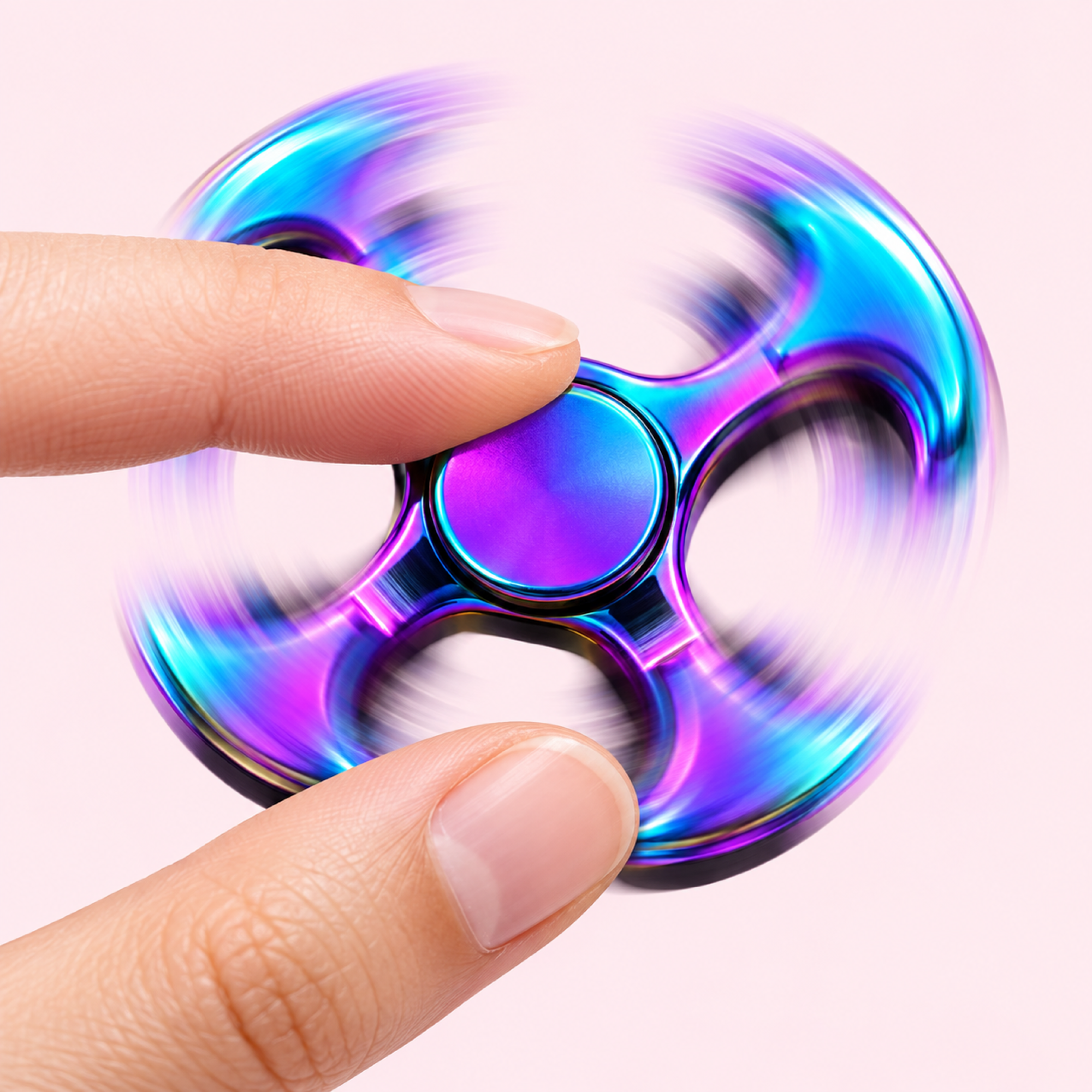
Arm geometry matters more than finish. Two metal spinners with the same weight and different arm shapes feel genuinely different, because where the mass sits changes the gyroscopic resistance when you tilt it. The Metallic Purple Blue Fidget Spinner and the Rainbow Metal Fidget Spinner are both three-arm metal bodies, and the difference between them is in the arms rather than the colour.
Thin fingertip models are a different category, not a worse one. The Purple Cat Acrylic Fidget Spinner at 3 × 3 × 0.5 inches and 35 grams will lose every spin-duration comparison and win every pocket comparison, and the artwork stays readable while it turns, which no opaque body manages.
Where the Category Sits Now
Spinners stopped being a trend and became a component category — a mechanism you buy when rotation is the sensation you want, rather than a thing everyone owns. The history of how that happened is in when did fidget spinners come out, and the practical consequence is that the median spinner on sale today is considerably better than the median one in 2017, because the disposable end of the market died.
If you are choosing between a spinner and something else entirely, the deciding question is whether you want to watch a mechanism or operate one. Our month-on-a-desk ranking sorts the whole range on that basis, and spinners sit in an unusual spot: superb at a private desk, awkward in a shared room because of the visible motion.
Care, in Two Lines
Keep the bearing dry and clear; blow out lint rather than oiling it, because household oil thickens and collects more dust than it displaces. Re-seat the caps if a buzz appears. That is the entire maintenance schedule.
Three Worth Running the Check On
Metallic Purple Blue Fidget Spinner — three-arm metallic body. Start here if you want the gyroscopic weight in the hand.
Rainbow Metal Fidget Spinner — metal body, rainbow finish, visible centre cap. The classic silhouette with the mass where it does the most work.
Purple Cat Acrylic Fidget Spinner — transparent acrylic, 35 grams, three purple cat illustrations around a blue bearing centre. The carry-everywhere option.
See the whole fidget spinners range, or browse all fidget toys if rotation is not the mechanism you are after.