



Searching for a fidget cube custom option turns up two completely different things, and it is worth separating them before spending anything: bulk printed shells for promotional giveaways, and the much smaller question of what an owner can actually change about a cube they already have. The first changes only the outside. The second changes almost nothing, and knowing that saves a lot of disappointment.
What Printing Actually Changes
A printed or engraved shell changes the surface and nothing else. The mechanisms, the frame, the click quality and the layout all come from a standard body that the printer did not design.
That is fine when the object is a giveaway and the point is the logo. It is misleading when it is sold as a bespoke fidget, because two cubes with different artwork are usually the same cube.
It can also make a cube slightly worse. Thick printing over a clicker face stiffens the dome, and a printed film over a slide adds friction to the track. Neither is dramatic, but neither is an improvement.
What Is Fixed at the Factory
The layout. Which six mechanisms you get is decided by the mould, and it is the single thing that determines whether you will enjoy the cube.
Click weight. How hard each clicker is to press comes from the dome, which is part of an internal sheet you cannot reach.
The frame. How definite every face feels depends on the internal chassis, and nothing on the outside changes it — the face-by-face breakdown is in what is inside a fidget cube.
Size. A 2-inch cube and a 5 cm cube are different objects for different hands, and this is a choice made at purchase rather than afterwards.
Fidget Cube Custom Tweaks You Can Genuinely Make
Grip. A thin band of grip tape on two opposite faces changes how the cube sits in a hand more than any styling does, and costs almost nothing.
Which faces you present. Consistently holding a cube the same way up makes your two preferred mechanisms fall under thumb and forefinger. This sounds trivial and is the most effective adjustment available.
Noise, partially. A small felt pad inside the lid of the case you keep it in, or simply a desk mat, removes most of the sound a cube makes — which is contact noise rather than mechanism noise.
Where it lives. The biggest determinant of whether a cube gets used, and the only one entirely within your control.
What About Repainting or Modding One
People do it, and it is worth knowing which parts tolerate it.
The shell takes paint, but every coat that reaches a moving edge adds friction. Mask the clicker domes, the slide track and the gear recess completely, or accept that the mechanisms will feel stiffer afterwards.
Cap and button swaps are not a thing on cubes the way they are on spinners. A spinner’s caps unscrew; a cube’s mechanisms are part of an assembly behind the shell, and opening it is usually a one-way operation.
Replacing a dead clicker dome is not realistic at home. The dome sits on a sheet shared by the whole face, and by the time one has gone soft the others are close behind.
The practical conclusion is that a cube is a buy-right object rather than a modify-later one, which is the opposite of how spinners work.
Custom for a Giveaway
If the actual goal is branded units for an event, the useful advice is about the base rather than the print.
Pick a layout with no gear face. Fine teeth are the most fragile element and the most likely to arrive seized in a bulk run.
Pick a quiet layout if the recipients will use them in offices, which most will. A rocker-and-slide body travels better than a clicker one.
Pick the larger size if the print needs to be legible, and the smaller one if the object needs to be carried. You cannot have both.
And order samples of the exact layout, not just the exact artwork, since the shell you approve and the mechanism you ship are separately sourced more often than you would expect.
The Better Version of “Custom”
For one person, the honest answer is that choosing the right layout beats customising the wrong one, and the choice is wider than it looks.
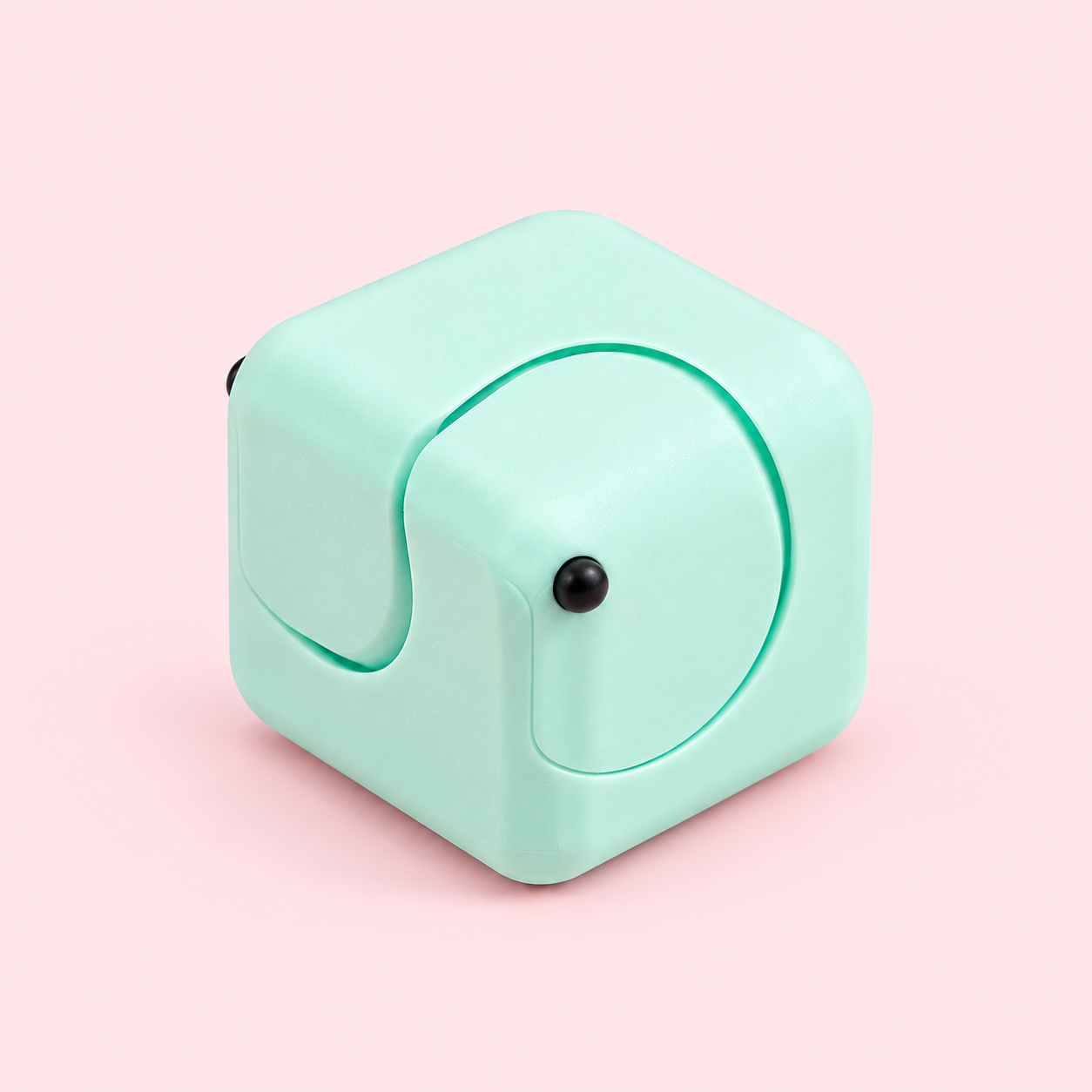
A continuous-mechanism body like the Mint Spin & Slide Fidget Cube at 5 × 5 × 5 cm is a fundamentally different experience from a clicker-led one, and switching between those two is a far bigger change than anything a print could do.
A busy-board layout such as the Blue Gray Busy Fidget Cube spreads more mechanisms across bigger faces, which suits a palm rather than a pocket.
And the classic six-function body, like the White & Pink Six-Sided Fidget Cube at 2 × 2 × 2 in, remains the right answer when you genuinely do not yet know which mechanism you prefer — the full decision is in which kind you actually want, and what the reviews leave out is in what cube reviews never tell you.
Three Layouts Worth Choosing Between
Mint Spin & Slide Fidget Cube — 5 × 5 × 5 cm, continuous mechanisms, the quiet option.
Blue Gray Busy Fidget Cube — 5 × 5 × 5 cm, more mechanisms across larger faces.
White & Pink Six-Sided Fidget Cube — 2 × 2 × 2 in, the classic six-function pocket size.
Browse fidget cubes and infinity cubes, or all fidget toys.