



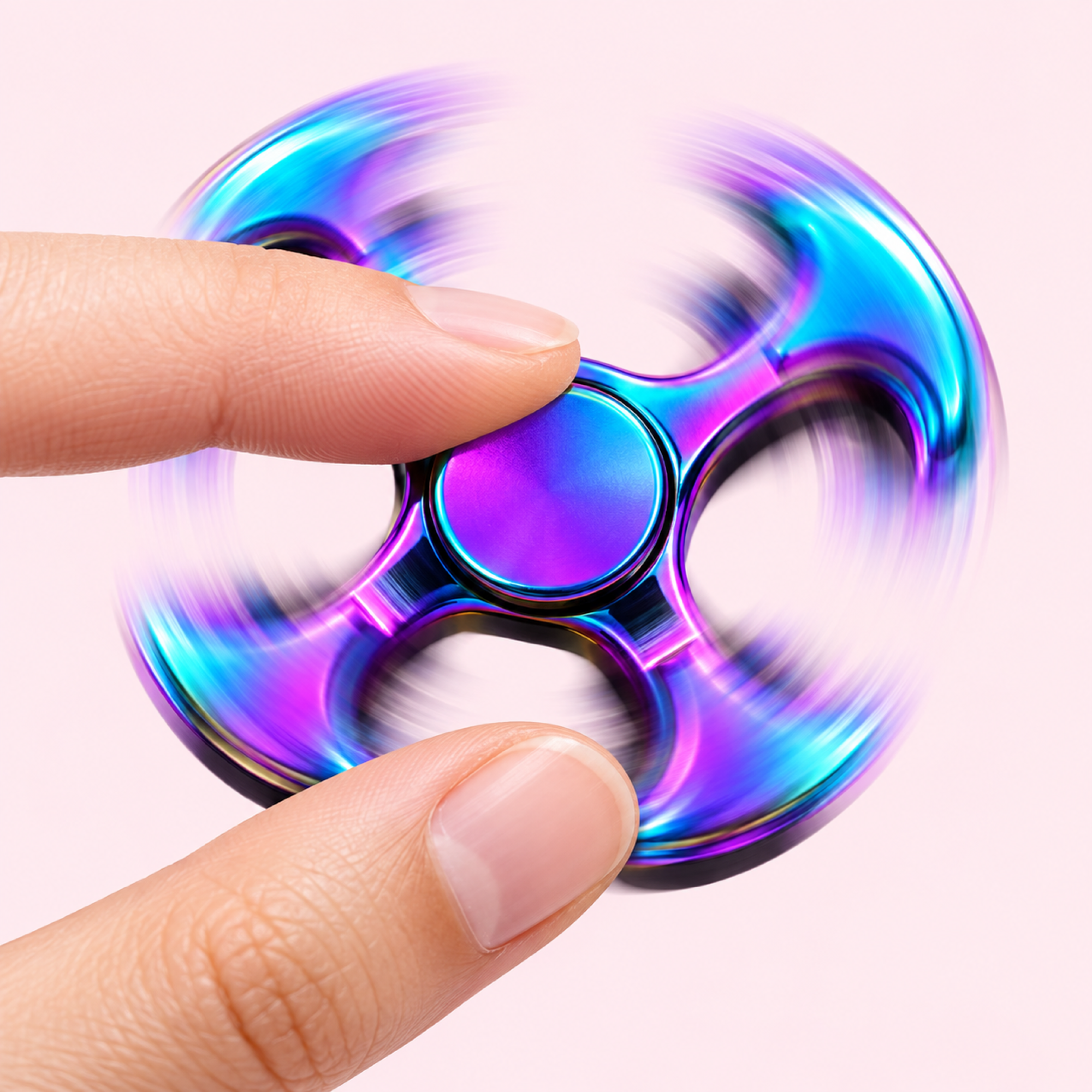
Everything people argue about in this category traces back to one component. Spin duration, noise, smoothness, and whether a spinner still feels good in a year are all decided by the fidget spinner bearing at the centre — a part that costs a fraction of the object, is almost never specified on a listing, and varies between individual units of the same model. Understanding what it is makes every other decision about spinners straightforward.
What a Fidget Spinner Bearing Actually Is
A ring of small steel balls held between an inner race and an outer race, with a cage keeping the balls evenly spaced. The inner race grips the centre post you hold; the outer race is fixed to the spinner body. When you flick it, the body rotates around the stationary inner race, and the balls roll rather than slide, which is why there is so little friction.
The size most commonly used is the 608 — an eight-millimetre bore, twenty-two-millimetre outer diameter, seven millimetres wide. It is the same bearing used in skateboard wheels, which is the reason spinners became easy to make: the critical component was already mass-produced and cheap everywhere.
That standardisation is also why bearings are the most replaceable part of a spinner, and why a spinner with a dead bearing is repairable rather than disposable.
Why Bearings Sometimes Sit in the Arms
A frequent question, and the answer is not what people assume.
Those are usually not bearings. In most three-arm designs the discs pressed into the arm ends are weights, there to put mass at the rim where it does the most for spin duration. They are often bearing-shaped because bearing-shaped steel discs are cheap and the right size.
Some designs do use real bearings as arm weights, and a few let them spin freely so they add a secondary sensation. But the central bearing is the only one doing mechanical work, and the arm discs are there for mass distribution — the physics covered in metal fidget spinner vs plastic.
Shields, Cages and What They Change
Shields and seals. Most bearings arrive with metal shields or rubber seals over the balls. Seals keep contamination out and add drag; shields add less drag and let more dust in. Removing them increases spin time and shortens bearing life, which is a trade enthusiasts make deliberately and most people should not.
Cage material. Steel cages are durable; nylon cages are lighter and quieter. Ceramic hybrids use ceramic balls in steel races, which reduces friction and increases cost.
Lubricant. Bearings ship packed with grease for longevity, and grease is thick. A spinner bearing straight from the factory spins less freely than it will after some use, because the grease redistributes. Some people degrease entirely for maximum spin, at the cost of much faster wear.
The honest summary: factory condition favours durability, and every modification that increases spin time decreases lifespan.
Contaminated or Worn: How to Tell
This matters because one is fixable and one is not.
Contamination feels inconsistent — the spin is smooth for part of a revolution and gritty for part of it, and it may change if you spin it again. It sounds like a fine rasp. It usually appears suddenly, after the spinner has been in a pocket or a bag.
Wear feels consistent — evenly rough all the way round, every time. It sounds like a low even whirr. It appears gradually over months.
Contamination clears. Wear does not, and at that point the bearing is the thing to replace rather than the spinner.
Clearing a Contaminated Bearing
Blow it out with compressed air while spinning it slowly. This alone fixes most cases, because the usual contaminant is pocket lint rather than grit.
Do not add household oil. Thin oils displace the factory grease and then collect dust faster than before, so the spinner improves for a week and gets worse than it started.
If the bearing is genuinely gritty with hard particles, the enthusiast route is removing the shields and cleaning the races in solvent, then re-lubricating with a proper bearing oil. That is a real repair with real results and it shortens the bearing’s life; it is worth it for an expensive body and not for a cheap one.
The full ten-second diagnostic for a spinner you are considering buying is in how to judge a spinner in ten seconds.
Why This Explains the Price Question
Bearing grade is the single cost driver that changes what you feel, and it is invisible. That is why two spinners that look identical can differ, why reviews of individual units are weak evidence about the next unit, and why the sensible approach is to test the object in your hand rather than trust a specification. The rest of the cost breakdown is in what you’re actually paying for.
Replacing One
Because the 608 is a standard part, swapping it is the most worthwhile repair in the whole fidget category.
The centre caps come off first — usually press-fit, occasionally threaded. Then the bearing presses out, typically with thumb pressure against a hard surface or a gentle tap. A replacement presses in the same way, and it should go in square: a bearing forced in at an angle will never run true, which produces exactly the wobble people blame on balance.
Two cautions. Press on the outer race when fitting, never on the inner one, because pressure through the balls damages the races. And check the seat is clean before fitting, since a fragment of old grease under the bearing tilts it.
If a body is worth keeping, this repair is worth doing once. If it is not, it never was the bearing’s fault that you stopped picking it up.
Three Bodies Built Around a Standard Bearing
Metallic Purple Blue Fidget Spinner — three-arm metal body with rim weights and a central bearing.
Rainbow Metal Fidget Spinner — metal body with a visible centre cap, the part to check first when a buzz appears.
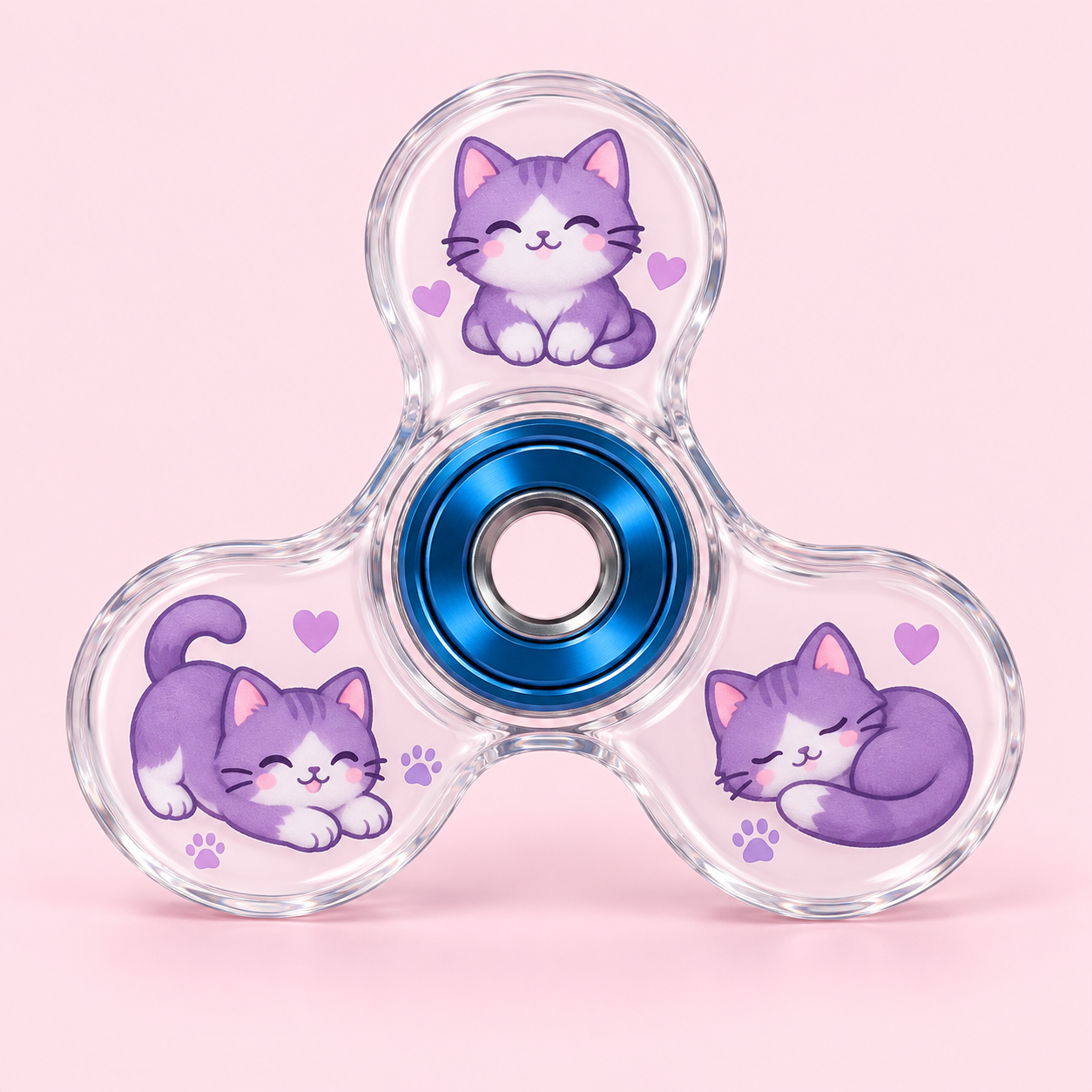
Purple Cat Acrylic Fidget Spinner — a transparent 35-gram body where you can actually see the bearing centre while it runs.
Browse the fidget spinners range, or see all fidget toys if rotation is not the action you want.