


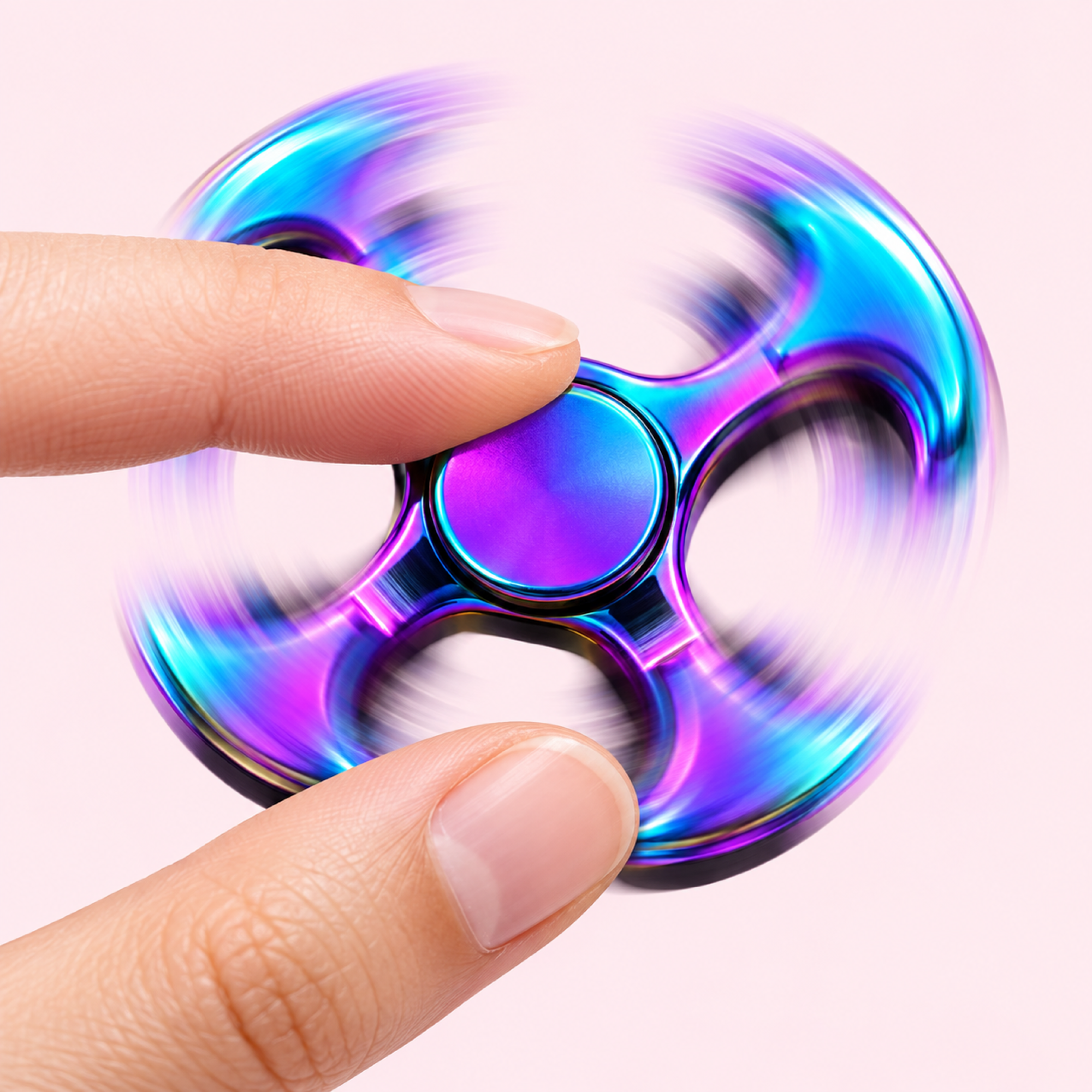
Search the model repositories and you will find thousands of designs, which makes it look like a solved problem. It is not quite, and the reason is structural: a 3D printed fidget spinner is a printed body wrapped around a bought bearing. The part that determines almost everything about how a spinner feels is the one part your printer cannot make, and knowing that up front changes the maths on whether to print or buy.
What You Are Actually Printing
A spinner has three functional elements and a printer handles exactly one of them well.
The body is printable and prints nicely. Three lobes, a centre hub, a couple of press-fit recesses — geometry a hobby printer handles without drama, in any colour or shape you want. This is the real argument for printing: total freedom over the silhouette.
The bearing is not printable in any meaningful sense. It is a precision assembly of small metal balls rolling between machined races, with tolerances no filament printer approaches. Every printed spinner uses a purchased bearing, usually a standard skate-type unit press-fitted into the hub.
The mass is the problem nobody mentions. Spin duration comes from rotational inertia, which depends on mass sitting far from the centre. Filament is light. A printed body has a fraction of the rim mass of a metal one, so a printed spinner spins noticeably shorter unless you add weights — and once you are press-fitting metal slugs into the lobes, you are assembling rather than printing.
Can You Print a 3D Printed Fidget Spinner, and What Does It Cost
Yes, and the filament cost is genuinely trivial — a spinner body is a few grams of plastic and a few tens of minutes of print time. That number is the one usually quoted, and it is misleading in two directions.
It omits the bearing, which has to be bought, and which arrives in a pack. It also omits the failure rate: press-fit tolerances for bearings are the fiddliest part of the model, and a hole printed a hair too tight cracks the hub while a hair too loose leaves the bearing spinning in its seat. Most people print two or three before one seats properly.
The honest framing is that printing a spinner costs very little money and a real amount of attention. If you enjoy that attention, it is a good project. If you want a spinner, it is a detour.
Where Printed Bodies Genuinely Win
Shapes nobody manufactures. A commissioned silhouette, a logo, a shape sized to a specific hand — no factory will do that for one unit and a printer will.
Replacement parts. If a commercial spinner cracks a lobe, a printed replacement body around the salvaged bearing is a legitimate repair.
Prototyping a feel. If you are unsure whether you want a two-lobe bar or a three-lobe body, printing both in an afternoon answers that question faster than buying both.
The general case for printed fidgets — which mechanisms print well and which sensations they cannot deliver — is covered in our 3D printed fidget toys guide, and it reaches the same conclusion from the other direction: printers are excellent at articulation and poor at everything involving give, mass or precision rotation.
Where Bought Wins
Layer lines are permanent. Every printed part has a fine corduroy texture where each layer fused to the next, and a spinner is held between two fingertips — the two most texture-sensitive places on your hand. Sanding helps and never fully removes it. An injection-moulded or machined body is smooth in a way a print is not.
Balance is a manufacturing problem. A spinner whose lobes differ slightly in mass wobbles at speed, and print variation is enough to cause it. Commercial bodies are moulded from one cavity, so the lobes are identical by construction.
Mass at the rim is structural. This is the big one. A metal body like the Metallic Purple Blue Fidget Spinner puts real weight where it does the most work, and no printed body reaches that without added hardware. The full trade-off between metal and light bodies is in metal fidget spinner vs plastic.
Finish survives pockets. Anodised and plated surfaces scuff; printed plastic scratches and eventually goes furry at the corners.
Why Printed Spinners Persist Anyway
Because the appeal was never really about the spin. The reason spinner models remain among the most downloaded objects on model sites is that a spinner is an ideal first functional print: small, fast, uses a mechanism, and produces something that visibly works when you are done. It is a calibration exercise with a toy at the end, and that is a completely valid reason to print one.
Just do not expect the result to displace a good bought one on your desk. In practice the printed one gets shown to people and the bought one gets used, which is the same split that decides which fidget stays out and which goes into a drawer.
The Practical Recommendation
Print if you want the shape, the project, or a repair. Buy if you want the spin.
If you are buying and unsure where to start, the deciding question is whether you watch the spin or just flick it — a heavy metal body for the first, a thin light one for the second.
Three Bought Bodies Worth Comparing Against a Print
Metallic Purple Blue Fidget Spinner — three-arm metallic body. The balance and rim mass a printed body cannot match without added hardware.
Rainbow Metal Fidget Spinner — metal body with a rainbow finish and a visible centre cap, the classic silhouette.
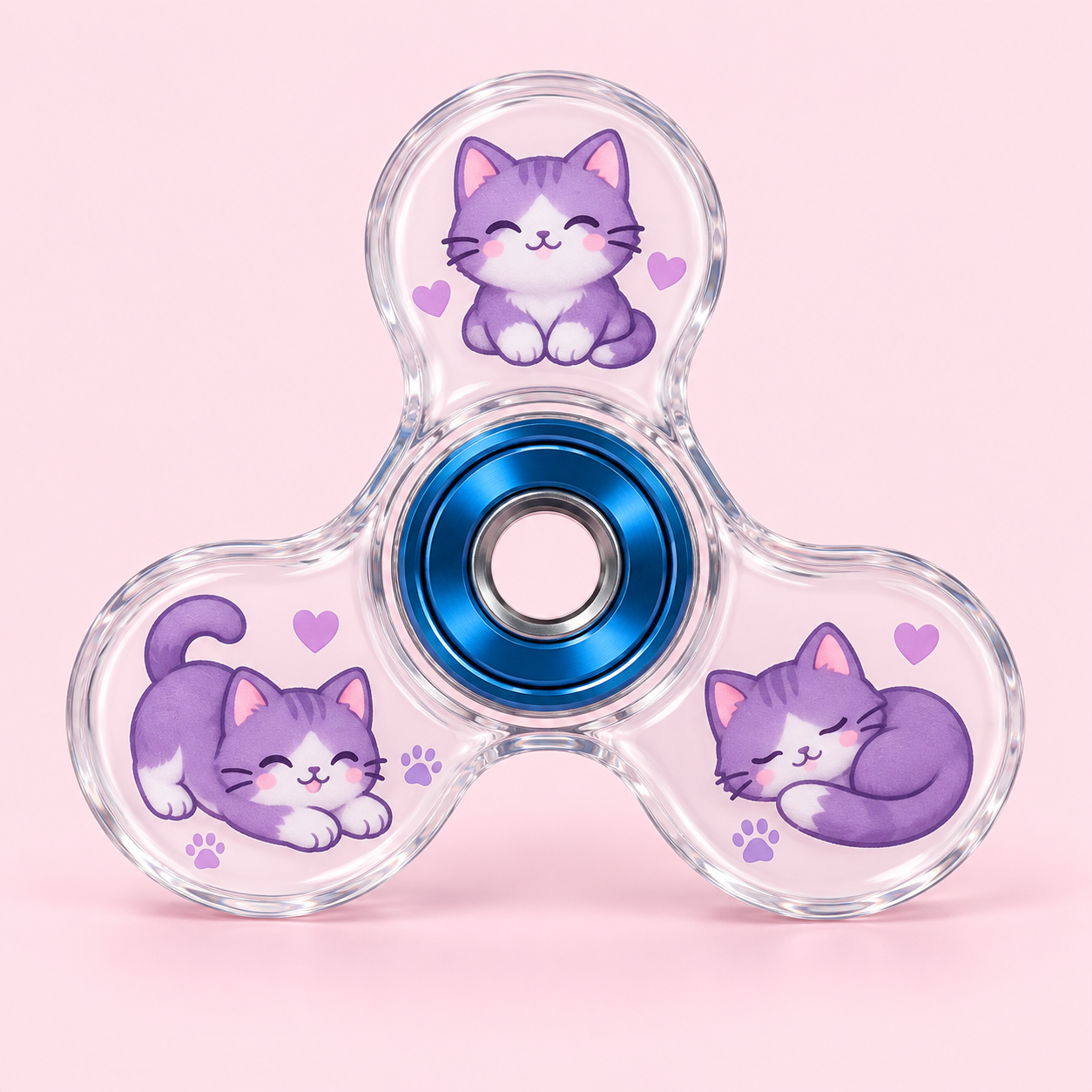
Purple Cat Acrylic Fidget Spinner — transparent acrylic at 3 × 3 × 0.5 inches and 35 grams, with artwork that stays readable while it turns. The closest commercial equivalent to a light printed body, done smoothly.
See the whole fidget spinners range, or browse all fidget toys if a spinner is not the mechanism you are after.