




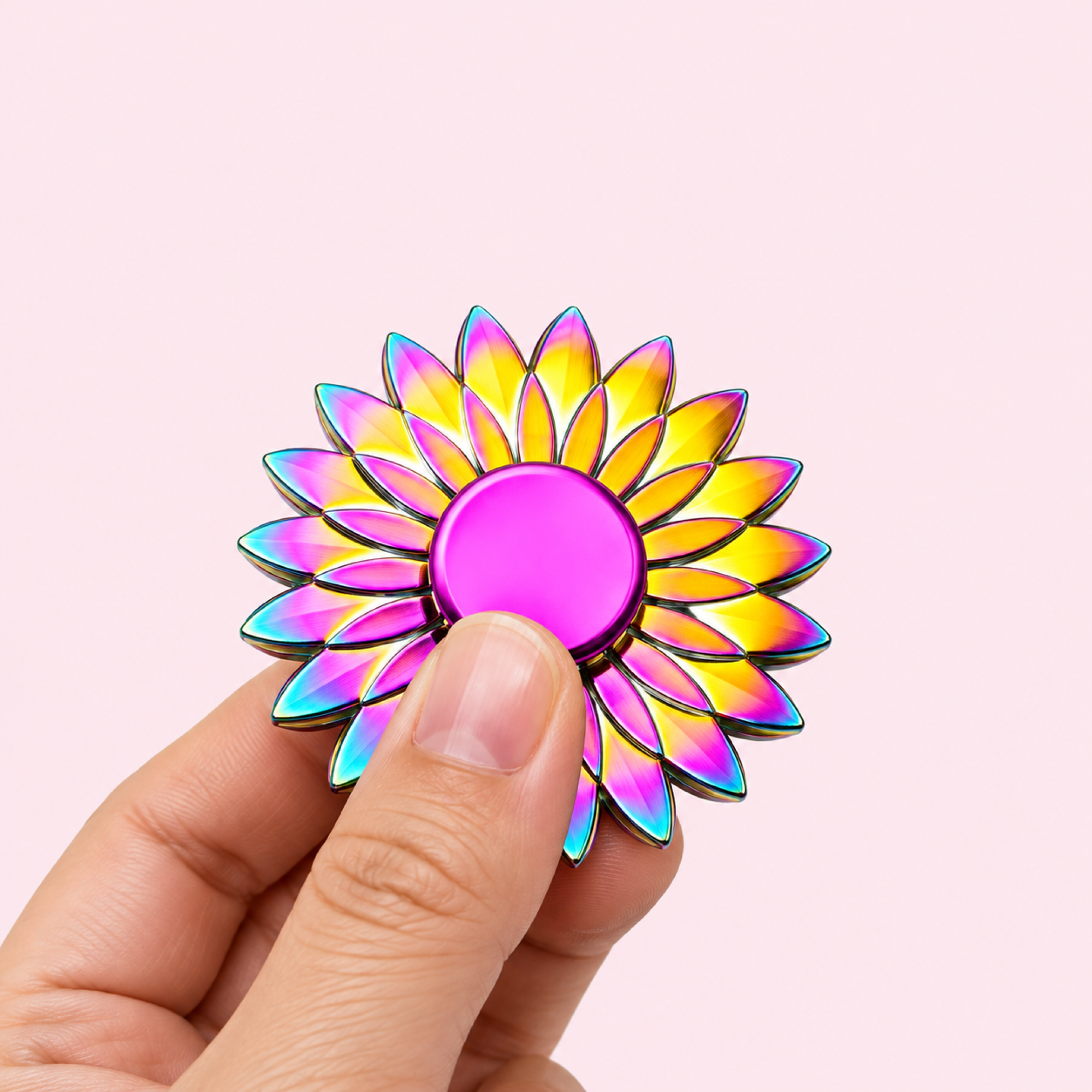
A fidget flying spinner is a motorised flying toy — a rotor inside a protective cage that launches from your hand and hovers, usually with an infrared sensor that keeps it aloft when a hand passes underneath. It shares a word with the desk spinner and essentially nothing else: different mechanism, different power source, different room, different failure modes.
What It Actually Is
Inside the cage is a small brushless or brushed motor, a lithium cell and an IR proximity sensor. The rotor lifts the object; the sensor bounces it away from obstacles so it stays up.
It is not a fidget in any useful sense. You cannot hold it while it runs, it needs both hands and open space, and it demands full visual attention — the opposite of everything a desk fidget is for.
The confusion is a naming artefact. When hand spinners were everywhere, flying toys were branded as spinners to ride the search traffic, and the name stuck.
What Decides Whether a Fidget Flying Spinner Is Any Good
Charge time against flight time. The real number is the ratio. Thirty minutes of charging for six minutes of flight is normal and is what most complaints are actually about.
Cage strength. These hit walls, ceilings and furniture constantly. A cage that deforms on the third impact puts the rotor in contact with whatever it hits next.
Sensor consistency. Cheap sensors trigger unevenly, so the toy drifts in one direction and needs constant chasing.
Whether the battery is replaceable. On most it is not, and a sealed lithium cell in a toy this size is the component that ends the object’s life — usually inside a year.
Where It Belongs
Outdoors on a still day, or in a room with high ceilings and nothing breakable. That is a narrow set of conditions and it explains why so many of these are used twice.
It is emphatically not a desk object, a classroom object, or something to take on a plane. Lithium cells and flying toys are both awkward in hand luggage, and neither has any use in a seat.
Nor is it a quiet toy. A rotor at speed is louder than any mechanical fidget, which rules out every shared-room use case that makes desk fidgets worth owning — the sound comparison for actual spinners is in where spinner noise comes from.
How They Fail
Three failures account for almost all of them, and all three are predictable from the design.
The rotor catches hair or fabric. The cage keeps fingers out and does not keep long hair out. A caught rotor stalls the motor, and a stalled brushed motor in a toy this size burns out quickly.
A hard landing bends the cage. Once the cage is out of round it touches the rotor, and from that point the toy runs rough and drains faster.
The cell stops holding charge. Small lithium cells in toys are rarely protected properly, get charged from flat repeatedly, and lose most of their capacity inside a year. Since the cell is usually sealed in, that is the end of the object.
None of these is a manufacturing defect you can shop around. They are what the format is, which is worth knowing before rather than after.
If You Wanted a Fidget
Most people searching for this want one of two things, and neither is a flying toy.
Something that spins in the hand. That is a desk spinner, and the geometry that suits you is sorted in types of fidget spinners. A Rainbow Metal Fidget Spinner gives the long decay and gyroscopic push-back that people remember from the original wave.
Something with movement you watch. A spinner does that too, and it does it without a battery, a charge cycle or a cage. The trade-offs of watching rather than feeling are in the honest answer on spinners and focus.
If what you want is genuinely a flying toy, buy it from a toy or hobby retailer where the battery and cage specifications are listed properly. It is a different product category and it deserves a shop that treats it as one.
Why We Do Not Stock Them
Anything with a sealed lithium cell is a different business: it needs battery shipping compliance, a returns process built around a component that degrades on a schedule, and honest flight-time claims that most suppliers will not make.
It also fails the test every object in this range has to pass, which is that it should be usable in a hand, in a room with other people, without anyone noticing. A flying spinner fails all three parts of that.
So this is a format we can explain and would not sell, which seems more useful than pretending otherwise.
What to Buy Instead
Rainbow Metal Fidget Spinner — mass and a long run-down, no battery, no cage, no charge time.
Metallic Purple Blue Fidget Spinner — three-arm body with strong gyroscopic resistance.
Purple Cat Acrylic Fidget Spinner — 35 g, 3 × 3 × 0.5 in, the pocketable end of the same idea.
Browse fidget spinners, or all fidget toys.