



Look at a fidget cube inside its packaging and it is easy to read the six faces as decoration on one object. They are not. Each face is an independent mechanism with its own action, its own noise level and its own way of wearing out, and the reason cubes feel so different from one another is that manufacturers pick a different six.
The Six Faces, One at a Time
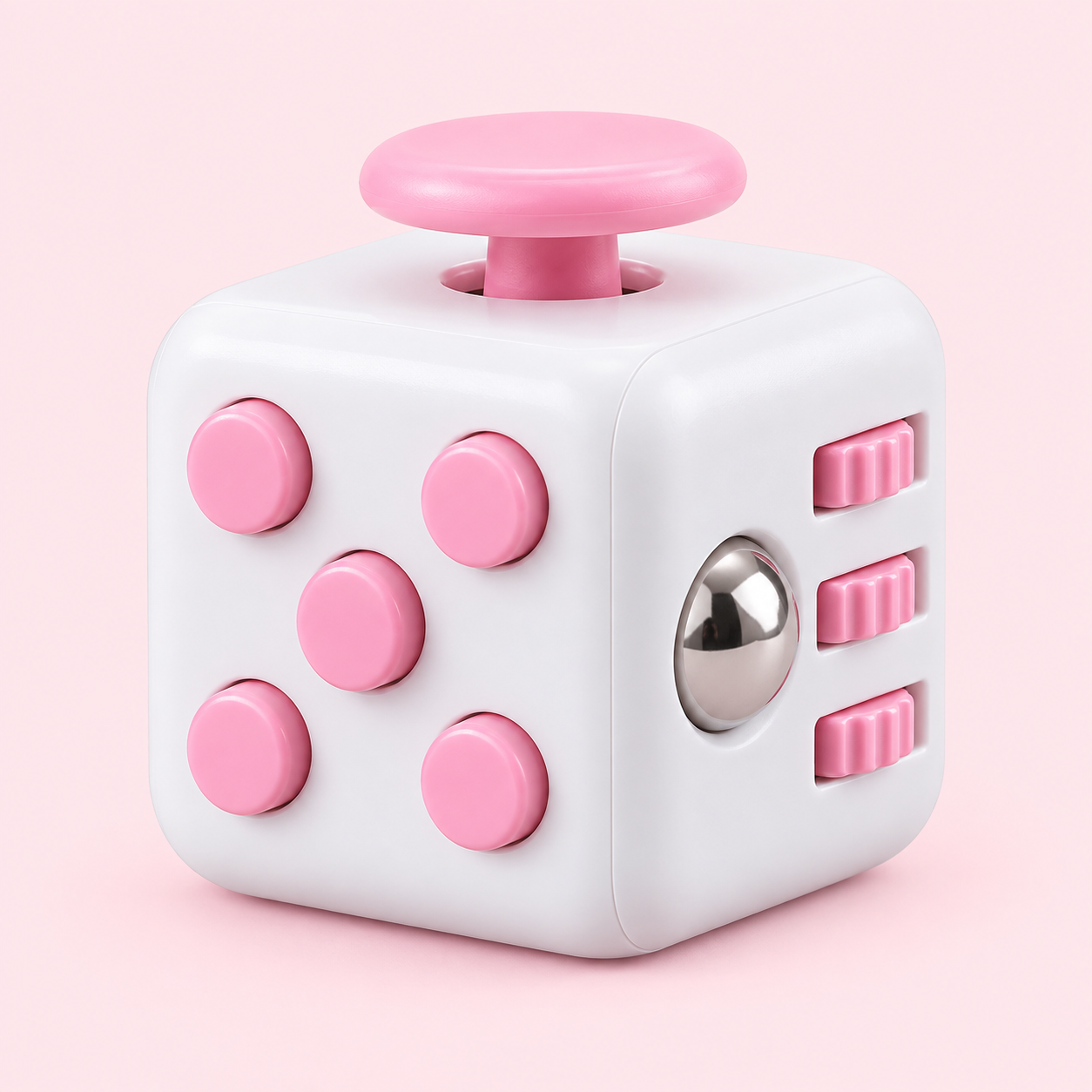
Clicker buttons. Usually five, arranged like a dice face, with two or three of them silent and the rest clicky. The most-used face on almost every cube, and the loudest.
A rocker switch. A small paddle that flips side to side with a hard stop at each end. Quiet, low-effort, and the face people reach for in meetings.
A rolling ball or dial. A captured sphere or wheel that spins in a recess. Continuous rather than discrete, which makes it the only face that gives you sustained motion.
A glide or slide. A plate that travels along a track with a soft detent. Silent by design.
A rotating gear or disc. A toothed wheel set flush into the face. Tactile, faintly audible, and the most fragile of the six.
A worry stone dish. A shallow concave depression with no moving part at all, meant for a thumb to circle. The White & Pink Six-Sided Fidget Cube at 2 × 2 × 2 inches follows this layout closely.
Which Faces You Actually Use
Watch anyone with a cube for ten minutes and the pattern is consistent: two faces get almost all the use and the other four are there for the first week.
The clicker face wins on feedback. It is the most definite action on the object and the one your thumb finds without looking.
The rocker or glide wins on room compatibility, which is to say it is what you switch to when the clicker becomes a problem for the people around you.
This is worth knowing before you buy, because it means the quality of two faces matters far more than the presence of six. A cube with a mushy clicker and a perfect gear is a bad cube.
Fidget Cube Inside: What Breaks First
The gear face. Fine teeth, thin plastic, and a mechanism that binds as soon as anything gets into it. This is the face most likely to seize.
The clicker domes. Each click is a small dome collapsing and rebounding, and after tens of thousands of presses the dome softens and the click goes dead. The mechanism still moves, it just stops feeling like anything.
The seams. A cube is two shells around an internal frame. Drop it on a hard floor at the wrong angle and the shells part, which is not repairable at home.
Never the worry-stone dish, because there is nothing there to break, which is a useful reminder that the simplest face outlasts the rest.
Six Faces or Fewer
Not every cube uses the full set, and fewer is often better executed.
A spin-and-slide format drops the clicker entirely in favour of two well-made continuous mechanisms, which is what the Mint Spin & Slide Fidget Cube at 5 × 5 × 5 cm is for, and it is a completely different object from a six-function cube despite the same outline.
A busy-board style cube spreads more mechanisms across larger faces — the Blue Gray Busy Fidget Cube shares those dimensions and takes that route.
The larger 5 cm format matters more than the mechanism list, incidentally. A 2-inch cube is a pocket object you work with one hand; a 5 cm cube sits in a palm and uses both.
How It Compares With an Infinity Cube
They share a name and almost nothing else. A six-sided cube is a collection of small mechanisms; an infinity cube is eight linked blocks that fold endlessly, with one continuous action and no buttons at all.
The fold is smoother and quieter, and it never goes dead the way a clicker dome does. What it lacks is variety — one motion, repeated.
If the folding format is what you are actually picturing, the object is explained in what an infinity cube is, and the material question for that format is covered in metal against plastic.
What to Check Before Buying
Press every clicker on the face and listen for one that sounds different from the others. A mismatched dome means a mismatched batch.
Rock the switch fully both ways and feel for a hard stop. A rocker without a defined end position feels vague forever.
Spin the ball or dial and check it does not catch at one point in its travel. A catch is a moulding flaw and it will not wear smooth.
Hold the cube at its seam and squeeze gently. Any flex there means the shells are not properly bonded, and that is the one fault that ends the object rather than a face — the wider buying decision is in deciding which kind you want.
Why Two Cubes Feel Nothing Alike
The mechanism list explains most of it, but not all. Two cubes with an identical six-face layout can still feel completely different, and the reason is the frame rather than the faces.
Everything on a cube is mounted to an internal chassis. A rigid chassis transmits each click as a clean, isolated event; a flexible one lets the whole shell absorb some of it, and the click arrives muffled and slightly late.
You can feel this without opening anything. Hold the cube loosely and press a clicker: on a well-framed cube the sound and the feeling arrive together, and on a poorly framed one the body flexes first.
That is also why weight is a reasonable proxy at this size. A cube that feels dense for its dimensions usually has more structure inside, and more structure is what makes every face feel definite.
Three Layouts to Compare
White & Pink Six-Sided Fidget Cube — 2 × 2 × 2 in, the classic six-function layout in a one-hand size.
Mint Spin & Slide Fidget Cube — 5 × 5 × 5 cm, continuous mechanisms instead of clickers.
Blue Gray Busy Fidget Cube — 5 × 5 × 5 cm, more mechanisms spread across bigger faces.
Browse fidget cubes and infinity cubes, or all fidget toys.