


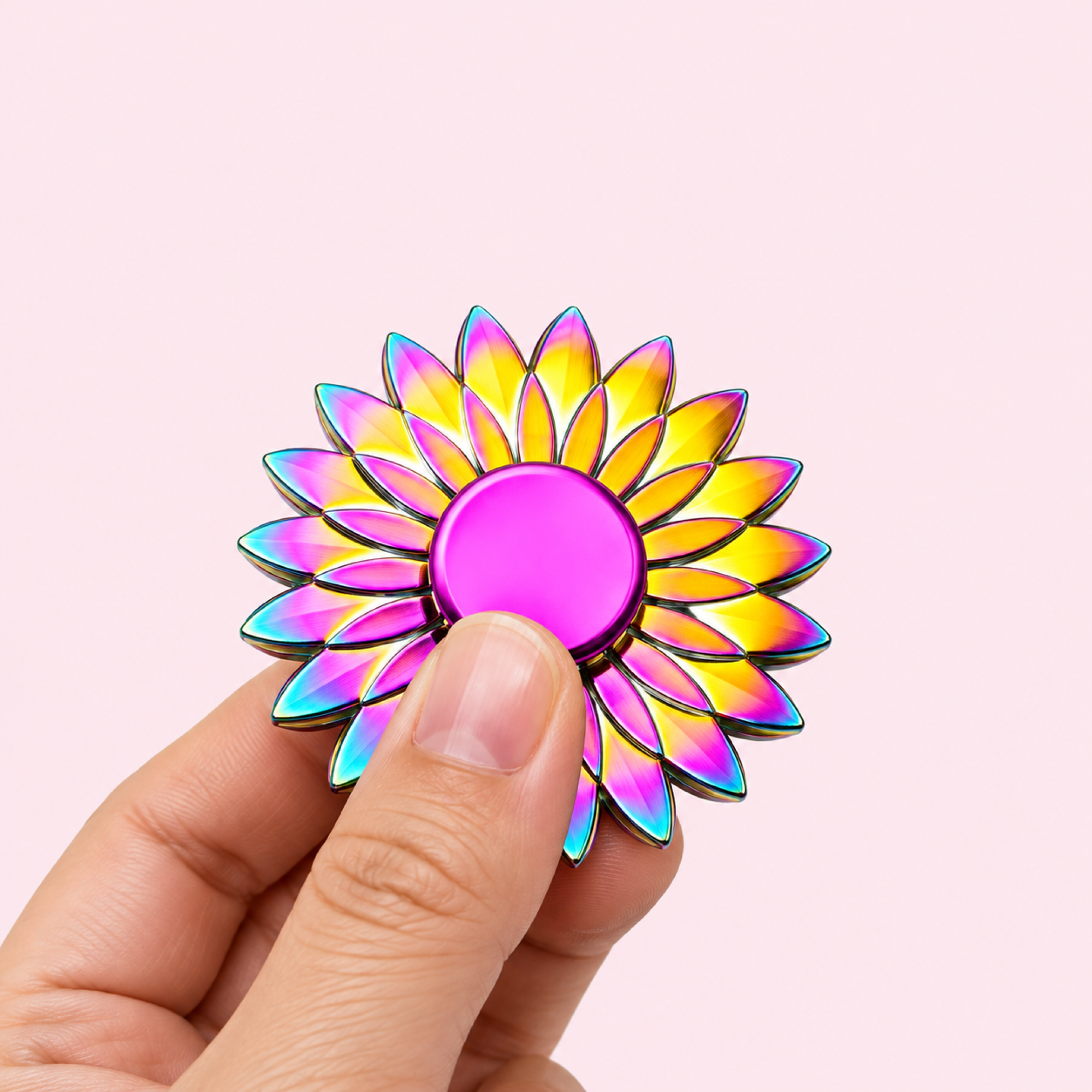
Almost every other fidget is judged at rest. A spinner is judged in motion, and motion is brutal to decoration: at speed your eye stops seeing a pattern and starts seeing the average of that pattern smeared into a ring. A rainbow fidget spinner looks spectacular in a photograph for exactly the reason it can look disappointing in your hand, and the difference between finishes that survive rotation and finishes that do not is predictable.
What Rotation Does to a Pattern
Your visual system integrates anything moving faster than it can track, so a spinning body becomes a set of concentric rings, each ring showing the average colour at that radius.
That has three consequences.
Colours that vary around the body blend into one tone. Three arms in red, blue and yellow do not read as three colours at speed; they read as a single muddy ring, because the eye is averaging them.
Colours that vary along the arm survive. A gradient from hub to tip stays visible while spinning, because each radius keeps its own colour and the rings do not mix.
Fine detail disappears entirely. Text, small motifs and thin lines are gone the moment it moves.
The practical rule: decoration that runs outward from the centre survives rotation, and decoration that runs around the centre does not.
Why a Rainbow Fidget Spinner Finish Holds Up Better Than Most
Iridescent and rainbow plating. These work unusually well in motion, because the colour shift comes from viewing angle rather than from pattern. As the body turns, the whole surface cycles through hues at once rather than blending to grey. The Rainbow Metal Fidget Spinner has this quality — the finish is doing something at speed rather than only at rest.
Two-tone metallic bodies. A body that shifts between two related tones, like the Metallic Purple Blue Fidget Spinner, holds its identity because the two colours are close enough that averaging them produces a third colour rather than mud.
Transparent bodies with through-printed artwork. The genuine exception to the detail rule. A clear body lets you see the artwork on both the near and far side at once, and the overlap produces a moving pattern rather than a blur. The Purple Cat Acrylic Fidget Spinner uses three cat illustrations around a blue bearing centre, and the reason you can still tell they are cats at speed is that the transparency keeps them layered rather than smeared.
Bare metal. Nothing to blur. A brushed or polished body is the same object spinning or still, which is why it is the default at the enthusiast end.
What Does Not Survive
Multi-colour arms in contrasting colours. The most common design mistake in the category, and the one that photographs best.
Logos, text and small characters. Present at rest, absent in use.
Glitter under an opaque surface. It sparkles when still and averages out when moving.
Anything where the appeal depends on recognising a shape. A shaped spinner is a still-life object that happens to rotate.
Choosing Between Looking and Using
This is the honest decision, and it is worth making consciously.
If the spinner will sit on a desk and be picked up occasionally, buy for how it looks at rest. Shape, character and fine detail are all worth having, and you will see them most of the time.
If it will be spun constantly, buy for how it behaves in motion. Iridescence, radial gradients and transparency are the three properties that reward that, and they are not the ones that photograph best in a listing.
If you want both, transparency is the only finish that genuinely delivers at rest and in motion.
The same trade-off between decoration and function runs through the whole category, and the wider version — where a character shape costs you something mechanical — is in cute fidget toys that still work.
How a Finish Ages on a Spinner
A spinner is held between two fingertips and flicked, so the wear is concentrated in two places: the centre caps and the leading edge of each arm.
Plated finishes, which include most rainbow and iridescent bodies, wear at exactly those points first. A chip on an arm edge is visible at rest and invisible in motion, so the object keeps working and starts looking older. The material-by-material breakdown is in which finishes survive a pocket.
Transparent acrylic scratches rather than chips, and fine scratches on a clear body scatter light in a way that gradually dulls the artwork underneath.
Anodised and bare metal age most gracefully and start least interesting, which is the usual trade in this category.
A Quick Way to Test This Yourself
You do not need to own several spinners to see the effect.
Take any patterned object you can spin — a bottle cap with a label, a coin, a fidget you already have — and give it a hard flick on a smooth surface. Watch what happens to the pattern. Anything that varies around the axis goes to a flat average; anything that varies from centre to edge stays legible as rings.
Then do the same with a spinner in your fingers and look at it from directly in front rather than from the side. Face-on is how you actually see a spinner in use, and it is the view in which around-the-axis decoration vanishes most completely.
Most people who run this once stop buying multi-colour arms.
Three Finishes to Compare in Motion
Rainbow Metal Fidget Spinner — plated iridescence that keeps changing while it turns, with a visible pink centre cap.
Metallic Purple Blue Fidget Spinner — two close tones that average into a third rather than into grey.
Purple Cat Acrylic Fidget Spinner — transparent acrylic at 3 × 3 × 0.5 in and 35 g, where the artwork layers instead of blurring.
See the whole fidget spinners range, and if you want to check the mechanics before the looks, run the checks in how to judge a spinner in ten seconds.