


Most trick guides are lists of names with a video attached and no explanation, which is why people watch five and learn none. Fidget spinner tricks are all built from the same three variables — how fast it is turning, where its mass sits, and how much friction there is at the contact point — and once you can see those, an unfamiliar trick becomes something you can reason about instead of copy.
The Three Variables
Angular momentum. How much rotation the spinner is carrying. More of it means the spinner resists being tilted, which is what makes balancing and transferring possible at all. A slow spinner will not balance, no matter how steady your hand.
Where the mass sits. Weight at the rim gives strong gyroscopic resistance and long spins — good for balance tricks. Weight near the hub makes a spinner more responsive to being thrown and caught, because it changes direction more willingly. The full trade-off is in metal fidget spinner vs plastic.
Friction at the contact point. Every trick involves the spinner resting on something: a fingertip, a fingernail, a table. Less contact area means less friction and a longer trick, which is why balance tricks are done on a fingernail rather than a fingertip.
The Fastest Way to Start One Spinning
Worth covering first because most people never learn it properly.
Pinch the centre caps firmly between thumb and middle finger, then flick an arm with your index finger — not a push, a snap released from tension. The energy comes from the finger uncoiling, not from the arm sweeping.
The common mistake is gripping the caps too tightly, which drags the inner race and eats most of the input. Hold firmly enough that the spinner cannot escape and loosely enough that it can turn freely, which takes a few attempts to find.
For maximum speed, people use a table: hold the spinner flat against a surface and flick an arm repeatedly, adding energy to a spin that is already going. That is also the honest answer to how the longest recorded spin times are achieved — repeated inputs and a very low-friction bearing, not a single heroic flick.
Fidget Spinner Tricks, and Why Each One Works
Finger transfer. Move the spinning spinner from one finger to another. It works because gyroscopic resistance holds the plane of rotation steady while your hand moves around it. Needs a fast spin and a light touch; the transfer is a handover, not a grab.
Nail balance. Rest the running spinner on a fingernail. Works because a nail is a small, hard, low-friction surface. Fails when the spin has decayed below the point where it resists tilting.
The throw and catch. Throw the spinner upward, keep it turning, catch it. This is the one where hub-weighted bodies do better, because they tumble less predictably when rim-weighted. It is also the trick most likely to end with a dented floor and a chipped finish — which is a real cost with plated bodies, as covered in which finishes survive a pocket.
Table spin. Stand it on its edge or on a cap and let it run on the surface. Works on smooth hard surfaces and dies instantly on soft ones; the friction variable doing all the work.
Hand-to-hand pass. The same physics as the finger transfer over a longer distance, so it needs a faster spin to survive the journey.
Which Spinner Suits Which Trick
Heavy rim-weighted metal bodies are best for balance and transfer, because they carry momentum and resist tilt. They are worst for throws, because they hit harder and mark more.
Light bodies are best for throws and catches and worst for balance, since they slow too quickly to stay stable.
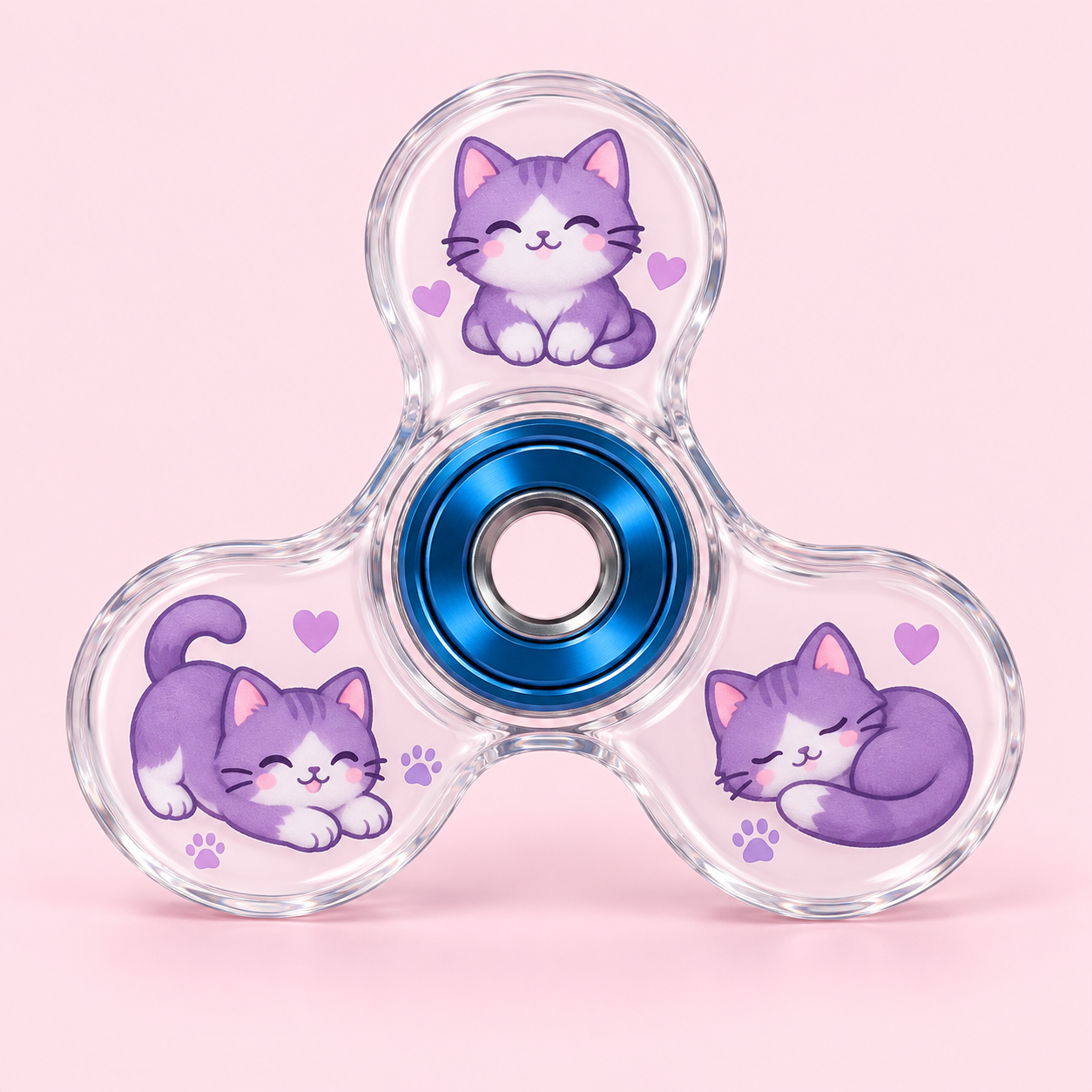
Transparent and thin fingertip bodies like the Purple Cat Acrylic Fidget Spinner at 35 grams are in the second group: forgiving when dropped, short on balance time.
And every trick gets easier with a smooth bearing, because the spin lasts longer and decays evenly. If yours slows unevenly or sounds grainy, fix that before practising anything — the diagnosis is in the fidget spinner bearing explained.
Practising Without Damage
Learn over a bed, a rug or your lap. Almost all early attempts end on the floor, and hard floors are what ruin finishes and bearings.
Learn with the spinner you mind least. A scuffed practice spinner is a much better teacher than a nice one you are frightened of dropping.
Stop when the bearing starts sounding different. Repeated impacts do damage bearings, and a session of dropped catches is the fastest way to turn a good one rough.
A Sensible Order to Learn Them In
Tricks build on each other, and doing them out of order is why people stall.
Start with a clean one-handed start, because every other trick depends on getting the spinner up to speed without wasting the input. Most people skip this and wonder why their spins die early.
Then the table spin, which teaches you what friction does without any catching risk.
Then the nail balance, which teaches you to feel when the spin has decayed past the point where gyroscopic resistance holds it.
Then transfers, which combine the two, and only then throws, which are the only ones with real potential to damage the object.
Anyone who can hold a nail balance for a few seconds has already learned the hard part; the showy tricks are mostly confidence after that.
Three Bodies for Different Tricks
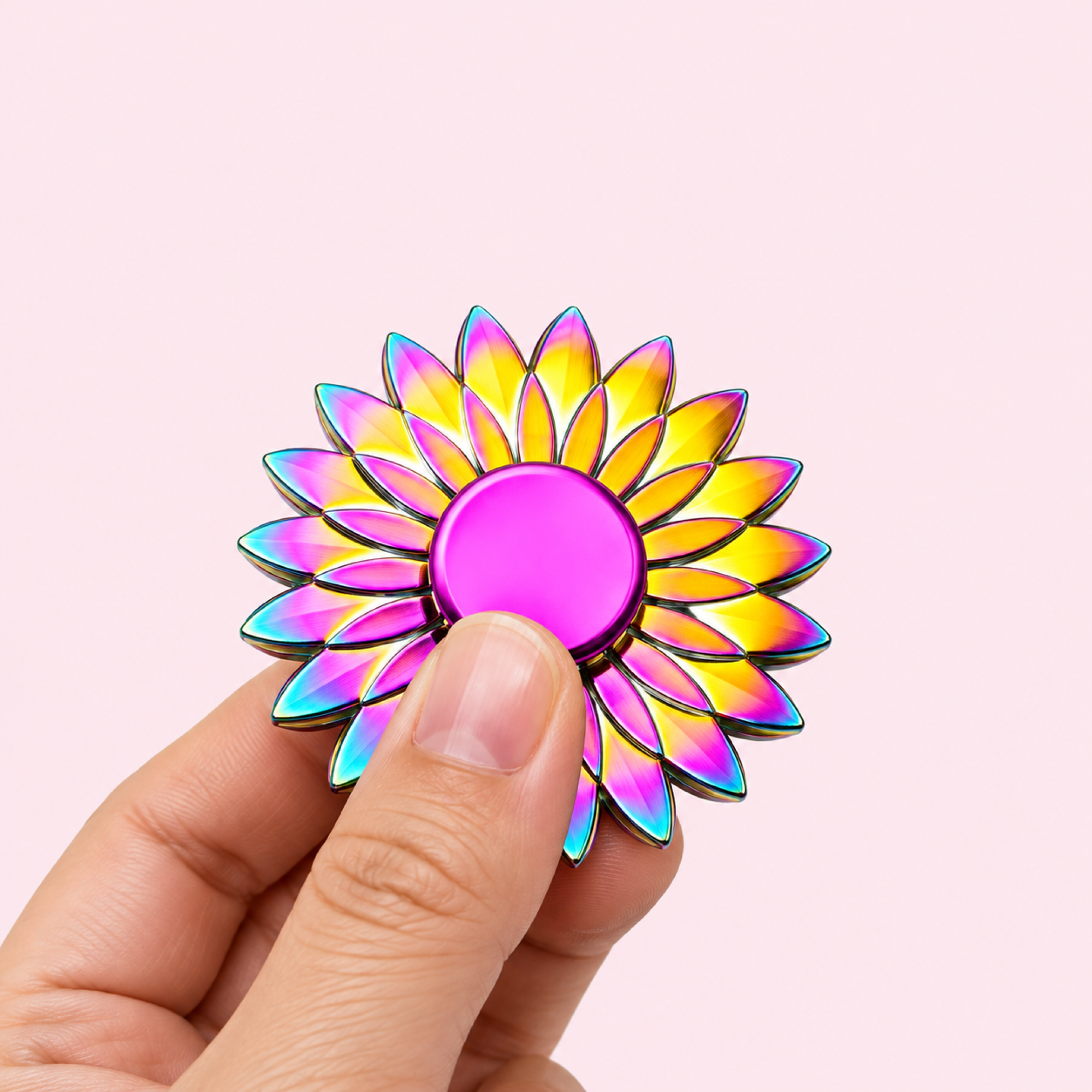
Rainbow Metal Fidget Spinner — rim mass and long spins, the body for balance and transfer work.
Metallic Purple Blue Fidget Spinner — three-arm metal with different arm geometry, which changes how it behaves mid-air.
Purple Cat Acrylic Fidget Spinner — 35 grams of transparent acrylic, forgiving to drop while you learn.
See the whole fidget spinners range, or browse all fidget toys if rotation is not the action you want.
Not after tricks? Fidget spinner ideas beyond spinning it covers the everyday uses — as a timer, on calls, out of sight — that keep a spinner in circulation.