


Portability is the most common reason people buy small fidget toys and the most common reason they stop using them. Below a certain size some mechanisms keep working perfectly and others become fiddly, weak or simply too quick to be interesting. The dividing line is not about quality — it is about which physical property the mechanism depends on, and whether that property survives being scaled down.
Mechanisms That Miniaturise Cleanly
Presses and clicks. A switch does not care how big the housing is. The bump, the travel and the reset feel the same on a keychain array as on a desk unit, which is why keyboard-style fidgets are among the best small objects in the category.
Textures. A surface pattern works at any scale as long as the features stay bigger than a fingertip’s resolution, which is a much smaller limit than people assume.
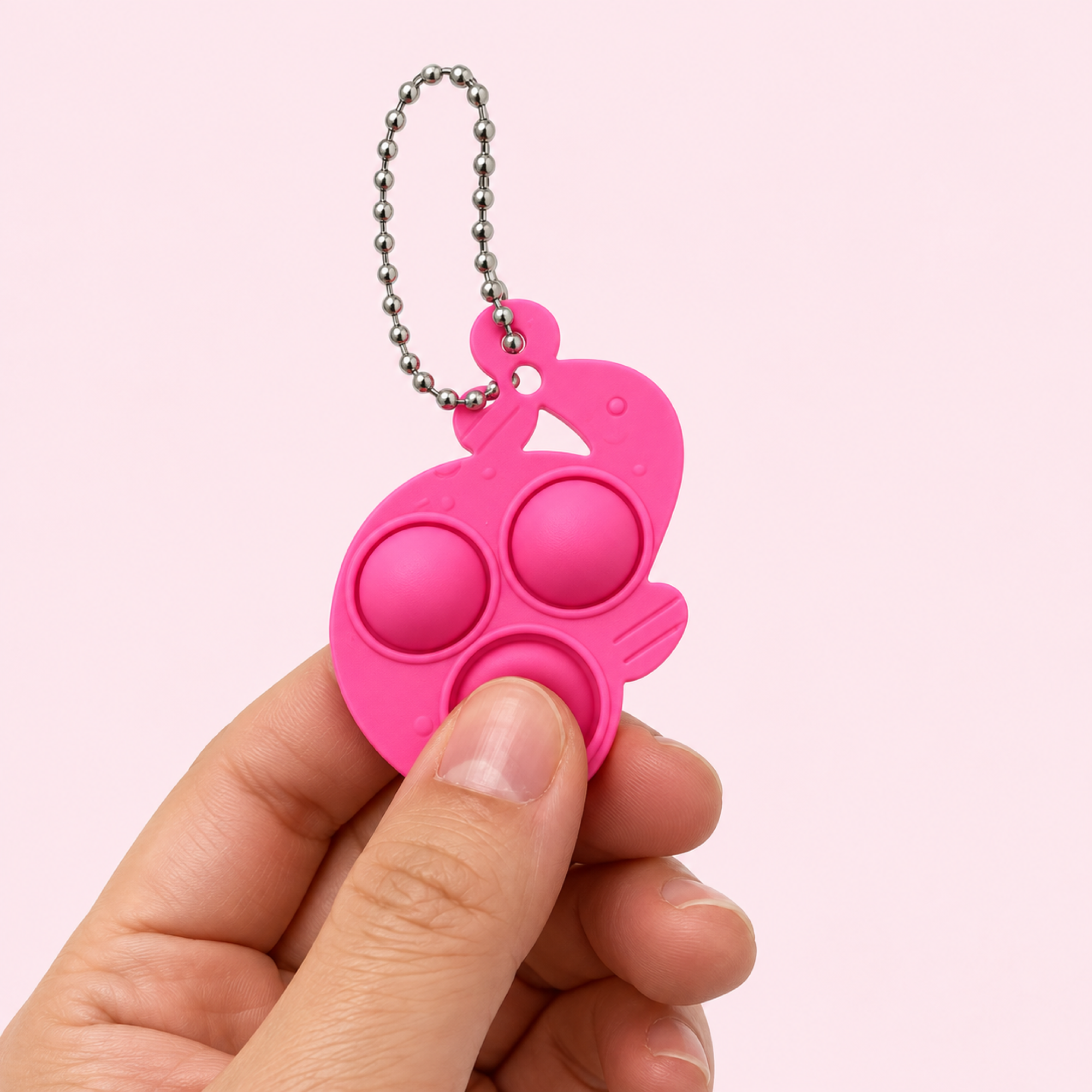
Bubble presses. A dome that inverts and pops back works the same small as large; there are just fewer of them. The Pink Bubble Pop It Keychain is a worked example — the individual press is identical to a full-size board, and what you lose is the sweeping motion across many bubbles.
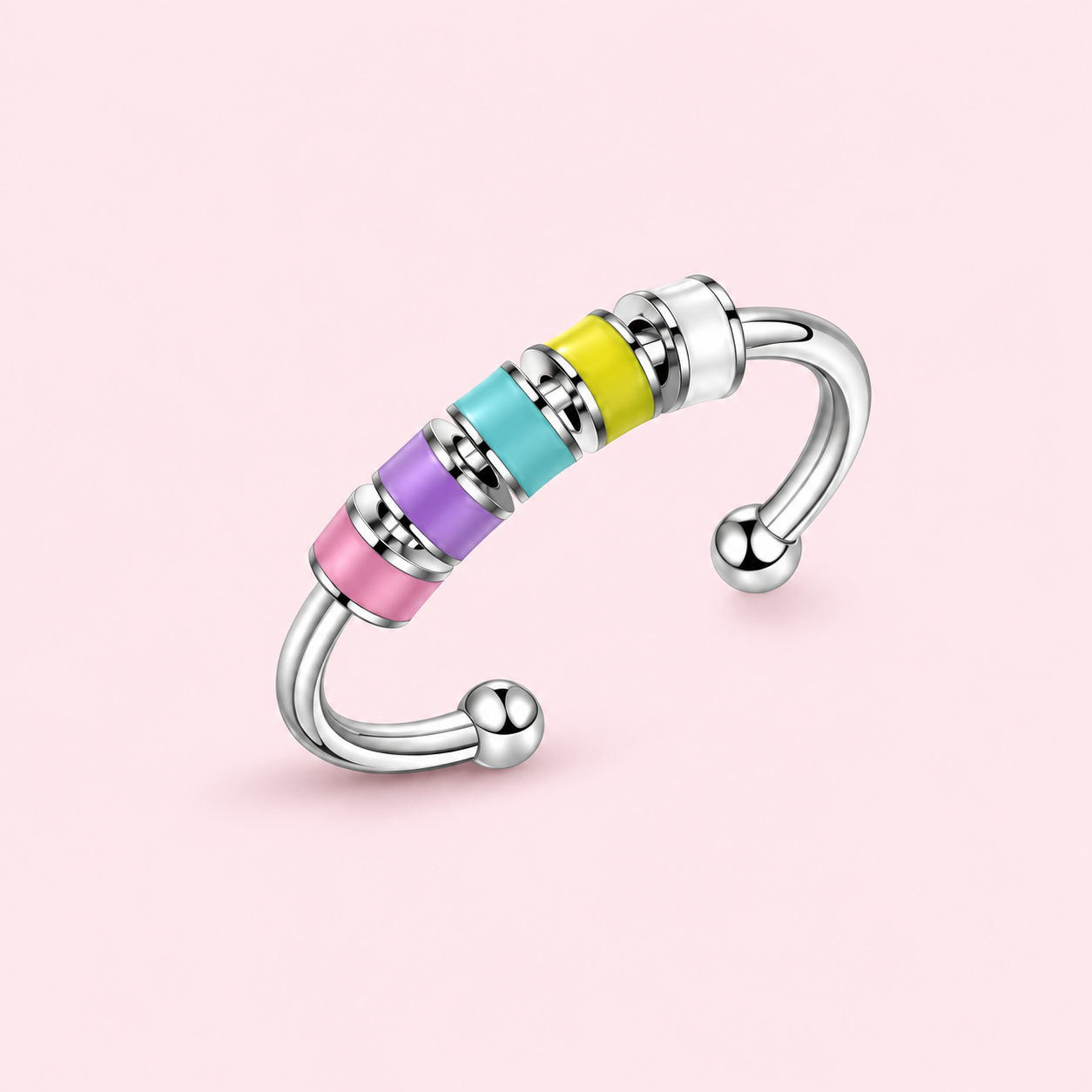
Worn mechanisms. Rings are small by definition and lose nothing.
Mechanisms That Do Not
Spinning. This is the clearest failure. Spin duration comes from rotational inertia, which depends on mass sitting far from the centre — and shrinking a spinner cuts both the mass and the radius. A miniature spinner stops almost as soon as you release it, which removes the entire point of watching one. The physics is the same argument made at full scale in metal fidget spinner vs plastic, just more severe.
Sliding travel. A slider needs enough distance for the thumb to feel the journey between the end-stops. Shrink the track and it becomes two stops with nothing between them — a switch, not a slider.
Stretch. Stretchy toys need slack. A small one runs out of extension immediately and the pleasant elastic zone disappears.
Anything two-handed. A small object cannot occupy two hands meaningfully, so a shrunk version is a fundamentally different toy rather than a portable one.
The Size That Actually Fits a Pocket
Flat beats small. A thin object lies against the fabric and stays where you put it; a small round one migrates to the bottom corner and comes out with lint in its mechanism. Thickness matters far more than footprint for anything you carry in a trouser pocket.
Clip-on beats loose. A split ring or bead chain on a bag strap or belt loop means the fidget is retrievable one-handed and does not share a pocket with keys. That last point matters because keys are the hardest thing most people carry, and they will mark plated and painted surfaces.
Sub-fingertip is too small. There is a floor: once a mechanism is smaller than the pad of a thumb, you operate it with a nail rather than with skin, and nail contact carries almost none of the tactile feedback that makes a fidget worth having.
Small Does Not Mean Quiet
A common assumption, and it is backwards. Small hard bodies are frequently louder than large ones because they are hollow and light, so the housing resonates. A tiny plastic clicker in a silent room carries further than a large silicone slider.
If quiet is what you actually need, size is the wrong variable to optimise — material and damping are the right ones, and they are covered in the quietest fidget toys that aren’t squishies.
What Small Fidget Toys Are Genuinely Best For
Waiting. Queues, platforms, lobbies — situations where you are standing, have one hand free, and cannot put anything down.
Meetings, where a pocket object can be operated below the table line without ever being seen.
Bags and coats, as a second fidget that lives permanently in a jacket so there is always one with you regardless of what you left at your desk.
They are not a replacement for a desk object. The depth of mechanism you can fit into a small body is lower, and a shallow mechanism stops registering sooner — the same abandonment pattern our month-on-a-desk ranking is built around. A two-object setup with one carried and one parked works far better than trying to make one small object do everything, as set out in the everyday-carry shortlist.
Buying Small for a Bag Rather Than a Pocket
A bag changes the calculus completely, and most advice ignores it.
In a bag, thickness stops mattering and findability starts. A small dark object at the bottom of a tote is effectively lost, which is why clip-on designs and bright colours earn their place there rather than in a pocket. Attach it to the inside of a strap or a zip pull and it is retrievable without looking.
Bags are also the one place where a slightly larger object is fine. If the fidget is going in a bag anyway, there is no reason to accept a shrunken mechanism — take the full-size version of whatever you like and clip it rather than pocket it.
Three That Work Small
Pink Bubble Pop It Keychain — bubble presses that feel identical to a full-size board, with a ring for a bag.
Pastel Keyboard Keychain — four keycaps with real press feel and a metal ring. Switches lose nothing to miniaturisation.
Panda Paw Fidget Keychain — a textured paw-shaped press on a clip, small enough to disappear and textured enough to find by feel.
Browse the fidget keychains range for carry-sized options, or see all fidget toys to compare against desk-sized mechanisms.