




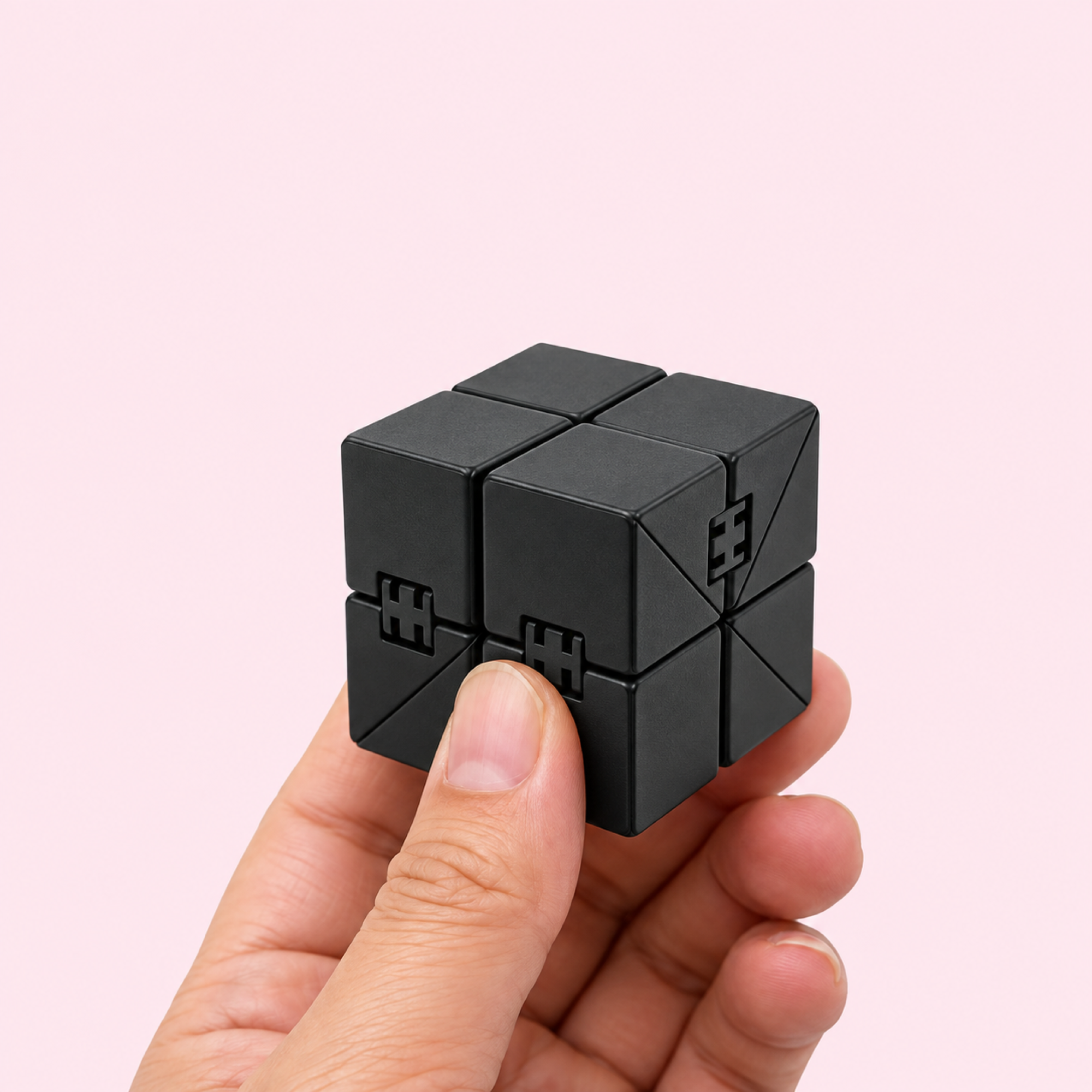
Cube-shaped fidgets are not one thing, and the confusion between them is the reason people buy the wrong one. What is an infinity cube, specifically, is a chain of eight small blocks joined by hinges in a loop, arranged so the whole assembly folds through itself and arrives back where it started — endlessly, in either direction, with no finished state and nothing to solve.
How the Mechanism Works
Eight cubes are linked at twelve hinge points in a closed chain. Fold along one axis and the chain rotates through its own middle, forming a new cube; fold again and you get another. There is no sequence to learn and no correct arrangement, because every arrangement is the same cube.
That is what separates it from a puzzle. A puzzle has a solved state, so it eventually gets solved and stops being interesting. A folding cube has no target, so there is nothing to complete and nothing to fail at, which is precisely why it holds attention.
The Infinity Folding Cube is a compact black body of linked segments built around this action.
What Is an Infinity Cube For
Continuous motion. It is the only common fidget where the action never reaches an end point and never needs resetting. A clicker completes, a slider arrives, a spinner decays — a folding cube just keeps going.
Absorbing both hands. Most people run one two-handed at first and switch to one-handed with practice, which is the point at which it becomes a desk object you can use while reading.
A repeatable rhythm. The fold has a cadence, and the cadence is most of the appeal: a steady sequence of small mechanical events under your fingers.
It is not, despite the shape, a puzzle or a dexterity test. If that is what you want, a multi-function cube with six different mechanisms on its faces is the other product entirely.
What Makes One Good or Bad
All of it comes down to hinge consistency.
Twelve hinges need the same clearance as each other. Too tight and the cube binds partway through the fold; too loose and it flops with no resistance, which removes the tactile feedback that makes the motion satisfying. Consistency across all twelve matters more than any single one being perfect, because your fingers notice the one that is different.
This is also why printed versions disappoint so often — tolerance error accumulates along a chain rather than averaging out, which is covered in 3D printed infinity cube vs bought.
Weight is the second variable. Heavier bodies carry the fold with momentum and need two hands; lighter ones are more controllable and quieter, as compared in metal infinity cube vs plastic.
How It Differs From Other Cube Fidgets
Multi-function cubes. Six faces, six small mechanisms — a switch, a dial, a rocker, buttons. Variety rather than depth, and the trade-off is that choosing a face is a small visual task, which is exactly what a fidget is supposed to avoid. The White & Pink Six-Sided Fidget Cube is this type.
Magnetic panel cubes. Faces held by magnets that release and re-seat, giving a latch-and-release action rather than a fold. The Magnetic Fidget Box has visible panels and sliding parts.
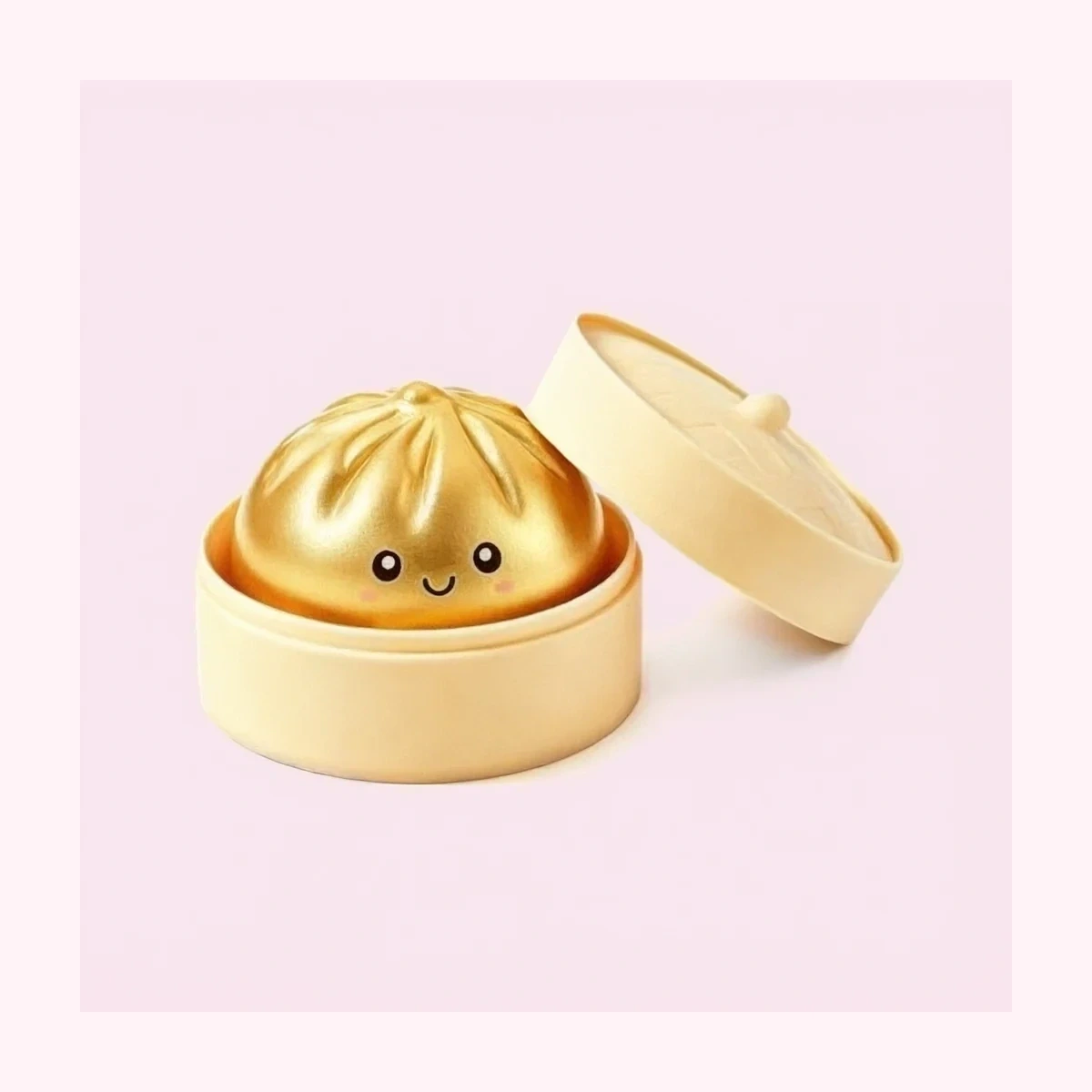
Shaped folders. The same hinge chain in a different silhouette, like the Hamburger Folding Fidget Cube, which changes the balance in the hand without changing the mechanism.
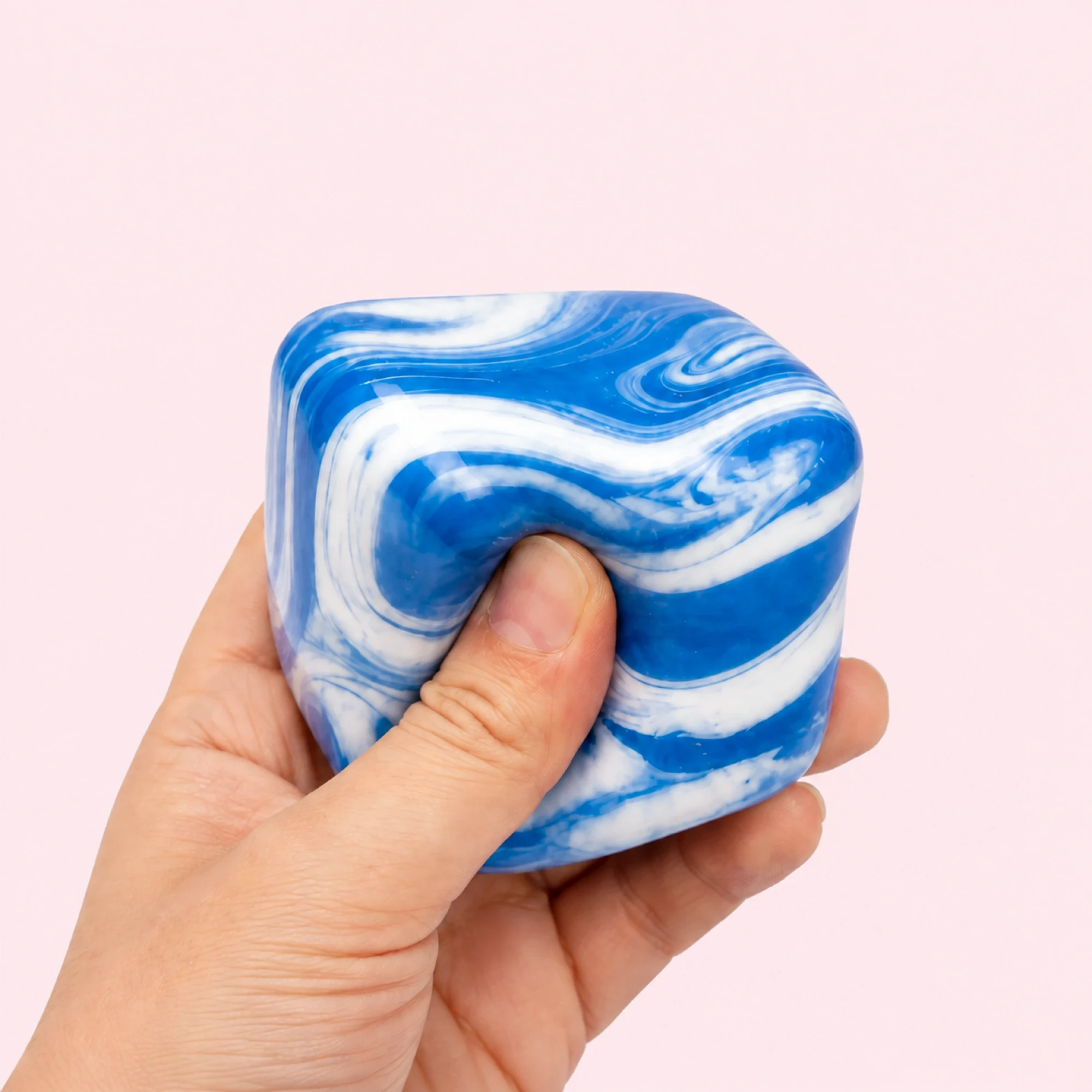
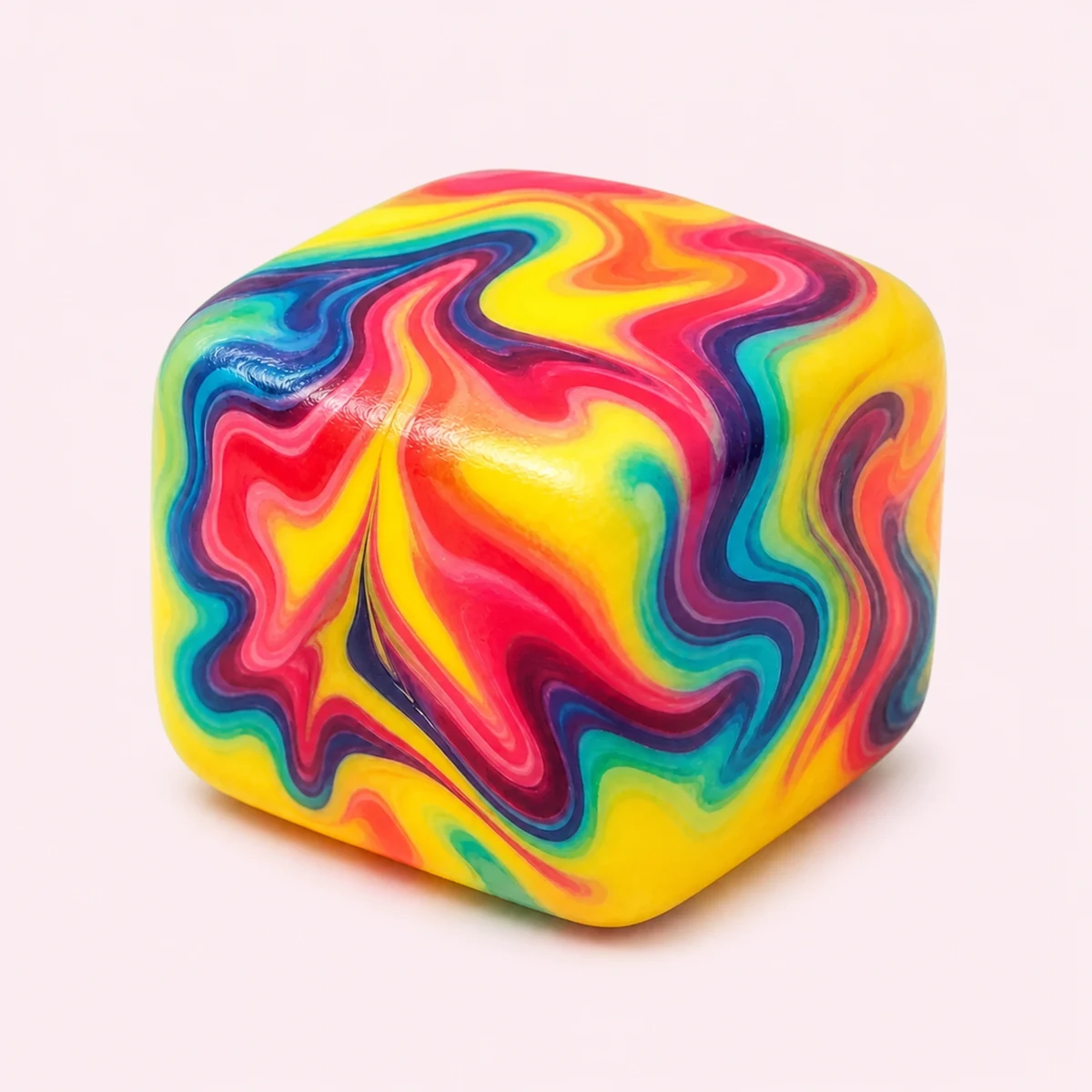
Squishy cubes. Not a mechanism at all — a compression toy that happens to be cube-shaped.
Four quite different objects sharing one shape, which is why “fidget cube” as a search term returns such inconsistent results.
Is It Worth Owning
Worth it if you like continuous motion and do not need the object to be silent. The fold ends with blocks meeting blocks, so a folding cube is a percussion instrument by construction, and the noise is the main thing that disqualifies it from a shared room.
Not worth it if you want something pocketable and one-handed from day one, or if you want variety rather than one deep mechanism.
The decision is easier framed by hand action rather than by shape, which is what types of fidget toys is for: folding is its own action, and people who like it tend to like it a great deal.
Learning to Run One One-Handed
Almost everyone starts two-handed and assumes that is how it works. One-handed operation is learnable in a few minutes and it is what turns the object from a novelty into something usable while you read.
The trick is that you are not folding it with your fingers so much as letting it fall through itself while you provide a pivot. Hold the cube in a loose cupped hand, start the fold with your thumb, and let gravity carry the chain while your fingers catch the next face. Stiff cubes make this much harder, which is another argument for consistent hinges.
Lighter bodies are easier to learn on. If you have tried and given up, the cube may simply have been too heavy for the technique rather than you being bad at it.
Three Cube-Shaped Options
Infinity Folding Cube — the mechanism described above, linked black segments folding in both directions.
Hamburger Folding Fidget Cube — the same hinge chain in a shaped body.
Magnetic Fidget Box — panels and slides instead of a fold, for a latch action with a definite stop.
Browse the fidget cubes range, or see all fidget toys if folding is not the action you are after.