


Searching for a yellow fidget spinner turns up far fewer options than black, blue or rainbow, and it is not fashion or coincidence. Yellow is genuinely awkward to produce on the two materials spinners are made from, and it is the colour that shows age fastest once produced. Both facts are worth knowing before buying any fidget for its colour.
Why Metal Spinners Are Rarely Yellow
Coloured metal fidgets get their colour from anodising, which grows a tinted oxide layer in the surface rather than laying paint on top of it.
Anodising produces deep blues, purples, blacks and bronzes readily. It does not produce a clean yellow — what comes out is closer to brass or gold, which is exactly why “gold” is common in metal fidgets and true yellow is not.
The alternative is painting or powder-coating the body, and both add a layer that wears at the arm edges and the thumb pad. That is the first place any coated spinner shows its age, and the material trade behind it is in metal against plastic.
So a genuinely yellow metal spinner is almost always a painted one, which makes it the version most likely to look scruffy within a year.
Why Plastic Ones Fade
Yellow pigment in acrylic and ABS is less lightfast than blue or black. A yellow body left on a sunny desk shifts towards a dull mustard in a way a blue one does not.
Worse, yellow is the shade clear and pale plastics drift towards on their own as they age. A yellowing white spinner and a fading yellow one converge on the same colour, which is why yellow reads as “old” to the eye even when the object is new.
It is the same ageing process described in yellow, sticky or hard. The difference is that on a yellow object you cannot see how far along it is.
What to Do If Colour Is the Priority
Buy the colour in silicone, not in metal. Silicone holds saturated yellow well, has no coating to chip, and the pigment runs through the body.
Buy two-tone rather than single-colour. Fading is far less obvious against a second colour, and a combination reads as deliberate rather than faded.
Avoid painted metal in any bright colour. Edge wear is not a defect, it is what painted metal does, and it starts precisely where your fingers go.
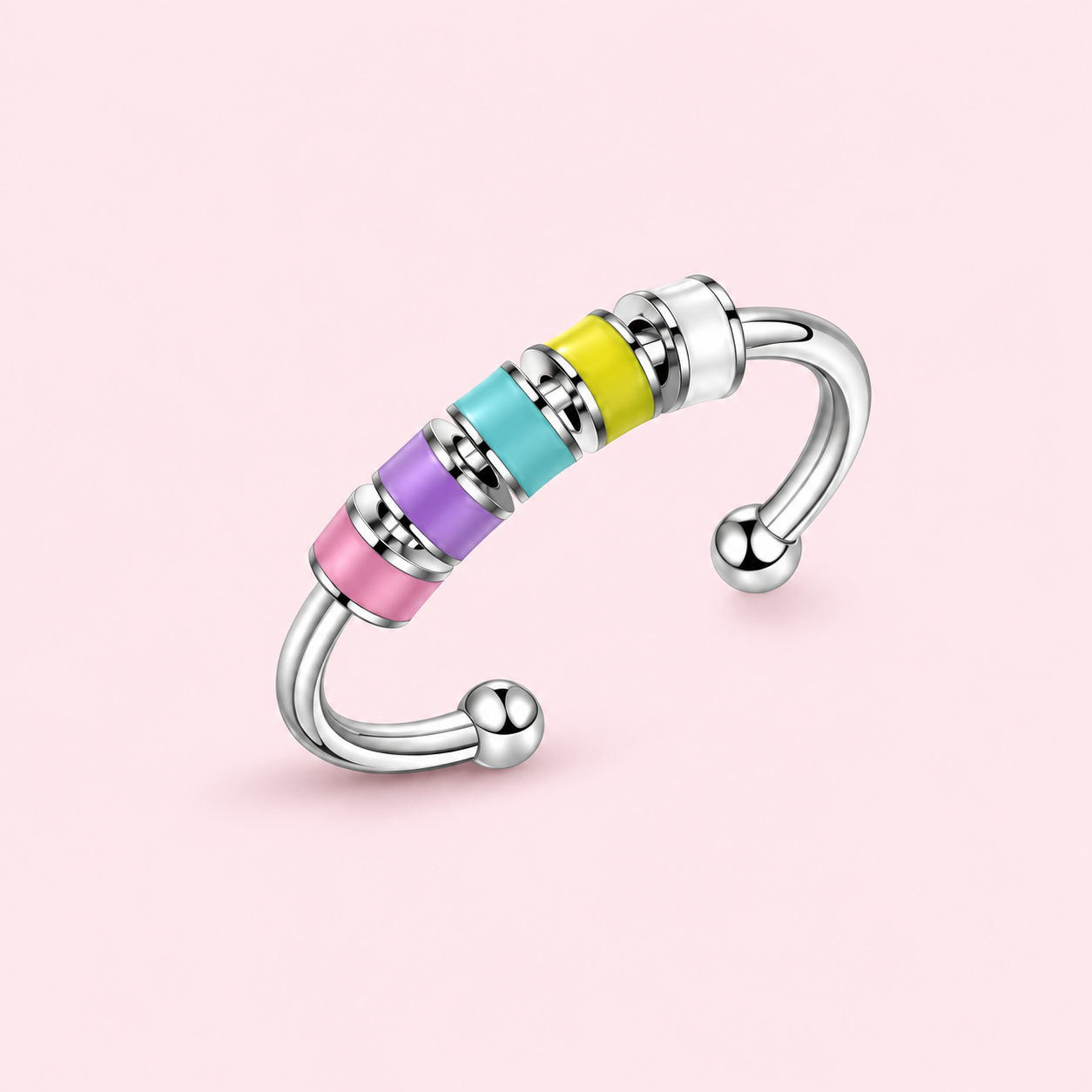
Treat rainbow as the exception. Rainbow on metal is an anodised gradient rather than paint, which is why it is both widely available and durable — the Rainbow Metal Fidget Spinner is that process.
Pigment Through, or Colour On Top
This is the single most useful check on any coloured fidget, and it takes one look at an edge.
Colour that runs through the material survives scratches, because a scratch exposes more of the same colour. Colour on the surface does not, because a scratch exposes whatever is underneath.
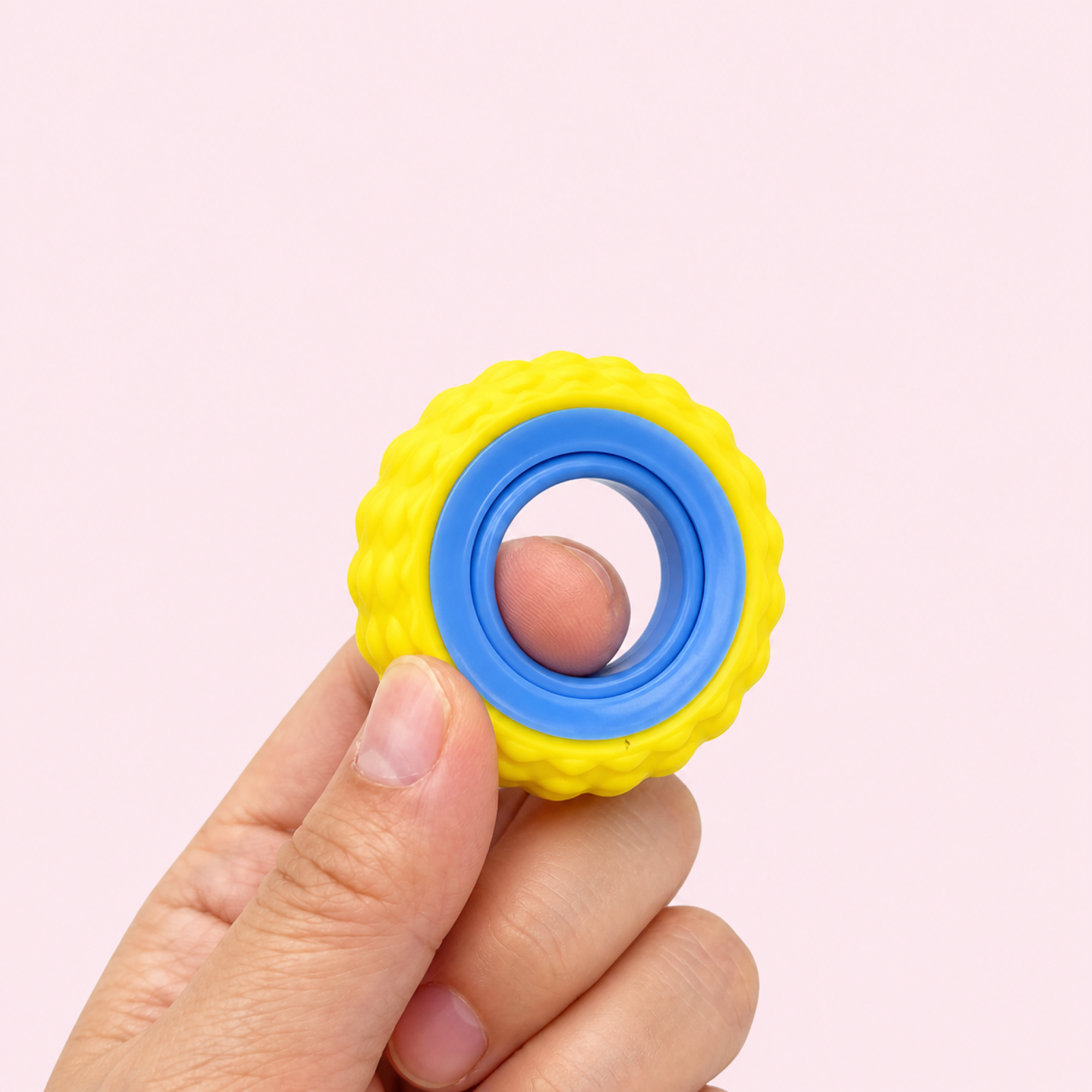
A Yellow & Blue Sensory Ring is moulded silicone, so the colour is the material. A Yellow Textured Slider Fidget Board at 10 × 5 × 2 cm is the same: moulded rather than coated.
Anodising sits in between — the colour is in the surface rather than on it, which is why anodised metal outlasts painted metal without matching moulded plastic.
Choosing Colour Without Regretting It
Decide whether the colour needs to survive or only needs to arrive. A gift is judged on the day; a daily-carry object is judged in a year.
For anything worn or carried, pick a colour that ages gracefully — black, dark anodised tones and two-colour silicone all do. Bright single-colour coatings do not.
For a desk object that never leaves a shaded room, colour durability barely matters, and you should buy whatever you like the look of.
Check the material before the colour, because the material decides how long the colour lasts. The general version of that trade-off is in cute fidget toys that still work.
If You Specifically Want a Yellow Fidget Spinner
Rotation and colour are separate decisions, and insisting on both at once is what makes a yellow spinner hard to find.
Pick the geometry first — three-arm for long decay, disc for pocketability, ring for wearability — as sorted in types of fidget spinners.
Then take whichever colour that geometry offers in a durable finish, and put the yellow somewhere else in your set. A yellow slider beside a plain metal spinner gets you both, and neither compromises the other.
How to Judge a Colour Claim in a Listing
Photographs of bright fidgets are the least reliable images in the category, and there are three things worth doing before trusting one.
Look for the object on a white background and on a hand. Saturation is routinely pushed in product shots, and a hand in frame gives you a reference the editing could not fully move.
Read the material line, not the colour name. “Yellow” tells you nothing; “silicone” or “anodised aluminium” tells you whether it will still be yellow next year.
Treat “gold” and “yellow” as different products. On metal they are usually the same anodising recipe described two ways, and if you wanted a bright primary yellow, gold will disappoint you in person.
And if a listing shows one body in eight bright colours, that is a painted or printed range rather than a moulded one, which tells you which wear pattern to expect.
Three Yellow-Side Fidgets Worth Owning
Yellow & Blue Sensory Ring — silicone, two-tone, colour through the material.
Yellow Textured Slider Fidget Board — 10 × 5 × 2 cm, moulded colour, nothing coated.
Rainbow Metal Fidget Spinner — anodised rather than painted, the durable way to get colour onto metal.
Browse the fidget spinners range, or all fidget toys.