


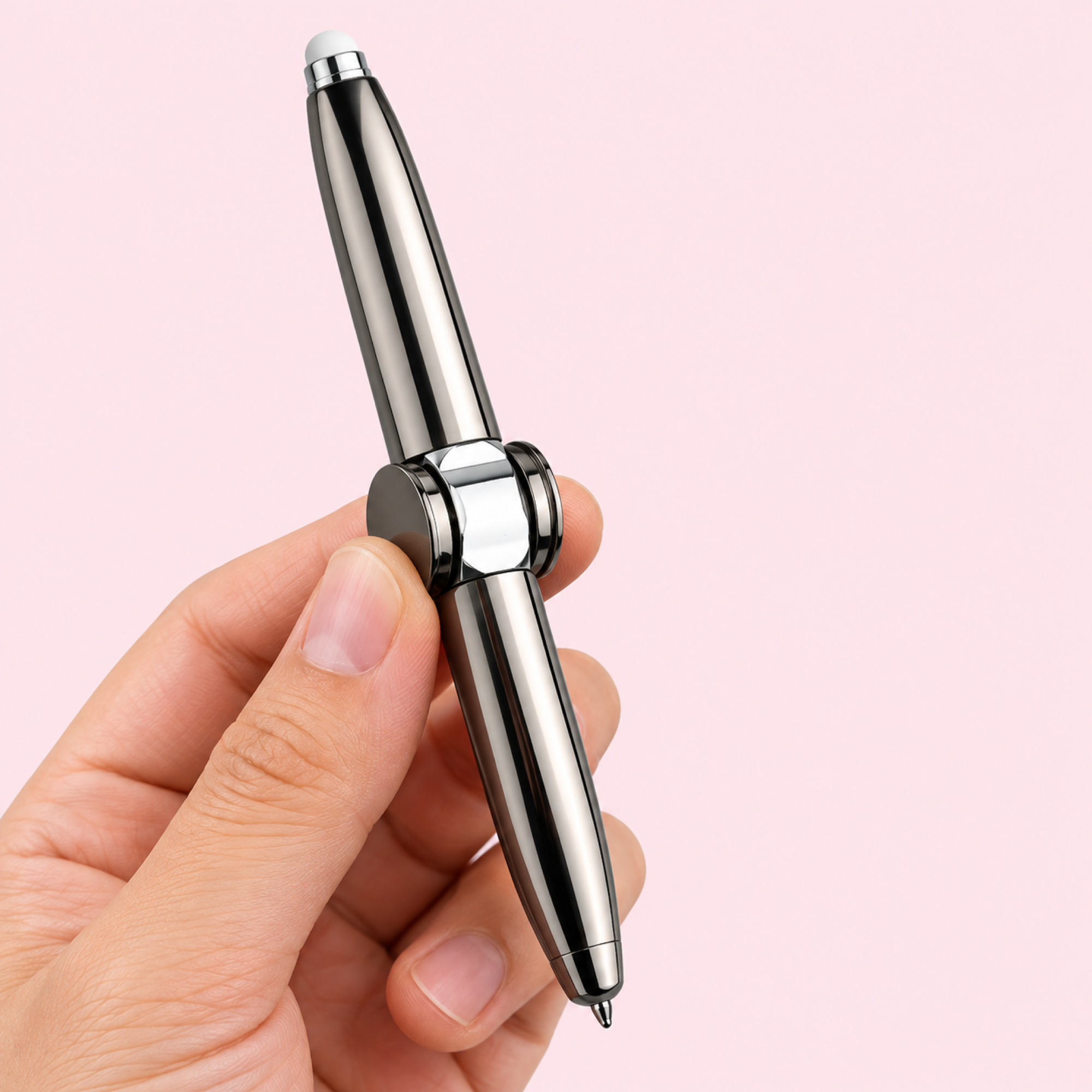
A pen is the best disguise a fidget can have. It is already on the desk, already in the hand, and nobody looks twice at someone turning one over. What is a fidget pen, in practice, is any pen built so that the body itself does something — and there are four quite different ways of achieving that, which is why two objects with the same name can have nothing in common.
What Is a Fidget Pen: The Four Types
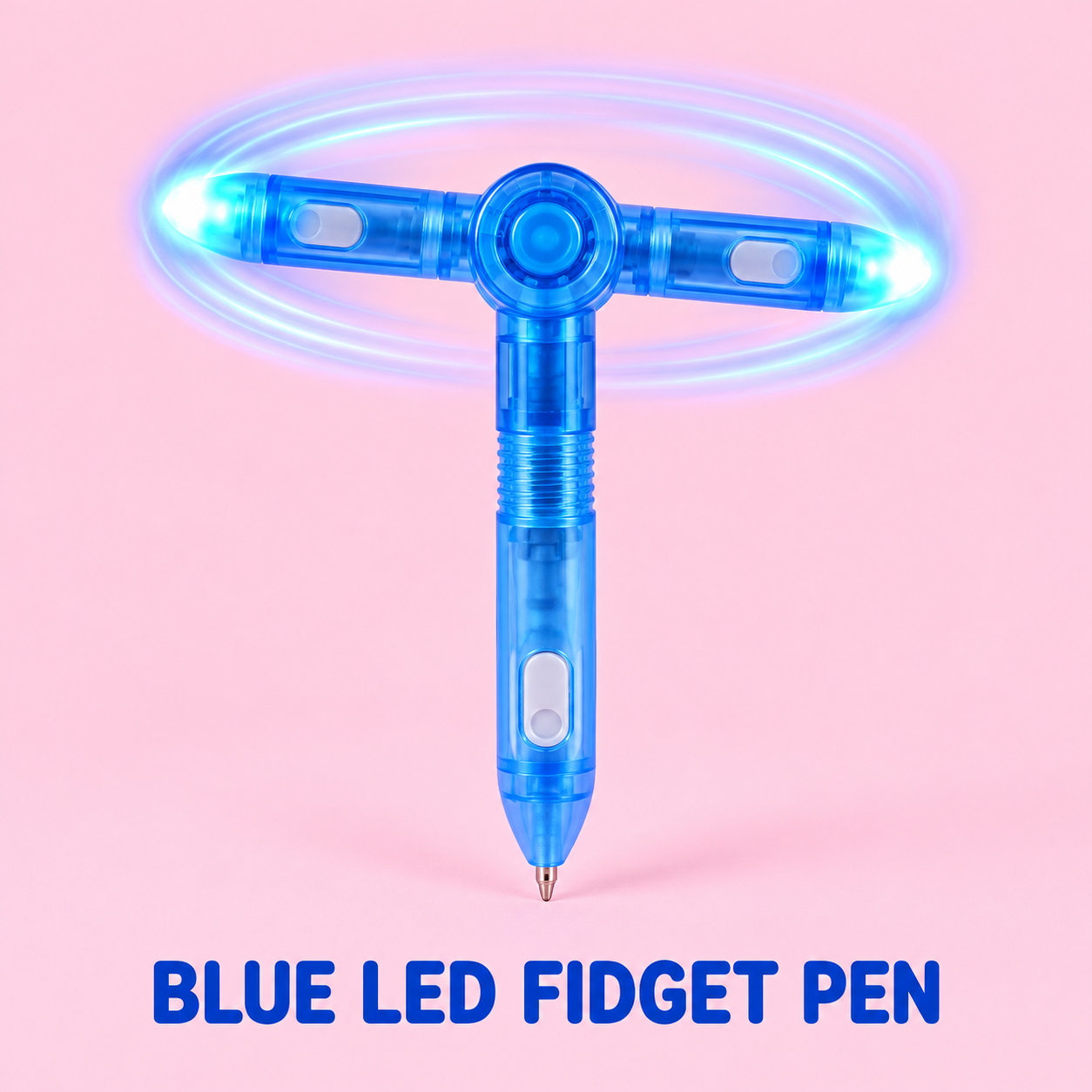
Spinner pens. A weighted section rotates around the grip, so the pen turns in your hand while the barrel stays put. One-handed, continuous, and nothing detaches. The Metal Spinner Pen is this type, in a silver-grey metal body.
Magnetic segmented pens. The body separates into magnetised pieces that snap back together in shapes. The most engaging to play with and the most fragile to carry, because the thing holding it together is magnetism — covered in detail in how a magnetic fidget pen works.
Clicker pens. A retractable mechanism deliberately built for repeated clicking rather than for deploying a nib. Satisfying, audible, and the reason pens got banned from meetings long before fidget toys existed.
Slider and texture pens. A ring, a knurled band or a sliding collar on the barrel that your fingers work while you hold it. The least obvious and the most usable in company, because nothing moves visibly and nothing makes a sound.
Which Ones Still Write
Worth asking before anything else, because a fidget pen that writes badly is just an awkward fidget.
Spinner pens usually write well. The mechanism is around the grip rather than in the writing end, and the extra weight is generally an advantage for handwriting rather than a problem.
Magnetic pens vary. The refill lives in one segment, so the pen is shorter and lighter in the hand than it looks, and balance suffers. Check whether the refill is a standard size — a proprietary one turns the object into a fidget the day it runs out.
Clicker pens write fine by definition, since the click is the normal mechanism used harder.
Slider pens write fine, because nothing about the barrel changes.
Which Survive a Pocket
Spinner pens do. Nothing comes apart, the mechanism is enclosed, and metal bodies take scuffs rather than damage — the material-by-material wear breakdown is in which finishes survive a pocket.
Magnetic pens do not. Segments separate under pressure from keys and phones, and a stack missing one piece is finished, because replacements are not sold individually and polarity has to match.
Clicker pens survive but get clicked in your pocket, which is its own problem.
Slider pens survive well.
Choosing by Where You Will Use It
Meetings and shared offices. Slider or spinner, both silent. A pen is the single best-camouflaged fidget available, because nobody questions a pen — the same reasoning that makes dual-purpose objects the top recommendation in the everyday-carry shortlist.
Your own desk. Any of the four. A magnetic pen is at its best here, where the segments cannot be lost.
Carried everywhere. Spinner or slider, and prefer a clip that actually grips.
Anywhere quiet. Not a clicker. The sound carries further than people think, and the mechanism-by-mechanism noise comparison is in which clicks are meeting-safe.
What Fails First
On spinner pens, the pivot collects lint and the spin goes gritty. Blowing it out clears most cases; adding oil makes it worse in a month.
On magnetic pens, a lost segment.
On clicker pens, the spring, which is the only genuinely worn-out failure in the group.
On any pen, the clip. Metal clips fatigue where they bend, and a clip that has lost its spring turns the pen into something that falls out of a pocket.
Is a Fidget Pen Worth It Over a Dedicated Fidget
If you write by hand regularly, yes — it earns its desk space twice, and that is the single strongest argument for the format.
If you never write by hand, a dedicated object will do the same job better, because a pen shape constrains what mechanisms fit. A slider gives more travel and a ring gives more availability, and the trade-offs are laid out by hand action in types of fidget toys.
The pen’s real advantage is social rather than mechanical: it is the only fidget that nobody notices you using.
Weight and Balance, the Part Reviews Skip
A pen is held in a precision grip for long stretches, which makes balance matter far more than on any other fidget shape.
A pen that is heavy at the nib end drags the tip into the paper and tires the hand. A pen that is heavy at the cap end lifts the tip and feels unstable. The comfortable arrangement puts the weight near your fingers, which for a spinner pen usually means the rotating section sits over the grip rather than at one end.
This is also why a heavy fidget pen is not automatically a better one. Mass helps a spinner because it sits at the rim and does work; mass in a pen mostly just has to be carried, and it is carried by three fingers.
If a pen feels tiring rather than substantial within a page of writing, balance is the reason, and no amount of getting used to it fixes the physics.
Three Pen-Shaped Options
Metal Spinner Pen — metal body that spins one-handed and writes with the other end. The most practical of the four types.
Magnetic Silicone Slider — if what you liked about a magnetic pen was the snap, this delivers it in a body that cannot lose parts.
Black Mechanical Fidget Ring — if what you wanted was discretion, a worn fidget beats even a pen.
Browse the fidget pens range, or all fidget toys to compare a pen against a dedicated mechanism.