





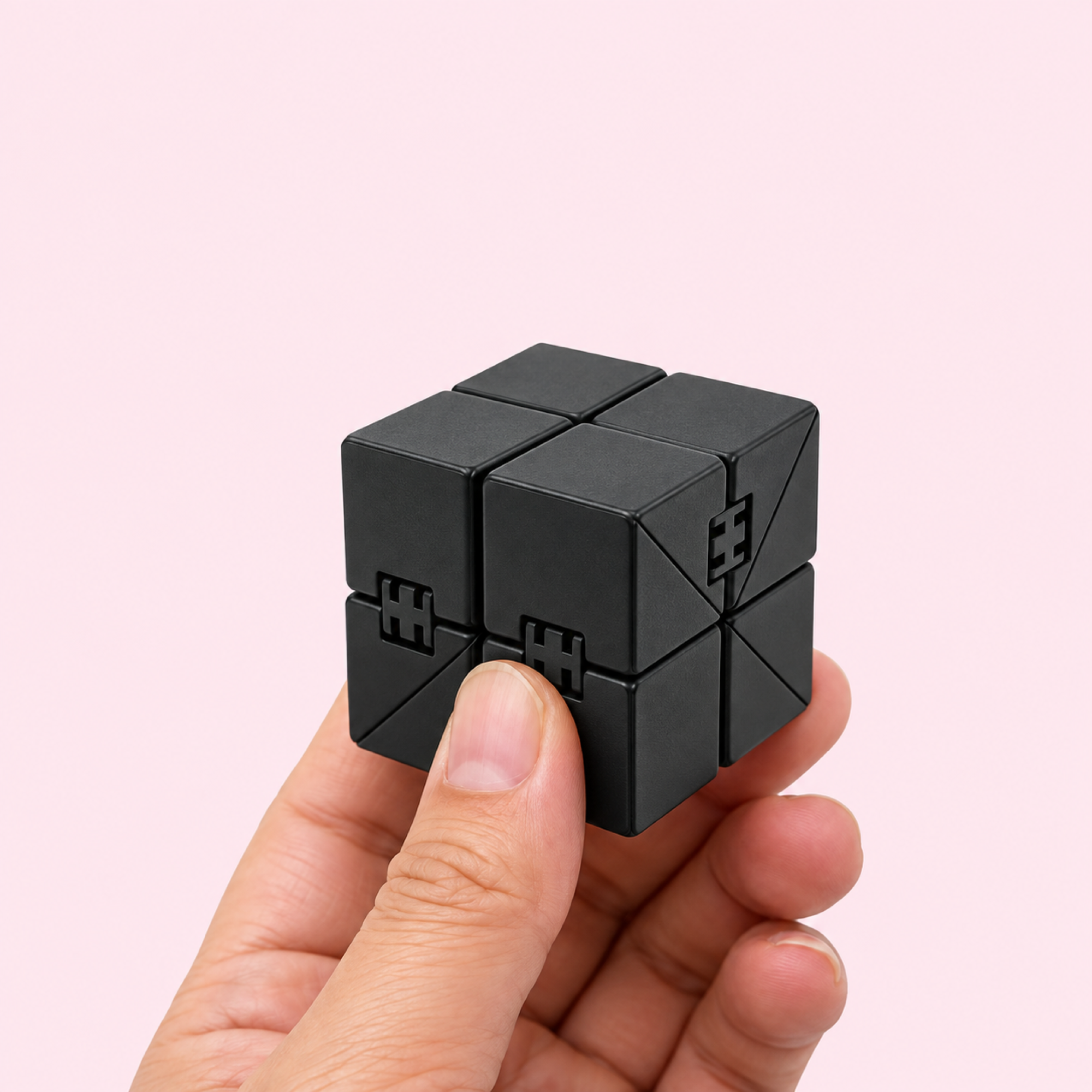
An infinity cube is eight small cubes connected by a chain of hinges that lets the whole assembly fold through itself forever. It is one of the most downloaded objects on every model site, and it is also one of the most disappointing things to print, for a reason that has nothing to do with printer quality. A 3D printed infinity cube has to get twelve hinges right in a row, and tolerance error does not average out across a chain — it accumulates.
Why the Hinges Decide Everything
Each hinge needs enough clearance to rotate freely and little enough to avoid slop. On a single hinge that is an easy target. On a chain of twelve, every hinge that is a fraction loose adds play, and by the far end of the fold the cube either binds or flops.
Binding is the more common failure. Filament shrinks slightly as it cools and the shrinkage is not identical in every axis, so a clearance that measured correctly in the model is tighter in the print. A cube that folds stiffly out of the printer usually does not loosen; it wears at the contact faces until there is slop instead, which is the other failure arriving by a slower route.
Flopping is what happens when clearances are generous. The cube folds beautifully and feels like nothing — no resistance, no defined stopping point. The whole appeal of the object is the light, even resistance as it turns through itself, and that resistance is a tolerance, not a feature you can add.
Can You Make a 3D Printed Infinity Cube, and How Long It Takes
Yes, and the two common approaches behave differently.
Print-in-place designs produce the whole cube in one job, with the hinges printed already assembled. It is impressive and it removes assembly entirely. It also puts every hinge at the mercy of the same shrinkage, and it usually needs a careful first layer and a slow print to keep the gaps clean. Print time for a small cube is typically an hour or two at reasonable quality; going faster is where the hinges suffer.
Multi-part designs print cubes and connectors separately for you to assemble. More work, and better results, because you can sand or ream individual joints that came out tight rather than scrapping the whole thing.
The honest expectation is that the first one will not fold well, the second will be closer, and you will learn more about your printer’s dimensional accuracy from this object than from any calibration cube.
What a Moulded Cube Gives You That a Print Cannot
Consistent hinge feel across all twelve joints, because they were moulded from the same tooling rather than accumulating error along a chain.
Smooth faces. A cube spends its life rotating between your fingertips, and layer lines are most noticeable exactly there. The Infinity Folding Cube is a compact black body of linked segments, and the sensation is the continuous fold — which is precisely what surface texture interrupts.
Silence. Printed plastic on printed plastic is one of the noisier fidget combinations, because the layer texture makes a fine rasp as faces slide past each other. If you need something usable in a shared room, this matters more than it sounds, and the wider question of which mechanisms stay quiet is covered in the quietest options that aren’t squishies.
Durability at the joints. Printed hinges are weakest along the layer boundaries, which run perpendicular to the stress in most orientations.
When Printing Is Still the Right Call
When you want a size or a colour nobody sells. Scaling a model is trivial and a jumbo or micro cube is a genuinely different object to use.
When you want to understand the mechanism. Printing a folding cube teaches you how the hinge chain works in a way that owning one does not.
When you are testing whether you even like the format before buying. A rough printed cube answers that question adequately.
The general case for what prints well and what does not — mechanisms yes, give and precision no — is set out in our 3D printed fidget toys guide, and a folding cube sits right on that boundary: it is a pure mechanism, which suggests printing should work, and it is a precision mechanism, which is why it often does not.
How Much Does an Infinity Cube Cost to Print
Filament for a small cube is negligible, measured in grams. The real cost is iterations and print time, and the realistic count is two to four attempts before one folds the way you wanted. If your time is worth anything, that arithmetic favours buying unless the printing itself is the point.
Related Mechanisms Worth Knowing
A folding cube is one of three cube-shaped mechanisms that feel completely different. Panel cubes with magnetic faces give you a latch-and-release action rather than a fold — the Magnetic Fidget Box is that type. Shaped folding toys like the Hamburger Folding Fidget Cube use the same hinge idea with a different silhouette and a different balance in the hand.
Picking between them comes down to whether you want continuous motion, a definite click, or something to look at. All three are in the fidget cubes range.
Three Bought Cubes Worth Comparing Against a Print
Infinity Folding Cube — compact black linked segments, folds in both directions, consistent hinge feel. The benchmark a print is trying to reach.
Magnetic Fidget Box — visible magnetic panels and sliding parts, a latch action rather than a fold.
Hamburger Folding Fidget Cube — the folding mechanism in a shaped body, which changes how it sits in the hand.
See the whole fidget cubes range, or browse all fidget toys if folding is not the mechanism you are after.