




A silent fidget solves the wrong problem for a lot of people. If the urge you are scratching is the one that makes you click a pen two hundred times an hour, a slow-rising foam squishy gives your hand something to do but never gives your ear the payoff. That payoff is the entire point of clicky fidget toys, and it is also the reason they get banned from meeting rooms. The useful question is not whether a clicker makes noise. It is how far that noise travels, and whether the person two desks over can tell what you are doing.
What Makes Clicky Fidget Toys Different From Everything Else on a Desk
Every other fidget category rewards your hand. A clicker rewards your hand and your ear, and the two arrive together — the tactile snap and the audible tick are the same event. Break the mechanism and the appeal disappears; a clicker with a mushy, silent action is just a button.
That coupling is why these are the hardest fidgets to share a room with, and why the choice between models matters more here than in any other category. A spinner is either quiet or it isn’t. A clicker is loud in a particular way, and the way determines who notices.
Three Click Mechanisms, Ordered by How Far the Sound Carries
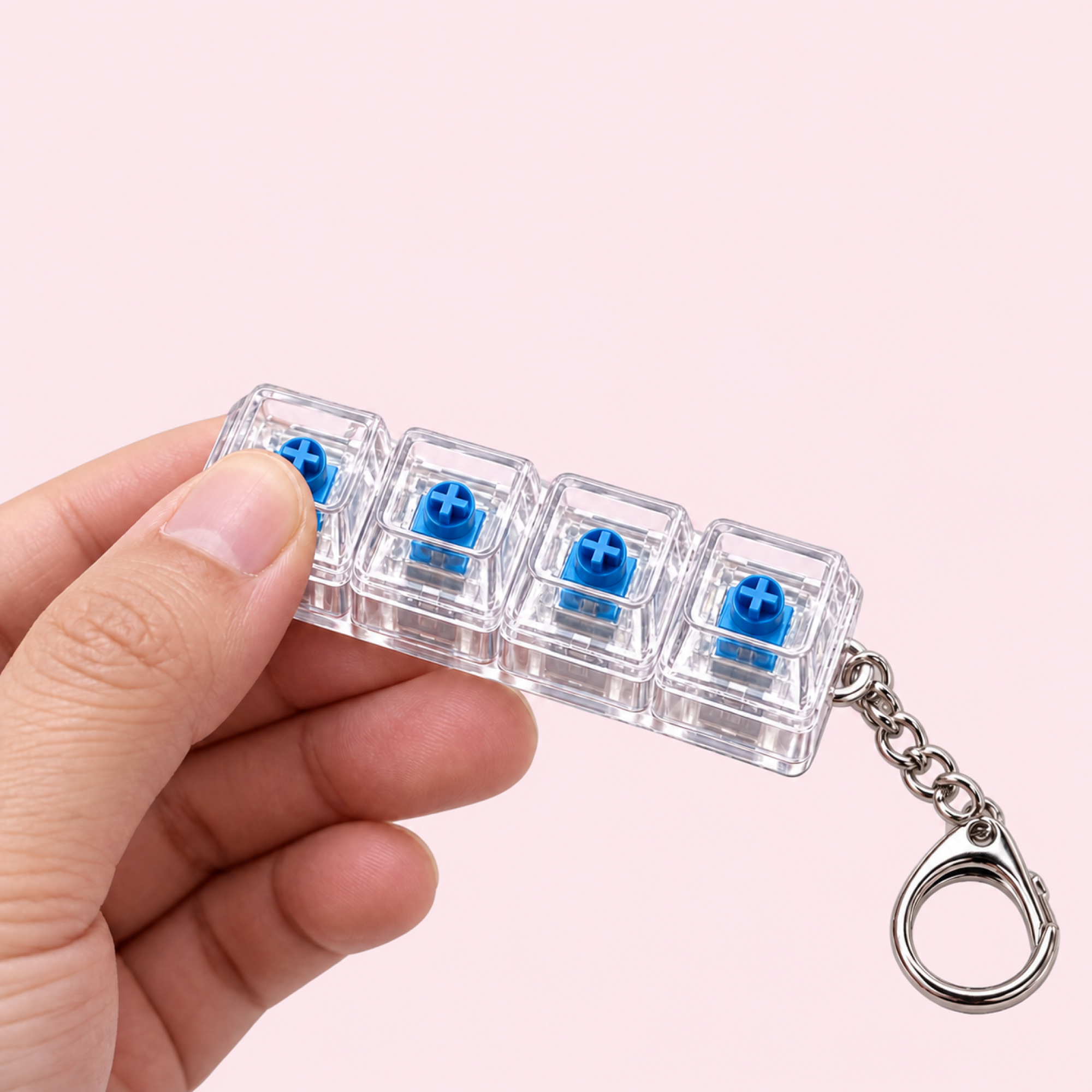
Keycap arrays. A row of real mechanical-style switches under moulded caps. The sound is a crisp, high-frequency tick with a short tail — the same profile as a keyboard, which is exactly why it disappears in an office and sticks out at a dinner table. The giveaway is repeatability: with four keys under four fingers you can roll a burst of clicks in half a second, and a burst reads as deliberate to anyone listening. A single press does not.
Plunger clickers. One moving part pressed into a housing, like the top of a retractable pen. One press, one click, no rolling bursts available. The White Cat Clicker Keychain is this type: the cat’s head presses down into a cylindrical holder. Lower ceiling on how much noise you can make per second, which in a shared room is the more important number than peak volume.
Textured mechanical rings and sliders. The quietest of the clicking family, because the moving surface is small and damped by your own finger. A ring like the Black Mechanical Fidget Ring puts a layered scale texture under your thumb; the action is felt more than heard, and your hand physically covers the sound source while you use it.
The ordering is consistent: the more independent moving parts a fidget gives you, the faster you can make noise with it, and speed is what gets noticed. Volume alone is a poor predictor.
The Hot-Mic Test
Anyone on video calls should apply one filter before buying a clicker: can you use it below the microphone’s pickup threshold with the hand you actually have free?
Three things decide this, and none of them appear on a product page.
Distance is the first. Laptop microphones sit at the top of the screen, roughly arm’s length from where your hands rest. A fidget in your lap is a foot further from the mic than one on the desk, and that foot matters more than any difference between models. If you intend to fidget on calls, buy something you can operate out of sight below the desk line — which rules out anything you need to look at.
Surface coupling is the second and the one people miss. A clicker resting on a hard desk transmits every press into the desk, and the desk is often physically touching the laptop. The same toy held in a closed hand is dramatically less audible, because the vibration has nowhere to go. This is why a clip-on model on a lanyard or a keyring frequently outperforms a larger desk-parked one.
Rhythm is the third. Microphones with noise suppression are good at discarding steady background sound and bad at discarding irregular transients. A slow, even press every few seconds tends to vanish. A burst of six clicks does not. If your habit is bursty, a plunger-type clicker with a hard ceiling on clicks per second will serve you better than a keycap array that invites rolling.
Matching the Fidget to the Room
For a shared office, a keycap fidget is genuinely defensible: it sounds like work. Nobody in a room full of keyboards can distinguish a small key array from someone typing, and the Mini Keyboard Fidget Keychain and Pastel Keyboard Keychain both trade on that camouflage.
For a classroom, a library, or a quiet carriage, the camouflage argument collapses — there is no ambient keyboard noise to hide inside. That is the situation where a ring or slider earns its place, or where you switch categories entirely. Our quiet fidget squishies guide covers the silent-foam end of the range, and the two articles are meant to be read together: one tells you which clicks are survivable, the other tells you what to reach for when none of them are.
For a desk you share with nobody, none of this applies and you should buy whatever sounds best to you. The rest of the fidget keyboards and clickers range is worth a look on exactly those grounds.
What Usually Fails First
Clickers have a shorter mechanical life than most fidgets, because they are the only category with a moving part that takes a percussive load thousands of times a day. Two failure modes dominate.
Switch fatigue shows up as an uneven feel across an array — one key going soft while the other three stay crisp. The toy still works; the pleasure does not, because the appeal was the uniformity. You feel it long before anything breaks.
Hardware failure shows up at the keyring, not the mechanism. Split rings and bead chains on clip-on models take more abuse than the clicker does, and a keychain fidget that spends its life in a pocket with actual keys will usually lose the attachment before it loses the click. If you carry one, check the ring every few weeks; replacing a split ring is trivial and replacing the toy is not.
Three Worth Starting With
Four-Key Mechanical Fidget — a compact transparent four-key unit on a blue key base. The one to pick if you want the rolling-burst feel and you work somewhere that already sounds like typing.
White Cat Clicker Keychain — cat top, tan cylindrical holder, silver bead chain. One press, one click, no bursts available. The most room-safe of the three by mechanism rather than by volume.
Black Mechanical Fidget Ring — a wide band with layered scale texture, worn rather than carried. Quietest of the set because your own hand damps it.
Browse the full fidget toys range if you want to compare a clicker against the silent options side by side, or read keyboard-side fidgets for where to physically park one so it does not eat your attention.