


Nobody asks when did fidget spinners come out because they want a date. They ask because the object feels like it arrived out of nowhere in one spring and disappeared just as fast, and that story does not quite hang together. The honest version has three separate beginnings, only one of which involved a bearing, and an ending that is less final than people assume.
So When Did Fidget Spinners Come Out? Three Starting Points, Not One
1993. Catherine Hettinger filed a patent application for a spinning toy — a soft, finger-mounted disc often described as a finger frisbee. The patent issued in 1997 and lapsed in 2005 for lack of commercial interest. It is frequently cited as the origin of the fidget spinner, and the important caveat is usually left out: her design had no central ball bearing, which is the component that defines how a modern spinner behaves. It is a genuine ancestor, not the same object.
2014. Scott McCoskery, working in IT in Seattle, machined a metal bar with a central bearing for his own use. He filed a provisional patent in May 2016 and a final application in May 2017, with a US utility patent issuing in March 2018. This is the lineage that matters mechanically: a weighted body spinning on a real bearing, made for an adult’s hand, sold in small numbers to people who found it through word of mouth.
Late 2016. A design patent application for a three-lobed spinner with a central ball bearing was filed in November 2016 and granted in October 2017. The three-lobe silhouette is what most people picture, and it is the shape that mass manufacturing settled on because it balances easily and pinches comfortably.
So the answer depends on which object you mean: 1993 for the idea, 2014 for the mechanism, and late 2016 for the shape that went everywhere.
The 2017 Peak
Search interest hit its maximum in the first half of 2017 and the collapse afterwards was steep. Schools in the United States, the United Kingdom and Australia reported classroom disruption, and formal bans followed in various districts through that year — which, as with every banned object, functioned as advertising.
What actually ended the craze was not the bans. It was that the market filled with the cheapest possible interpretation of the design: unbalanced plastic bodies, rough bearings, caps that fell off. When the median example of a product is bad, people conclude the product is bad.
What Survived, and Why
The mechanism never stopped working. A weighted body on a good bearing is still one of the most satisfying objects you can hold, and the category quietly reorganised around people who care about that rather than around a trend.
Three things changed in the hardware.
Materials moved up. Brass, stainless steel, titanium and copper bodies became normal at the enthusiast end, because mass at the rim is what produces a long spin and metal is how you get mass at the rim without bulk. The trade-off is weight in a pocket, which is covered in detail in our metal versus plastic comparison.
Bearings got taken seriously. The bearing is a set of small metal balls rolling between an inner and outer race, and the quality of that assembly determines both spin duration and noise. It is also the part nobody lists on a product page, which is why two spinners that look identical can feel nothing alike.
Shapes diversified. Once the three-lobe body stopped being the default, fingertip spinners, ring spinners and two-lobe bars all found their own audiences. A thin acrylic fingertip model like the Purple Cat Acrylic Fidget Spinner at 3 × 3 × 0.5 inches and 35 grams is a different product category from a heavy metal desk spinner, not a cheaper version of one.
Why the Question Keeps Getting Asked
Two reasons, and they are worth separating.
Some people are checking whether a spinner is still worth buying. The answer is that the good ones were always good and are easier to find now than in 2017, because the bad ones stopped being profitable to make.
Others are trying to date a memory — a spinner in a school bag, a specific year. For that, 2017 is almost always the right answer, and the strange part of the timeline is how compressed it was: the object went from niche to ubiquitous to embarrassing inside about eighteen months.
What This Means If You Are Buying One Now
Judge the bearing, not the brand. Spin it and listen: a smooth bearing is nearly silent and decays gradually, a rough one whirrs and stops abruptly.
Judge where the mass sits, not how heavy it is. Weight at the rim spins; weight at the hub does nothing.
Check the centre caps are seated. Loose caps are the single most common reason a spinner develops a buzz, and the easiest thing to fix.
And decide honestly whether you want to watch it or carry it, because those are different purchases — the same split we use to rank everything else in what holds up after a month on a desk.
Three Spinners, Three Eras
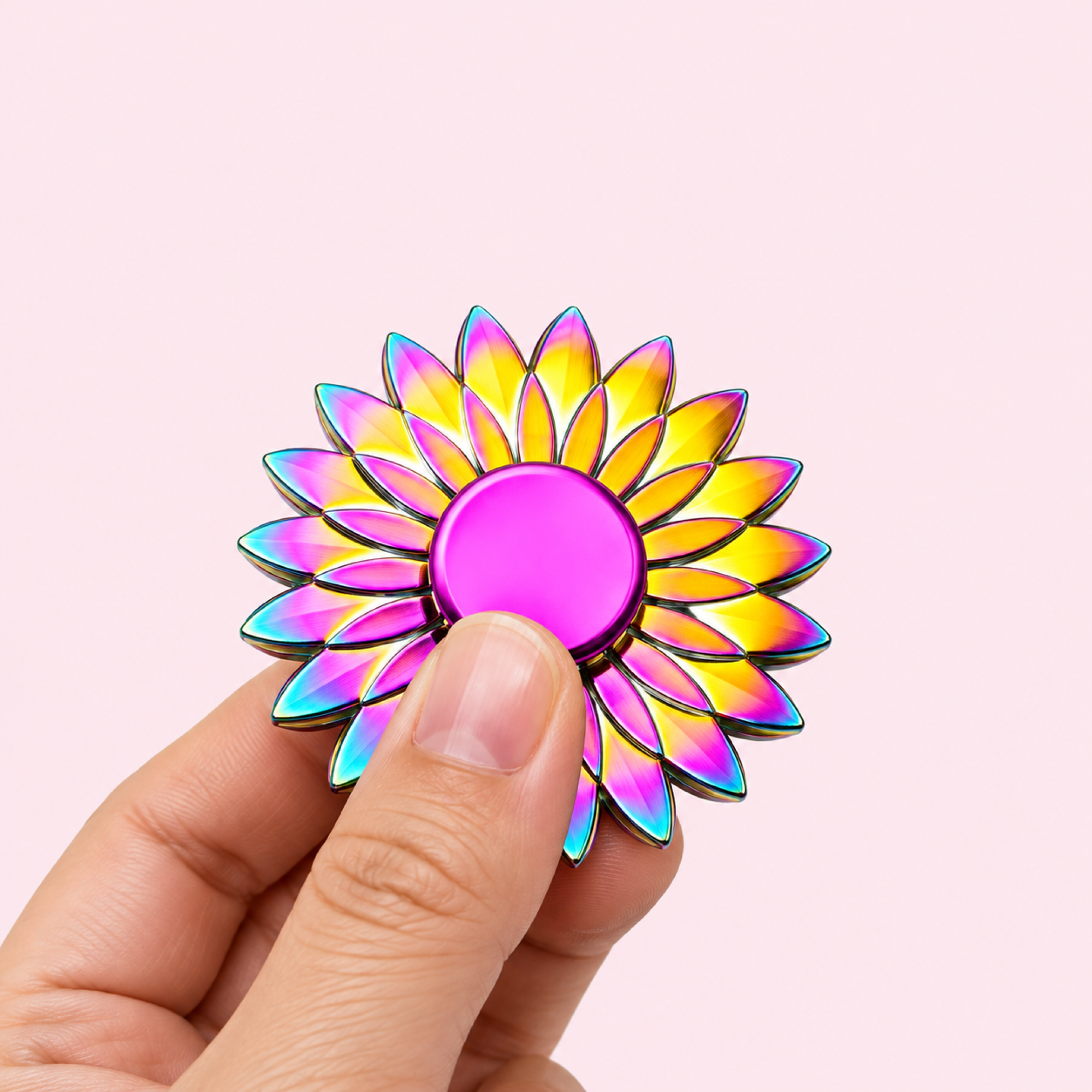
Rainbow Metal Fidget Spinner — the classic three-lobe metal body with a visible centre cap. The shape that went global in 2017, built the way it should have been then.
Metallic Purple Blue Fidget Spinner — three-arm metallic body with different arm geometry, which changes the feel more than the finish does.
Purple Cat Acrylic Fidget Spinner — transparent acrylic, 35 grams, artwork that stays legible at speed. The fingertip direction the category took after the craze.
Browse the full fidget spinners range, or see all fidget toys for the shapes that replaced spinners on most desks.